World
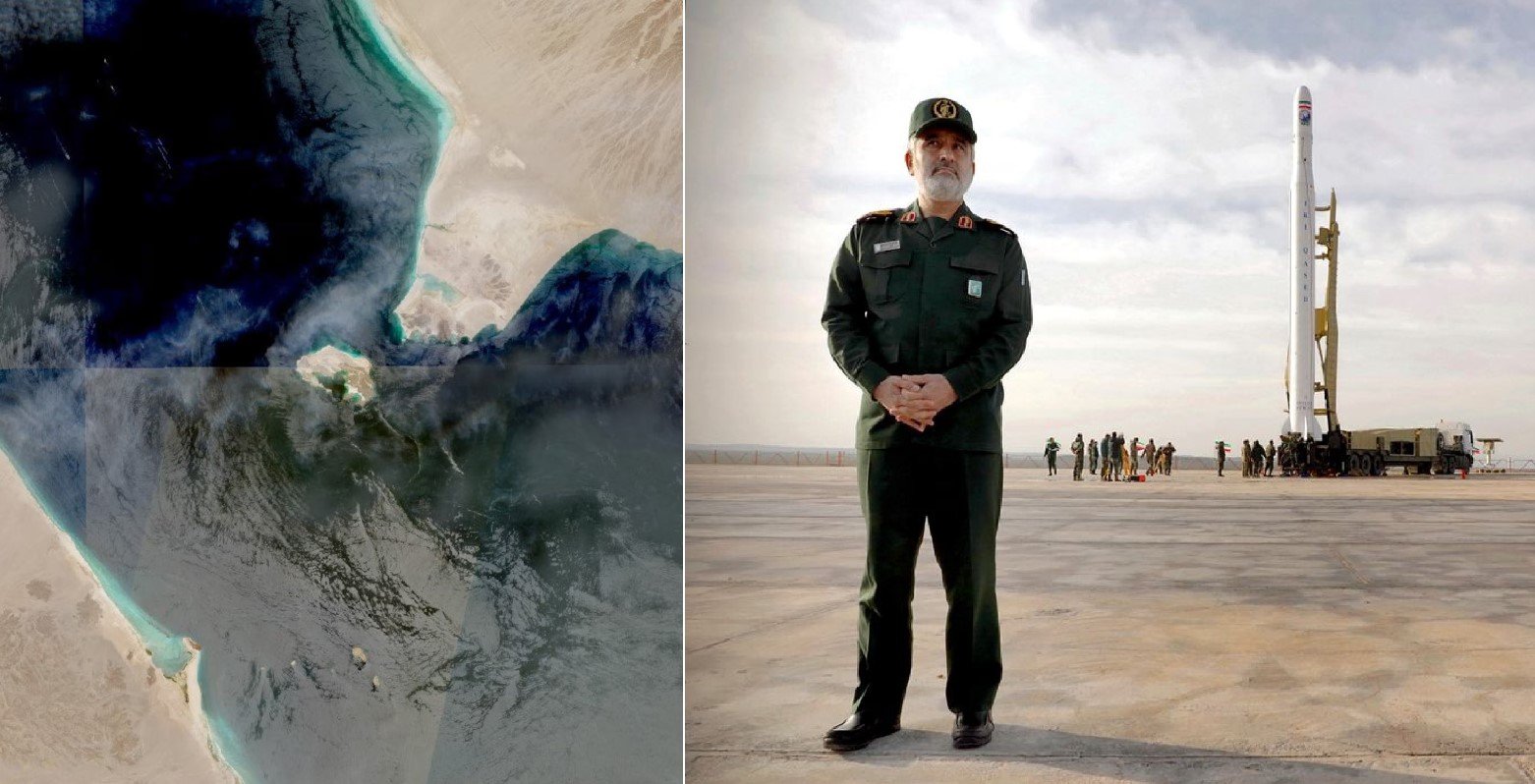
MOKHA, YEMEN — Experts from Iran’s Islamic Revolutionary Guard Corps (IRGC) have visited Houthi-held areas near the Bab al-Mandab Strait to discuss radar installations and oversee tunnel excavation, according to two Houthi military sources cited by Agence France-Presse (AFP) on September 19. The Iranian experts, who arrived from Hodeidah, made separate visits on Thursday and Friday. They inspected the Bab al-Mandab area, the port and airport of Mokha, and the Jabal Al-Nar military camp east of the city. According to the sources, the experts oversaw excavation work in the mountainous hills overlooking Mokha and the Bab al-Mandab Strait. They also discussed the installation of radar systems near Mokha and on Zuqar Island in the southern Red Sea. Separate Yemeni military sources reported that the Houthis have begun installing radar systems on mountain ridges overlooking the southern Red Sea and establishing positions on those ridges and Zuqar Island. The sources also said that four IRGC experts visited the port and airport of Mokha and the Bab al-Mandab area and met Houthi commanders from the missile force. The reported activities come after the Houthis captured key areas along Yemen’s western coast, including Mokha and positions near the Bab al-Mandab Strait. The strait connects the Red Sea with the Gulf of Aden and is an important international shipping route. The developments are also taking place as fighting continues around the Kahbub mountain area overlooking Bab al-Mandab. Yemeni government sources told AFP that clashes between Houthi forces and government forces have intensified in the area. Other reporting has also documented fighting around the Kahbub mountain range in recent days. The reported radar and tunnel work would add to the military infrastructure being established around positions overlooking the southern Red Sea. However, the details of the reported installations and their operational status have not been independently confirmed. The reports come amid a broader escalation in Yemen that has intensified since July, according to AFP, against the backdrop of the wider conflict involving Iran and the United States.
Read More → Posted on 2026-09-20 16:52:25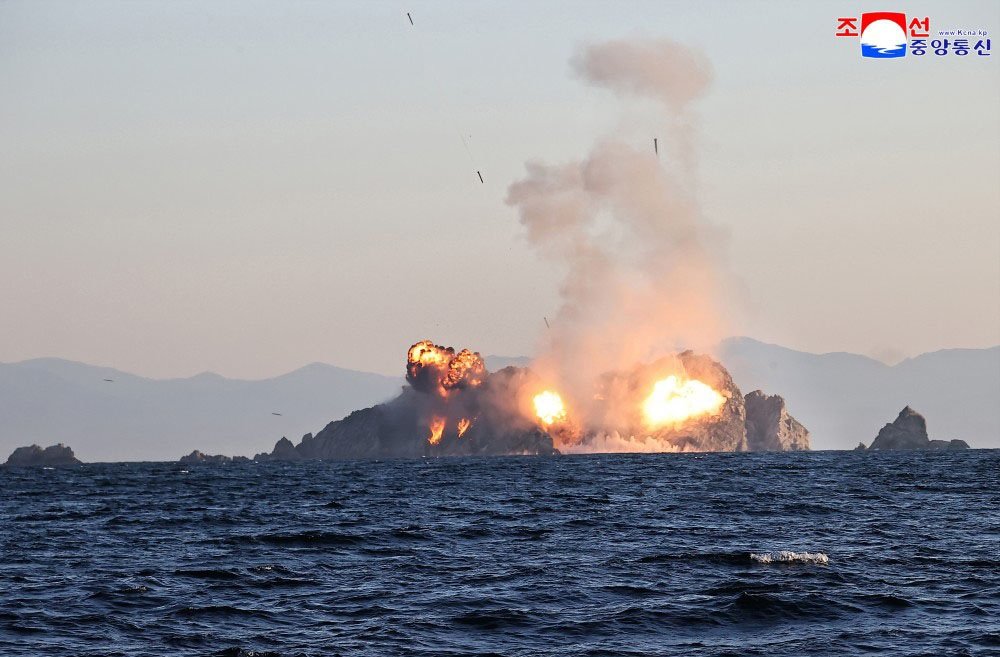
World
SEOUL — North Korea launched a short-range ballistic missile toward the Sea of Japan, also known as the East Sea, from its eastern coast on Sunday, according to Japanese and South Korean authorities. The launch took place at around 3:00 p.m. local time, with South Korean authorities identifying the Wonsan area as the launch location. Japan’s estimates indicated that the missile reached a maximum altitude of about 60 kilometers and traveled approximately 440 kilometers before falling into the Sea of Japan outside Japan’s exclusive economic zone (EEZ). South Korea’s Joint Chiefs of Staff (JCS) separately assessed the flight distance at about 450 kilometers. South Korean and U.S. intelligence authorities tracked the launch from its initial stage and shared information with Japan. Japan’s Prime Minister’s Office instructed authorities to gather and analyze information, ensure the safety of aircraft and vessels, and maintain readiness for possible contingencies. South Korea also convened a security meeting following the launch. Seoul condemned North Korea’s ballistic missile activity and called for an immediate halt to launches that violate United Nations Security Council resolutions. Japan also lodged a protest against North Korea. Japanese authorities said the missile fell outside Japan’s EEZ, and there were no confirmed reports of damage to aircraft or vessels. Second Projectile Launched Several hours after the first launch, North Korea fired another projectile from its eastern coast toward the East Sea. South Korea’s military detected the second launch but initially said detailed flight information was not available. Japan assessed that the second projectile also fell outside its EEZ. Later reporting indicated that South Korean authorities assessed the second launch as another ballistic missile, with the projectile traveling more than 600 kilometers. Launches Follow Recent Trilateral Exercise The launches came shortly after the conclusion of Freedom Edge 26, a trilateral military exercise involving South Korea, the United States and Japan. The exercise ended on September 11. North Korea had also launched multiple short-range ballistic missiles from the Wonsan area on September 12, one day after the exercise concluded. During the September 12 launches, South Korea said the missiles flew about 250 kilometers toward the East Sea. North Korean state media later reported that its military had conducted a coordinated firepower exercise involving missile and artillery units. North Korea has also carried out other missile-related activities in recent months. Japanese authorities have repeatedly assessed previous North Korean ballistic missile launches as falling outside Japan’s EEZ, while coordinating information with South Korea and the United States. Ballistic missile launches by North Korea are prohibited under multiple United Nations Security Council resolutions. South Korea said it would maintain strengthened surveillance and continue coordination with the United States and Japan following the latest launches.
Read More → Posted on 2026-09-20 12:24:50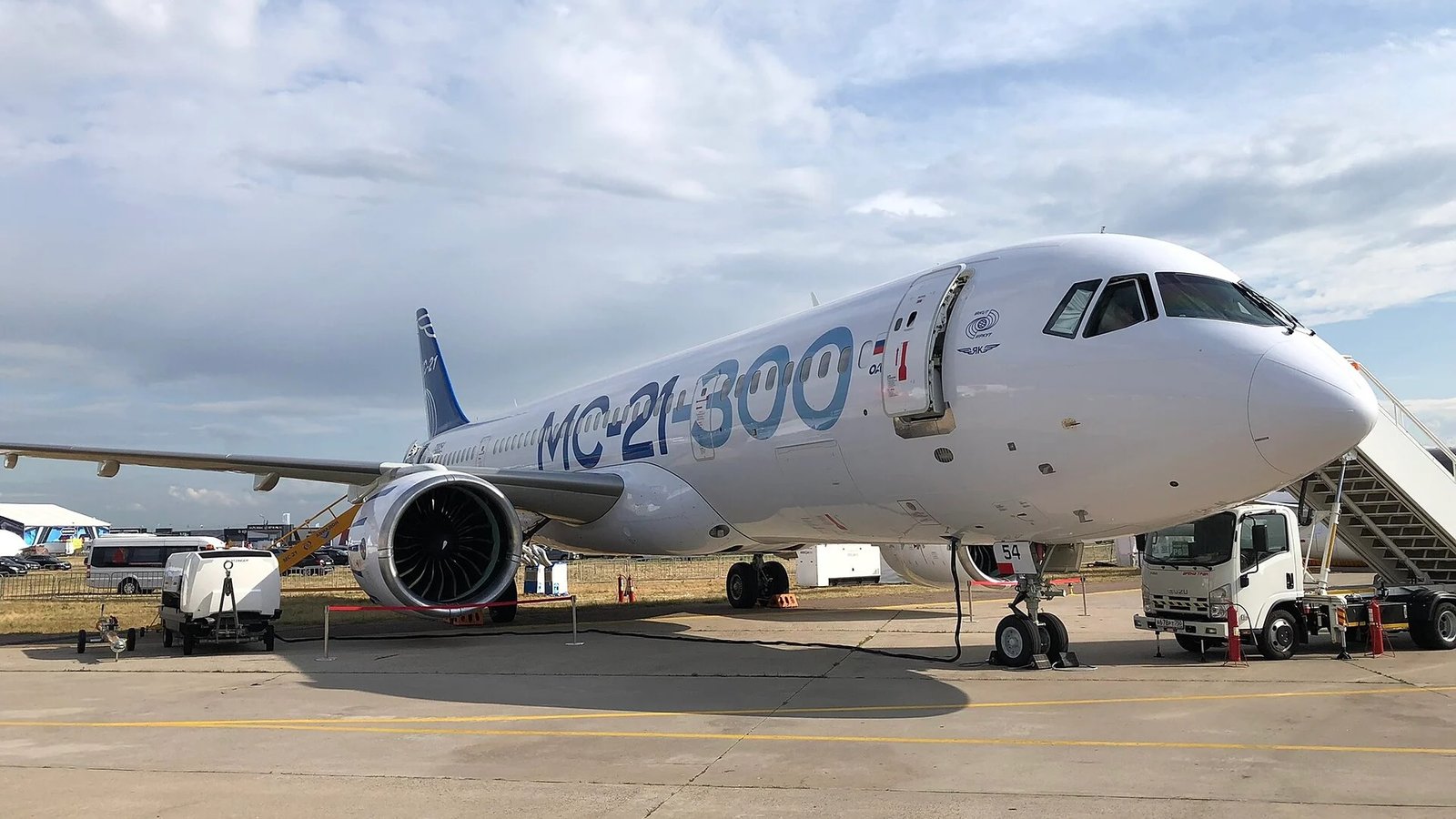
World
Moscow, — Russian flag carrier Aeroflot has signed a contract for the supply and long-term technical support of 90 domestically produced MC-21-310 medium-haul passenger aircraft. The agreement, signed in Moscow on Friday, is described as the largest contract in Russian civil aviation history for the supply and after-sales support of Russian-built passenger aircraft. The contract was signed by Aeroflot and three companies of the state-owned Rostec Corporation — the United Aircraft Corporation (UAC), United Engine Corporation (UEC) and leasing company Aviakapital-Service. Russian President Vladimir Putin took part in the ceremony via video link from Sheremetyevo Airport. Industry and Trade Minister Anton Alikhanov and Transport Minister Andrei Nikitin also attended. Under the agreement, the 90 MC-21-310 aircraft will be delivered between 2029 and 2032. Aeroflot is scheduled to receive 14 aircraft in 2029, 18 in 2030, 24 in 2031 and 34 in 2032. The order is in addition to an earlier 2023 contract for 18 MC-21 aircraft. Those aircraft are scheduled for delivery in 2027 and 2028, with the first eight expected in the fourth quarter of 2027 and the remaining 10 in 2028. Together, the two contracts cover 108 MC-21 aircraft. The comprehensive agreement includes the aircraft, flight and procedural simulators, training for pilots, flight attendants and technical personnel, maintenance software and 22 years of full after-sales technical support for all 108 aircraft from their respective delivery dates. MC-21-310 Aircraft The MC-21-310 is a narrow-body, medium-haul passenger aircraft with a maximum capacity of 211 passengers in a single-class configuration. In a typical two-class layout with around 175 seats, its stated maximum range is 3,830 km. The aircraft features a wider cabin and aisle, larger windows and increased overhead-bin space. The MC-21-310 is powered by the Russian-made PD-14 turbofan engine and uses domestically produced composite materials for its wing and tail. The fully localized version is expected to receive certification in 2027. Seventeen aircraft intended for Aeroflot are already at different stages of assembly at the Irkutsk Aviation Plant, according to the information provided. Aeroflot to Become Launch Operator Aeroflot will serve as the launch operator of the MC-21-310. The airline plans to begin training pilots, flight attendants and engineers for the aircraft. Aeroflot CEO Sergey Alexandrovsky said the airline is ready to train personnel for the new aircraft and welcomed Aeroflot's role as its launch operator. The first aircraft are planned for short domestic routes, including Moscow–St. Petersburg and Moscow–Nizhny Novgorod, where technical support can be provided. Rostec CEO Sergei Chemezov said production of each aircraft takes between 1.5 and two years and that the long-term order provides a clear production workload for moving toward steady serial production. UAC CEO Vadim Badekha said UAC plans a strategic partnership with Aeroflot for the introduction of the aircraft into service. UAC will also handle maintenance of the MC-21 fleet delivered to Aeroflot. The contract is part of Russia's broader programme to develop domestic civil aviation and reduce reliance on foreign-built passenger aircraft. The MC-21-310 is intended to become a core aircraft type for Aeroflot's medium-haul fleet in the coming years.
Read More → Posted on 2026-09-19 13:57:18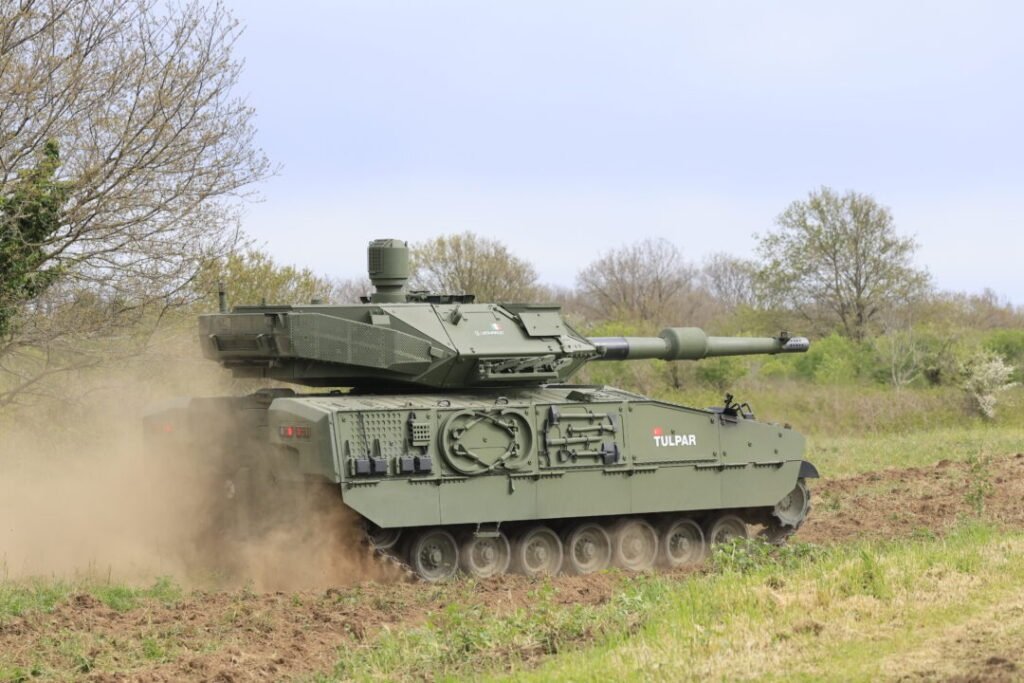
World
ROME, ITALY — Turkish land systems manufacturer Otokar and Italian defence group Leonardo have completed the integration and live-firing tests of the TULPAR medium tank equipped with Leonardo’s HITFACT MkII 120mm turret. The trials were conducted at Italy’s UTTAT Nettuno test range near Rome. The integration combines the firepower of a 120mm main battle tank gun with TULPAR’s tracked mobility, protection and modular architecture. Integration and Live-Fire Tests Before the firing trials, engineering teams from Otokar and Leonardo completed an integration programme covering the mechanical, electrical, electronic and software interfaces between the TULPAR platform and HITFACT MkII turret. The teams conducted functional checks, safety inspections and system validation to verify the performance, reliability and interoperability of the integrated system. The platform then underwent live-fire trials under both static and dynamic conditions. The tests covered different operational scenarios and assessed the weapon system, fire control system, weapon stabilisation and overall functionality. According to the two companies, the integrated weapon system met all planned test objectives. Otokar and Leonardo Statements Sedef Vehbi, Military Cluster Head at Otokar, said the programme demonstrates the TULPAR’s ability to integrate advanced large-calibre turret systems while providing the mobility, survivability and firepower required by modern armed forces. Vehbi also highlighted TULPAR’s modular architecture, which allows different mission-specific weapon systems to be integrated onto the platform. Luca Perazzo, Deputy Managing Director of Leonardo’s Defence Systems Business Area, said the successful trials demonstrate the technological capabilities and modularity of the HITFACT MkII turret. According to Perazzo, the HITFACT MkII is currently the only system featuring a 120mm smoothbore gun that provides main battle tank-level firepower while being suitable for integration on light and medium platforms. The turret can also use Vulcano 120 guided ammunition for precision engagements. Leonardo also offers the HITFIST family of medium-calibre turrets, including configurations equipped with the company’s 30mm X-GUN technology. HITFACT MkII Turret The HITFACT MkII is a lightweight, modular and fully digitalised turret equipped with panoramic electro-optical systems for the commander and gunner. It can be configured with either a 105/52mm rifled gun or a 120/45mm low-recoil smoothbore gun. The 120mm version can fire NATO-standard 120mm ammunition under STANAG 4385. Leonardo says the turret is qualified, in production and in operational service. It is designed to integrate a high-pressure main battle tank gun onto both wheeled and light tracked vehicles. For counter-unmanned aerial system missions, the turret can also be fitted with a HITROLE CUAS remote weapon station equipped with Leonardo’s Blaze 30×113 gun. The HITFACT MkII is already used on the Centauro II wheeled combat vehicle. TULPAR Medium Tank The TULPAR is Otokar’s next-generation modular tracked armoured combat vehicle. Its scalable architecture supports a gross vehicle weight range of 28 to 45 tonnes. The common platform can be configured for several roles, including medium tank, infantry fighting vehicle, fire support, air defence, mortar, recovery and medical evacuation. Otokar says the vehicle has been tested in demanding climatic and terrain conditions and provides high levels of ballistic and mine protection. Depending on configuration, TULPAR uses a 700–1,100 hp turbocharged diesel engine, with a maximum road speed of around 70 km/h and a range of approximately 500–600 km. International Market Interest Otokar and Leonardo first displayed the TULPAR equipped with the HITFACT MkII turret at the World Defense Show in Riyadh in 2024. The integrated TULPAR-HITFACT MkII configuration is also one of four finalists shortlisted by the Brazilian Army in its programme to replace its ageing Leopard 1A5 tank fleet. With the completion of the 2026 integration and live-fire trials, Otokar and Leonardo said they will continue exploring further cooperation in land combat systems and integrated solutions for potential customers worldwide.
Read More → Posted on 2026-09-18 15:40:31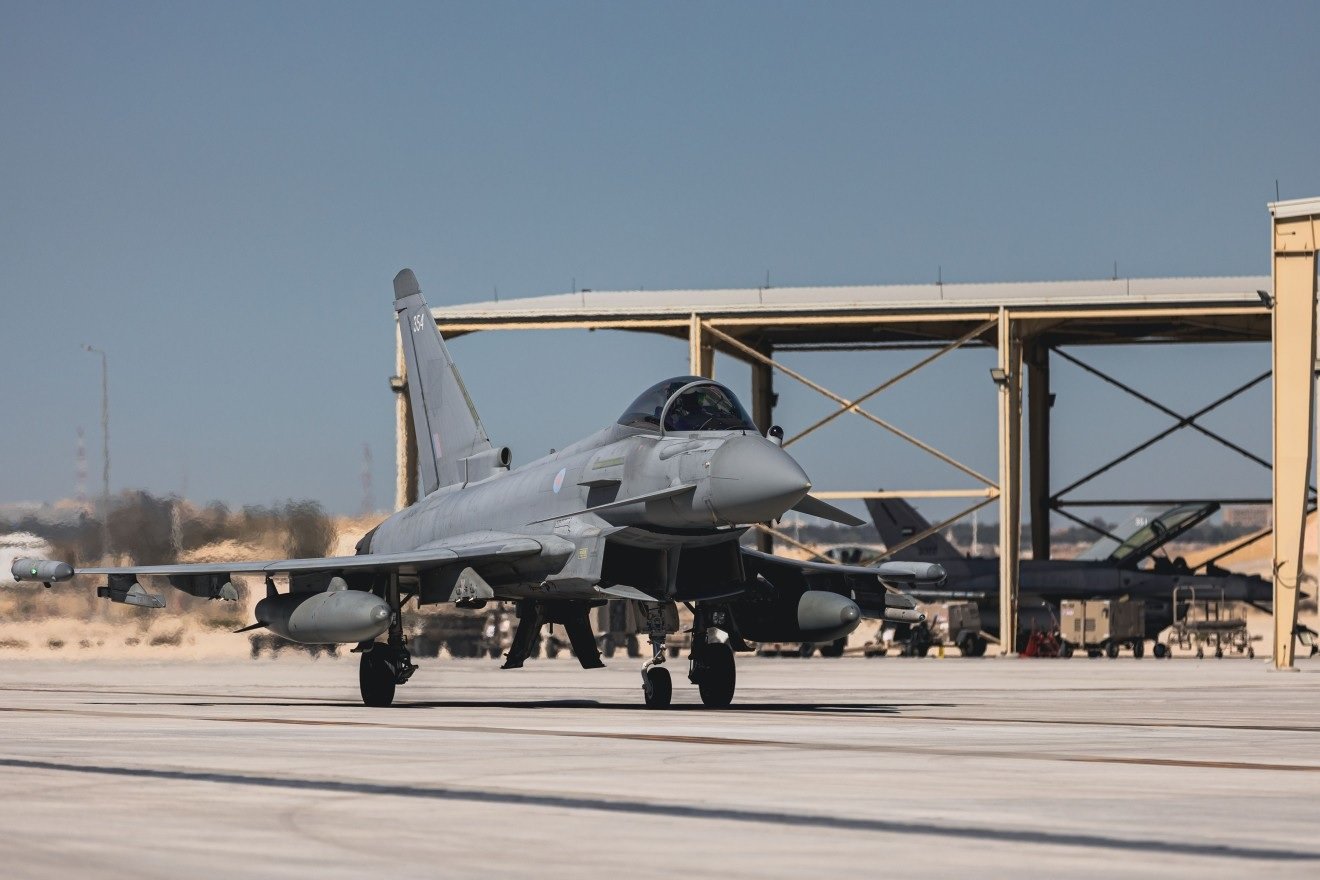
World
ROME, — An Italian Air Force Eurofighter Typhoon F-2000 was damaged during an overnight attack on King Fahd Air Base in Ta’if, Saudi Arabia, the Italian Defence Ministry said Friday. Italian Defence Minister Guido Crosetto confirmed that the aircraft was parked in a decentralized area of the base when it was hit. No Italian military personnel were involved or injured, and no other vehicles or infrastructure used by Italian forces were damaged. Crosetto said he followed the situation overnight in contact with General Luciano Portolano, Chief of the Defence Staff. He also requested further assessments from Portolano, Lieutenant General Giovanni Maria Iannucci, commander of the Joint Operational Command, and General Antonio Conserva, Chief of Staff of the Italian Air Force. The assessment will examine the security situation, the condition of Italian personnel and possible operational options. The Italian Defence Ministry has not disclosed the extent of damage to the F-2000 or whether the aircraft remains operational. Houthi attacks on Saudi Arabia The attack took place as Ta’if and other areas of Saudi Arabia have faced repeated alerts and attacks. Reports on the recent attacks have attributed the strikes to Houthi forces. The Saudi-led coalition has also reported Houthi launches involving ballistic missiles and drones targeting Ta’if, Abha and Khamis Mushait. The Italian F-2000 was hit while inside the King Fahd base during the overnight attack. Italy’s Task Force Air-Arabia Italy has maintained Task Force Air-Arabia at King Fahd Air Base as part of its regional deployment. The Italian Defence Ministry says the task force is involved in air defence and airspace surveillance in support of partner countries in the Gulf. An official Italian Defence Ministry update in September confirmed that the force operates from King Fahd Air Base. According to Italian Defence Ministry information, the national contingent includes about 400 Air Force personnel deployed across Saudi Arabia, Kuwait and Bahrain. Its Saudi Arabian component includes several specialized task groups. The Task Group Typhoon operates four Eurofighter F-2000A aircraft for assigned airspace defence. The Task Group Argo operates an E-550A CAEW aircraft for early warning, aerial surveillance and command-and-control functions. The Task Group Medal uses C-130J/KC-130J aircraft for tactical transport, operational support and possible medical evacuation missions. Previous damage to Italian aircraft in Kuwait The incident follows an earlier attack involving Italian aircraft at Ali Al Salem Air Base in Kuwait. Italian Eurofighter F-2000A aircraft have been deployed at Ali Al Salem as part of Task Force Air Kuwait, supporting surveillance and reconnaissance missions under Operation Prima Parthica/Inherent Resolve. The Italian Defence Ministry confirms the presence of Eurofighters and MQ-9A aircraft at the base. According to the information provided for the March 2026 incident, an Iranian missile and drone attack damaged Italian Eurofighters and destroyed an Italian MQ-9A Reaper. The aircraft damage was caused by fragments, while the MQ-9A was destroyed during the attack. The extent of damage to the Eurofighters and their subsequent operational status has not been fully detailed in the public information available. The latest incident in Saudi Arabia adds another case of Italian military aircraft being damaged while deployed at a fixed base in the Middle East. For the F-2000 at King Fahd Air Base, Italian authorities are still assessing the damage and possible operational measures.
Read More → Posted on 2026-09-18 15:22:20
World
TEL AVIV — Israeli radar technology company Arbe Robotics has formally entered the counter-drone market with its new Alerion C-UAS Radar, a compact, high-resolution 4D imaging radar designed to detect and track small unmanned aerial systems (sUAS). The company announced Alerion on September 14, 2026, marking its expansion from automotive radar technology into the defense and homeland security sectors. Arbe is headquartered in Tel Aviv and is listed on Nasdaq and the Tel Aviv Stock Exchange under the ticker ARBE. Designed to Detect Low-Signature Drones Alerion detects the physical radar return of a drone rather than depending on radio-frequency emissions from the aircraft. This allows it to detect and track FPV, mini, autonomous and fiber-optic-controlled drones, including aircraft that do not use conventional RF command-and-control links. The radar is designed to provide continuous tracking from the initial detection of a drone through its final approach to a protected site. Arbe says it can maintain tracks when drones fly at low altitude, perform complex maneuvers or hover near trees, buildings and other ground clutter. The system is also designed to operate in daylight and darkness and in rain, fog, dust and smoke. 2,304 Virtual Channels Alerion uses a 48-transmit by 48-receive (48Tx/48Rx) architecture, producing 2,304 virtual channels. It generates 4D radar data covering range, azimuth, elevation and Doppler. According to Arbe, the high-resolution data helps distinguish small drones from birds, vehicles, buildings and vegetation, reducing false alarms. The tracking data can also provide cueing for electro-optical/infrared (EO/IR) cameras and counter-UAS effectors. Arbe designed Alerion to operate as the sensing layer of a multi-sensor C-UAS architecture, where its radar data can be combined with other sensors and command-and-control systems. Compact Solid-State Radar The Alerion uses a solid-state architecture with no moving parts and is based on Arbe's production-proven automotive radar technology. The radar measures 135 × 103 × 42 millimeters, consumes 28 watts and operates between -40°C and +70°C. Its modular design supports coverage from 120° to 360°. The system can be deployed on fixed infrastructure, tactical vehicles, portable and mobile systems, temporary sites and distributed perimeters, including applications involving critical infrastructure, borders, military bases and other protected facilities. Field Testing Completed Arbe said Alerion has completed field testing for defense applications and is currently being evaluated by counter-UAS system integrators in multiple countries. Arbe CEO Ram Machness said the company is applying the high-resolution sensing capabilities developed for automotive applications, including the ability to resolve small objects in dense clutter, to counter-drone defense. The company is scheduled to publicly showcase Alerion at the Counter-UAS Homeland Security Europe conference in London on September 23–24, 2026.
Read More → Posted on 2026-09-18 15:07:02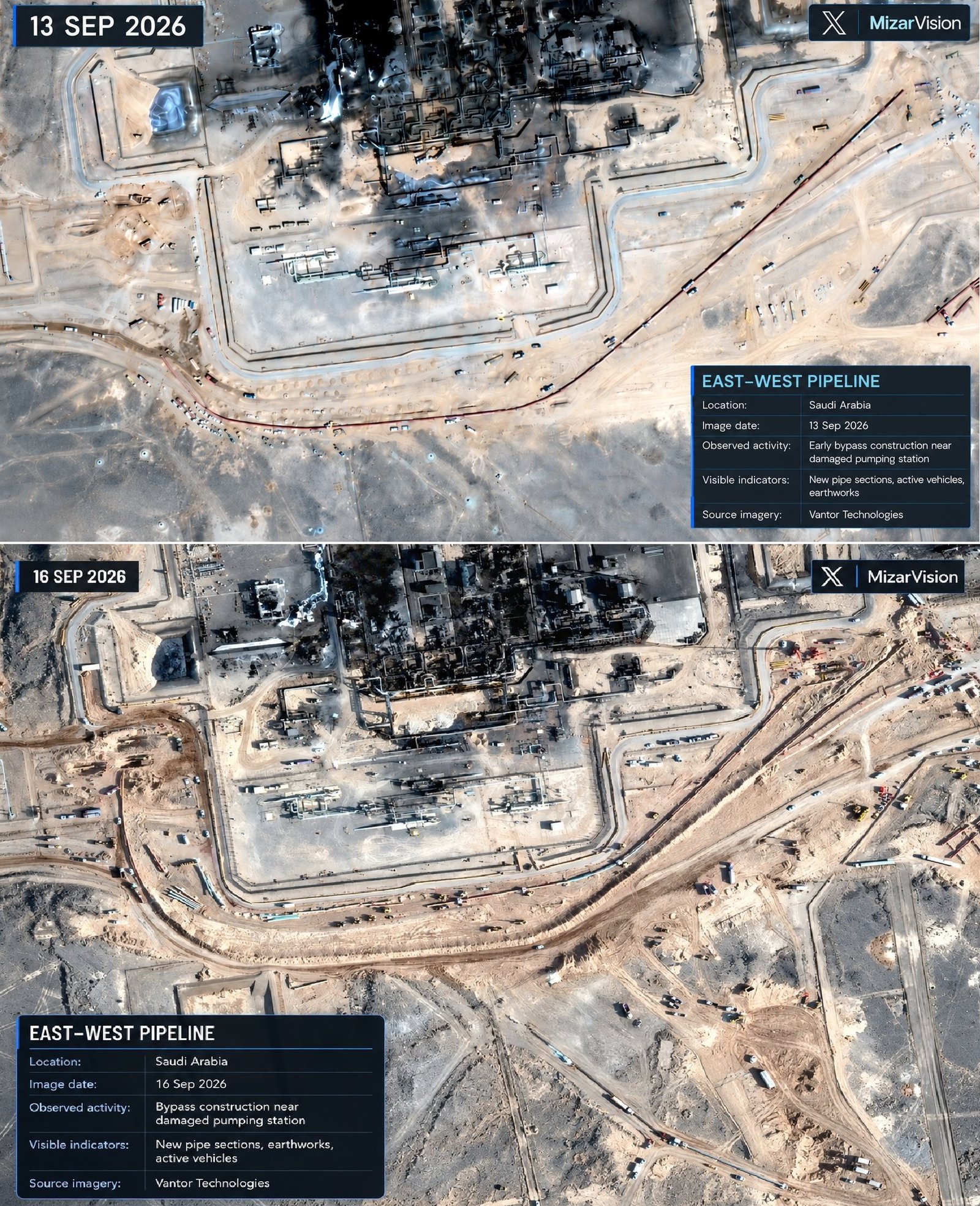
World
RIYADH, — Saudi Arabia is moving ahead with emergency work to restore crude oil flows through its East-West Pipeline after drone attacks damaged several pumping stations earlier this month. Satellite imagery captured by Vantor Technologies on September 16 shows Saudi crews constructing a temporary bypass around one of the damaged pumping stations. Workers appear to be laying and welding two new sections of pipeline that could allow crude to flow around the affected facility while permanent repairs continue. The imagery provides visual evidence of the ongoing construction activity. Reuters separately reported on September 17 that three pumping stations along the pipeline were damaged in the attack, increasing the number from two identified in earlier assessments. The attacks took place on September 10 and 11. Saudi Arabia subsequently shut down the East-West Pipeline as a precaution. Reuters reported that the attacks originated from Iraqi territory, while the Islamic Resistance in Iraq denied involvement and no group has claimed responsibility. Temporary bypass aimed at restoring flows The temporary bypass is intended to route crude around a damaged pumping facility rather than waiting for the complete repair of the original equipment. Reuters reported that industry and oil sources estimate that full repairs could take five to six weeks, while partial pipeline operations could resume earlier. Bloomberg separately reported that Saudi Aramco is working to bypass the damaged section and aims to restore about half of the pipeline's capacity within days. The exact progress and operational capacity of the temporary bypass have not been publicly detailed by Saudi Aramco or Saudi government representatives. East-West Pipeline is a major alternative export route The 1,200-kilometer (745-mile) East-West Pipeline, also known as Petroline, connects Saudi Arabia's eastern oil-producing and processing areas with Yanbu on the Red Sea coast. Saudi Aramco describes the pipeline as providing flexibility to export crude from both the eastern and western coasts of the Kingdom. According to Reuters, the pipeline has a capacity of about 7 million barrels per day and had been transporting around 4 million to 5 million barrels of crude per day in recent months, equivalent to roughly 4% to 5% of global oil supply. The system includes 11 pumping stations and two pressure-relief stations. The pipeline is particularly important because it provides Saudi Arabia with an alternative route to the Red Sea, reducing reliance on tanker shipments through the Strait of Hormuz. Saudi Arabia is also using other measures to maintain crude exports during the disruption. Reuters reported on September 18 that Saudi Aramco plans to increase crude exports from its Gulf port of Ras Tanura, with ship-to-ship transfers at Oman's Sohar port helping compensate for reduced exports from Yanbu. If the temporary bypass is completed and operates as intended, Saudi Arabia could restore part of the East-West Pipeline's crude flows before permanent repairs to the damaged pumping equipment are finished. Main Source : MizarVision
Read More → Posted on 2026-09-18 13:39:38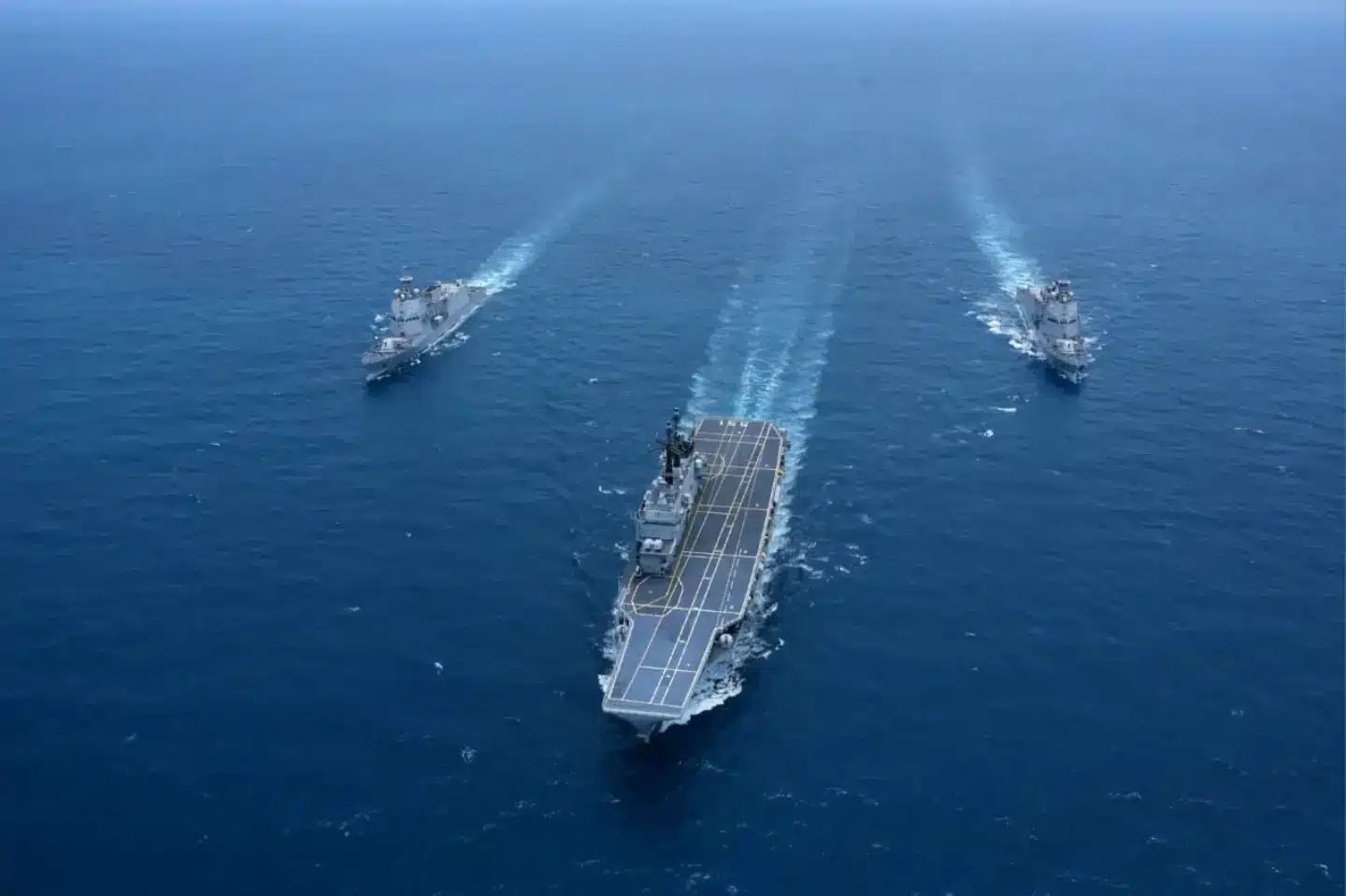
World
JAKARTA, — The former Italian Navy aircraft carrier ITS Giuseppe Garibaldi (C551) has entered Indonesian waters and is scheduled to arrive at Tanjung Priok Port in Jakarta on September 18, according to the Indonesian Navy (TNI AL). The vessel will enter Indonesian service as KRI Sriwijaya, making it the first aircraft carrier in the Indonesian Navy’s fleet. The carrier departed Taranto, Italy, on August 24 with a mixed Italian and Indonesian crew under Italian Navy Captain Marco Guerriero. During the voyage, it transited the Suez Canal and made port calls at Safaga, Egypt, and Colombo, Sri Lanka. Italian Navy warships escorted the carrier during part of its passage through the Red Sea. Entry Through the Malacca Strait Unlike the two Multipurpose Combat Ship (PPA) frigates Indonesia also acquired from Italy, the carrier entered Indonesian waters through the Malacca Strait and Indonesian Archipelagic Sea Lane I (ALKI I) near Bangka, rather than through the Sunda Strait. After entering Indonesian waters, the ship was met by Indonesian Navy vessels KRI Brawijaya (320) and KRI Prabu Siliwangi (321), which escorted it toward Jakarta. Indonesian naval aviation assets, including AS565 Panther helicopters, also took part in the welcoming and escort operation. A CN-235 maritime patrol aircraft was also involved. The carrier continued to fly the Italian flag during its transit into Indonesian waters. Arrival in Jakarta KRI Sriwijaya is scheduled to reach Tanjung Priok Port on September 18. Indonesian Defense Minister Sjafrie Sjamsoeddin is expected to welcome the ship, along with senior Indonesian military and government officials. The vessel is also planned to take part in the Indonesian National Armed Forces anniversary celebrations on October 5. New Name: KRI Sriwijaya The Indonesian Navy has confirmed that the former Giuseppe Garibaldi will be commissioned as KRI Sriwijaya. The ship had earlier been associated with the proposed name KRI Gajah Mada, but the Navy ultimately selected Sriwijaya. The name refers to the historical Sriwijaya maritime kingdom, which was based in Sumatra and exercised influence over regional trade routes and parts of maritime Southeast Asia. Planned Role According to the Indonesian Navy, KRI Sriwijaya will primarily support Military Operations Other Than War (MOOTW), with a particular focus on humanitarian assistance and disaster relief (HA/DR) missions. The Indonesian military has also begun preparing personnel and aircrews for operations from the carrier. The Navy has prepared 310 personnel to serve aboard KRI Sriwijaya and is conducting training to prepare them for their duties. Ahead of the carrier's arrival, Indonesian military units conducted joint helicopter training involving the Navy's AS565 Panther, the Air Force's NAS332 Super Puma, and the Army's Bell 412. The crews practiced take-offs and landings using a life-size mock-up of the Garibaldi's flight deck and also conducted shipboard training aboard the landing platform dock KRI Makassar (590). The training is intended to prepare helicopter crews from the three Indonesian military services for future operations from KRI Sriwijaya.
Read More → Posted on 2026-09-17 16:31:44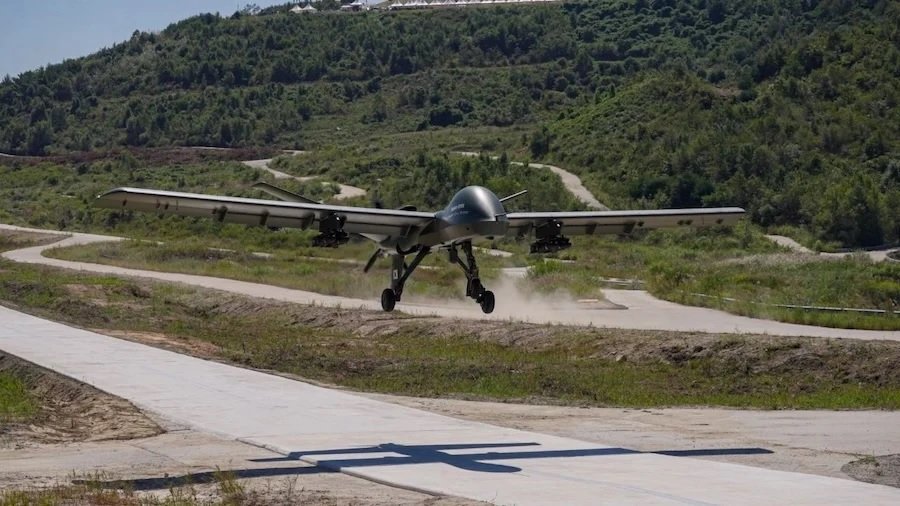
World
POCHEON-SI, SOUTH KOREA — General Atomics Aeronautical Systems (GA-ASI) and Hanwha Aerospace have completed the first battlefield-style short-field flight operations of the Mojave Short Takeoff and Landing (STOL) uncrewed aircraft system in South Korea. The demonstration was conducted during the 2026 Defense Drone Technology Exhibition at the Republic of Korea Army (ROK Army) 513th Aviation Battalion and the Seungjin Training Field in Pocheon-si, Gyeonggi-do. Mojave Lands on Tank and Artillery Trail Pilots operating from ground control stations first launched the Mojave from the conventional runway at the 513th Aviation Battalion. The aircraft then flew to the Seungjin Training Field, joined air operations and landed on a narrow, unpaved maneuver trail normally used by ROK Army tanks and artillery vehicles. The Mojave successfully took off again from the same dirt trail, resumed its flight and returned to the 513th Aviation Battalion. The test demonstrated the aircraft’s ability to operate from austere locations instead of relying solely on conventional airfields. The aircraft was fitted with dual weapon rails and inert payloads during the demonstration. GA-ASI said that in an actual combat situation, soldiers could refuel and re-arm the aircraft at a forward operating location before sending it back into the air. Short-Field Performance During the demonstration, the Mojave completed a takeoff run of less than 200 meters and a landing roll within 100 meters. The aircraft is powered by a roughly 450-horsepower turboprop engine and uses high-lift devices that allow it to operate from surfaces of about 100 to 300 meters. It can carry up to one metric ton of mission equipment and is designed for missions including intelligence, surveillance and reconnaissance, ground attack, logistics support and communications relay. GA-ASI said no other aircraft with the Mojave’s endurance, range and payload has the same short-field capability. GA-ASI-Hanwha Production Plans The demonstration follows a 2025 agreement between GA-ASI and Hanwha Aerospace to co-develop and co-produce STOL uncrewed aircraft systems for customers including the ROK Ministry of National Defense, the United States and other international users. GA-ASI CEO Linden Blue said the demonstration showed the Mojave’s ability to conduct tactical missions under conditions representative of battlefield requirements. Buhwan Lee, chief executive nominee of Hanwha Aerospace, described the flight as an important milestone and said the companies would continue working with South Korea’s defense industry to develop systems suited to future operating environments. The Critical Design Review (CDR) for the production Mojave STOL is scheduled for November 2026, with the first flight of the production aircraft planned for 2027. Hanwha Aerospace also plans to establish research, development and production facilities in South Korea, with more than 70 percent of production expected to be domestic at the mass-production stage. The Mojave STOL demonstrator is scheduled to travel to Changwon for Hanwha Aerospace’s Industry Day on September 21, 2026, where South Korean suppliers involved in the program are expected to participate.
Read More → Posted on 2026-09-17 15:55:29
World
DUBAI, — China has privately asked Iran to use its influence to help restrain Yemen’s Houthi forces following an appeal from Saudi Arabia, according to three Iranian sources familiar with the discussions. The request comes after rapid Houthi advances along Yemen’s Red Sea coast and around the strategic Bab el-Mandeb Strait. Saudi Arabia approached Beijing for assistance after the Houthi advances increased concerns over the security of Saudi oil exports and shipping routes. The Houthis have seized the Red Sea port city of Mokha and advanced toward strategic areas near the Bab el-Mandeb, including Perim (Mayun) Island. The Bab el-Mandeb connects the Red Sea with the Gulf of Aden and is an important route for international commercial and energy shipping. The recent Houthi advances have therefore increased concerns over the security of maritime traffic in the region. China Seeks Iranian Influence China has publicly called for restraint, dialogue and the restoration of safe navigation in the Red Sea. According to the Iranian sources, however, Beijing’s private message to Tehran went further, asking Iran to use its influence over the Houthis to prevent the conflict from spreading further across important energy and shipping routes. China has significant economic interests in maintaining stable energy supplies. It is also a major buyer of Iranian oil, giving Beijing an important economic relationship with Tehran. The Iranian sources did not disclose how China delivered the message or confirm whether the issue was raised during Iranian Foreign Minister Abbas Araghchi’s visit to Beijing on Wednesday. Chinese Foreign Minister Wang Yi met Araghchi during the visit and publicly called for measures to restore safe international shipping and regional stability. Iran’s Response According to the sources, Iranian officials told Beijing that regional peace and stability would remain difficult to achieve without an end to what Tehran describes as the US-Israeli war against Iran. The sources also said Chinese officials did not issue explicit threats or indicate that Beijing would impose economic pressure on Iran if Tehran did not use its influence over the Houthis. It remains unclear whether Iran will take specific steps in response to the Chinese request. Beijing’s Public Position China’s Foreign Ministry said Beijing does not want regional tensions to spread further into Yemen and the Red Sea. “Escalating regional instability is not in the interests of any party,” the ministry said in response to questions. It also called for respect for the sovereignty and security of all countries, protection of facilities important to civilian livelihoods, an end to actions that further complicate the situation, and the resolution of disputes through dialogue and negotiation. The latest diplomatic effort comes after China played a role in the 2023 Saudi-Iran rapprochement, when Beijing helped the two countries restore diplomatic relations. The current situation presents a different challenge because China is now seeking to use its relationship with Iran to address the actions of an Iran-aligned group operating in Yemen. For Saudi Arabia, the immediate concern remains the security of its energy exports and shipping routes. For China, the developments raise concerns about the security of maritime routes and energy supplies connected to the Middle East. It remains to be seen whether Beijing’s request will lead to any change in Houthi military activity around the Red Sea and Bab el-Mandeb.
Read More → Posted on 2026-09-17 15:49:12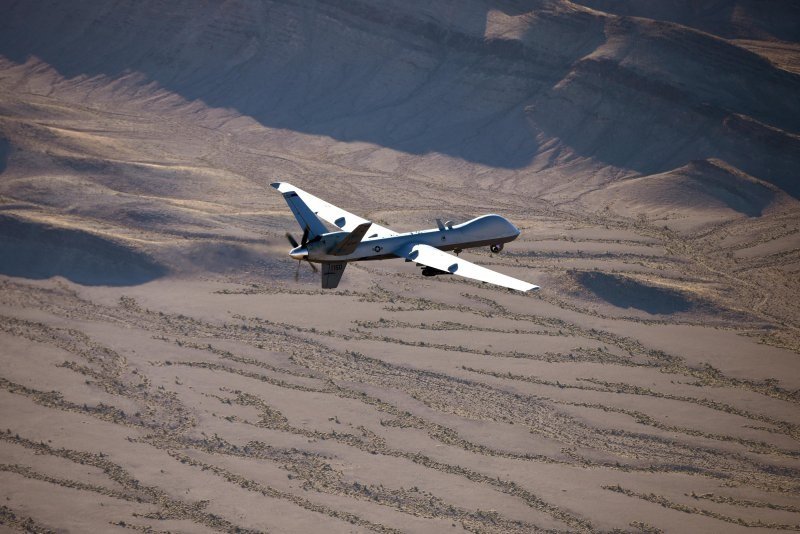
World
TEHRAN, — Iran’s Islamic Revolutionary Guard Corps (IRGC) said Thursday that its forces intercepted and destroyed a U.S. MQ-9 Reaper drone over Qeshm Island near the Strait of Hormuz. According to a statement from the IRGC’s public relations office, the drone was detected in Iranian airspace and was brought down at 10:12 a.m. local time. The IRGC said the operation was carried out by a new advanced air-defense system operated by the IRGC Aerospace Force under Iran’s integrated air-defense network. Iranian reporting said the system used domestically produced radar and missile systems. The IRGC identified the aircraft as the 53rd U.S. MQ-9 it has claimed to have destroyed during the conflict. The announcement came one day after Iran reported the destruction of another MQ-9 over the same area. On September 16, the IRGC said an MQ-9 was shot down at 2:29 a.m. local time over Qeshm Island using an advanced air-defense system operating within the country’s integrated network. That aircraft was described by the IRGC as the 52nd MQ-9 destroyed. U.S. Has Not Confirmed the Latest Claim There was no immediate public confirmation from the U.S. military regarding Thursday’s reported shootdown. The latest claim therefore remains an Iranian military assertion and has not been independently verified. The reported incident follows several recent Iranian claims involving U.S. unmanned aircraft in and around the Strait of Hormuz. The IRGC has also reported the destruction of MQ-1 drones in the region. MQ-9 Reaper The MQ-9 Reaper is a U.S.-made unmanned aircraft used for intelligence, surveillance, reconnaissance and precision-strike missions. The IRGC’s statement referred to an earlier valuation of an MQ-9 at around $30 million. It also pointed to a recently disclosed export version sold to Japan that was reported to have a value of more than $100 million. These figures refer to different configurations and should not be treated as the cost of every MQ-9 aircraft. Qeshm Island and Strait of Hormuz Qeshm Island is located in the Strait of Hormuz, an important maritime route. The area has remained an active part of the ongoing military confrontation involving Iran, the United States and Israel. The latest IRGC statement attributed the recent drone interceptions to newer-generation air-defense systems and changes in tactics for dealing with unmanned aircraft. Those claims describe Iran’s assessment of its air-defense performance and have not been independently confirmed. The reported September 17 incident is the second MQ-9 shootdown claimed by Iran over Qeshm Island within two days. The U.S. military has yet to publicly confirm the loss of the aircraft.
Read More → Posted on 2026-09-17 14:33:12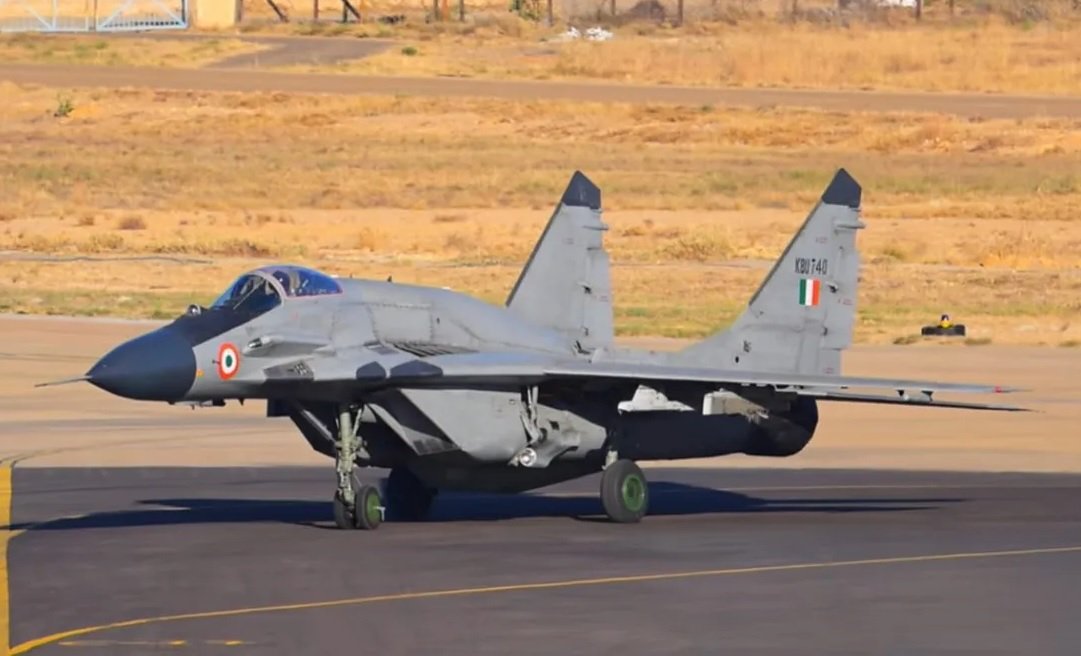
World
NEW DELHI — Ukraine’s state-owned defence export enterprise SpetsTechnoExport (STE) has emerged as the lowest bidder (L1) in an Indian Air Force tender worth ₹107.47 crore for the procurement of spare parts for the MiG-29UPG fighter fleet. According to publicly available tender records, STE submitted a bid of ₹1,07,47,03,790 and was ranked L1 after the tender’s qualification and financial evaluation stages. The tender was issued through the IAF procurement chain at Air Headquarters, Vayu Bhawan, Rafi Marg, New Delhi. Spare Parts for MiG-29UPG Fleet The tender covers specific spares required to support the operation and maintenance of MiG-29UPG aircraft. The bill of quantities includes 17 Signal Generator IM 511001 units, along with three accessories for the KSKK-130GK-20 I emergency oxygen system and 59 bearings. Public tender information identifies the procurement as a limited tender in the aviation category for goods. The period of work is listed as 365 days, while the bid validity was set at 270 days. The tender has reached the L1 stage, but this does not by itself constitute a final contract award. The formal award remains subject to the applicable procurement process and tender timelines. SpetsTechnoExport’s Earlier Work With India SpetsTechnoExport has previously worked with India on military aviation programmes. In 2009, India signed a contract with the Ukrainian company for the total technical life extension, overhaul and re-equipment of 105 IAF An-32 aircraft. The contract was reported at approximately $397.7 million. Under that programme, aircraft were upgraded both in Ukraine and at Indian Air Force facilities in India. Ukrainian companies also supplied equipment and spares for the programme. SpetsTechnoExport is a Ukrainian state-owned foreign trade enterprise established in 1998, specialising in the export and import of military and dual-use products and services. Maintaining the MiG-29UPG Fleet The MiG-29UPG is the upgraded version of the Russian-origin MiG-29 operated by the Indian Air Force. The current procurement is focused specifically on obtaining spare parts needed for maintaining the aircraft. The latest tender data therefore represents a procurement for fleet sustainment rather than a new aircraft acquisition. With STE now ranked L1, the next stages involve completion of the procurement process before a final supply agreement is concluded. The tender provides another example of India continuing to source specialised components for existing Soviet- and Russian-origin military platforms through qualified international suppliers.
Read More → Posted on 2026-09-16 17:13:04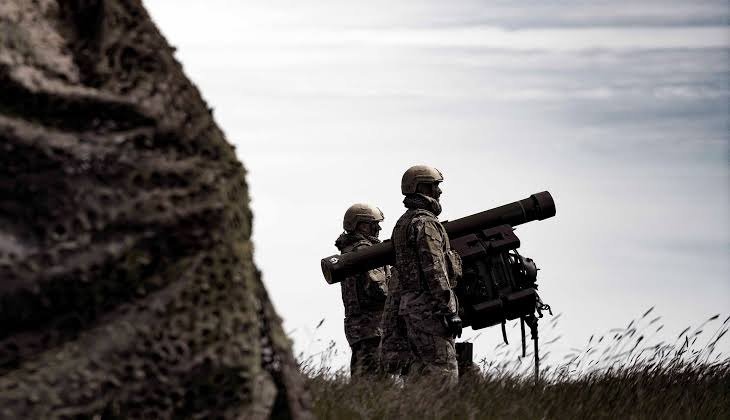
World
KYIV, — Ukraine’s Ministry of Defence has authorized 81 companies to participate in an experimental program that integrates private businesses into the country’s national air defence network. The figure has increased from 51 companies in mid-July. Overall, 92 enterprises from different industries and regions have applied to join the program, including critical infrastructure operators and other private-sector companies. Program Launched in 2025 The Ministry of Defence launched the pilot project in late 2025 in response to repeated attacks by unmanned systems. The program is designed to provide additional protection for company employees, production sites and other facilities facing regular drone attacks. The program has expanded steadily, with 24 companies authorized in April, 30 in June, 51 in mid-July and 81 by mid-September 2026. Private Units Remain Under Air Force Command The participating groups do not operate as independent security forces. They are integrated into Ukraine’s multi-layered air defence system and remain under the operational command of the Air Command of the Air Force of the Armed Forces of Ukraine. Participation is voluntary. Companies form and finance their own groups using trained and certified civilian employees or existing security personnel. Equipment and Training Depending on their assigned roles, the groups can operate mobile fire teams equipped with heavy machine guns, searchlights, acoustic detection sensors and thermal optics. Some units also use counter-drone interceptor systems. After receiving authorization, companies coordinate with the Air Force to establish their operating areas, equip their units and complete the required training before full integration into the national system. Under rules introduced in March 2026, participating companies may also temporarily receive certain military air defence equipment and ammunition that are not being used by frontline combat units, subject to Air Force approval. Combat Results The private air defence groups have already carried out assigned combat tasks. March 2026: A private industrial team in Kharkiv Oblast recorded its first confirmed destruction of Russian attack drones. April 2026: A corporate unit intercepted a jet-powered Shahed-type drone travelling at more than 400 km/h. July 2026: The Ministry of Defence reported that private teams had intercepted more than 50 Russian reconnaissance and strike drones, including Shahed and Zala systems. The remaining applications are still under review. The Ministry of Defence is continuing to expand the program as more companies seek authorization to protect their employees and facilities while operating within Ukraine’s centralized air defence command structure.
Read More → Posted on 2026-09-16 17:03:52
World
WASHINGTON — Exclusive photographs obtained by CBS News show significant damage at U.S. military installations in Saudi Arabia and Kuwait following Iranian missile and drone attacks. The images, provided by active-duty service members who spoke anonymously because of military media restrictions, show damaged buildings, vehicles and military equipment. At Prince Sultan Air Base in Saudi Arabia, one photograph shows a Boeing E-3 Sentry with its rear section heavily damaged. The aircraft's tail assembly was torn away from its charred fuselage, while its rotating radar dome was also destroyed. The E-3 Sentry is an airborne early-warning and control aircraft used for airborne surveillance and intelligence collection. Other photographs from the base show damaged barracks and buildings with collapsed roofs and burned interiors. Concrete T-wall blast barriers can be seen standing near some of the damaged structures. The photographs also show damage at Camp Buehring and Camp Arifjan in Kuwait. Camp Buehring, a major U.S. Army staging and logistics location northwest of Kuwait City, has images showing damaged barracks, destroyed housing trailers and vehicles. At Camp Arifjan, photographs show visible blast and structural damage to a building. One deployed U.S. service member told CBS News that the extent of the damage had not been fully communicated to the American public and criticized earlier descriptions of Iranian weapons that reached U.S. bases. The photographs appeared as the Department of Defense Office of Inspector General released a report covering Operation Epic Fury from February 28 through June 30, 2026. The report estimated up to $3.7 billion in equipment losses, including nearly 60 U.S. aircraft such as MQ-9 Reaper drones, KC-135 Stratotankers and tactical fighter aircraft. The report also said Iranian strikes damaged or destroyed hundreds of buildings and structures at U.S. bases in Kuwait, Bahrain, Qatar, the United Arab Emirates, Saudi Arabia, Iraq, Oman and Jordan. The overall cost of Operation Epic Fury during the period covered by the report was estimated at approximately $33.4 billion. This included $22.3 billion in expended munitions, $3.7 billion in equipment losses and $7.4 billion in other obligations. The estimate did not include the full cost of repairing damaged infrastructure. Earlier reporting said an Iranian missile and drone attack on Prince Sultan Air Base on or around March 27 damaged the E-3 Sentry and several KC-135 aircraft. More than 10 U.S. service members were reported wounded, including two seriously. The Pentagon did not respond to a CBS News request for comment on the newly released photographs. The images provide a visual record of damage at the specific Saudi and Kuwaiti sites, while the inspector general's report documents broader U.S. losses across the region.
Read More → Posted on 2026-09-16 16:49:42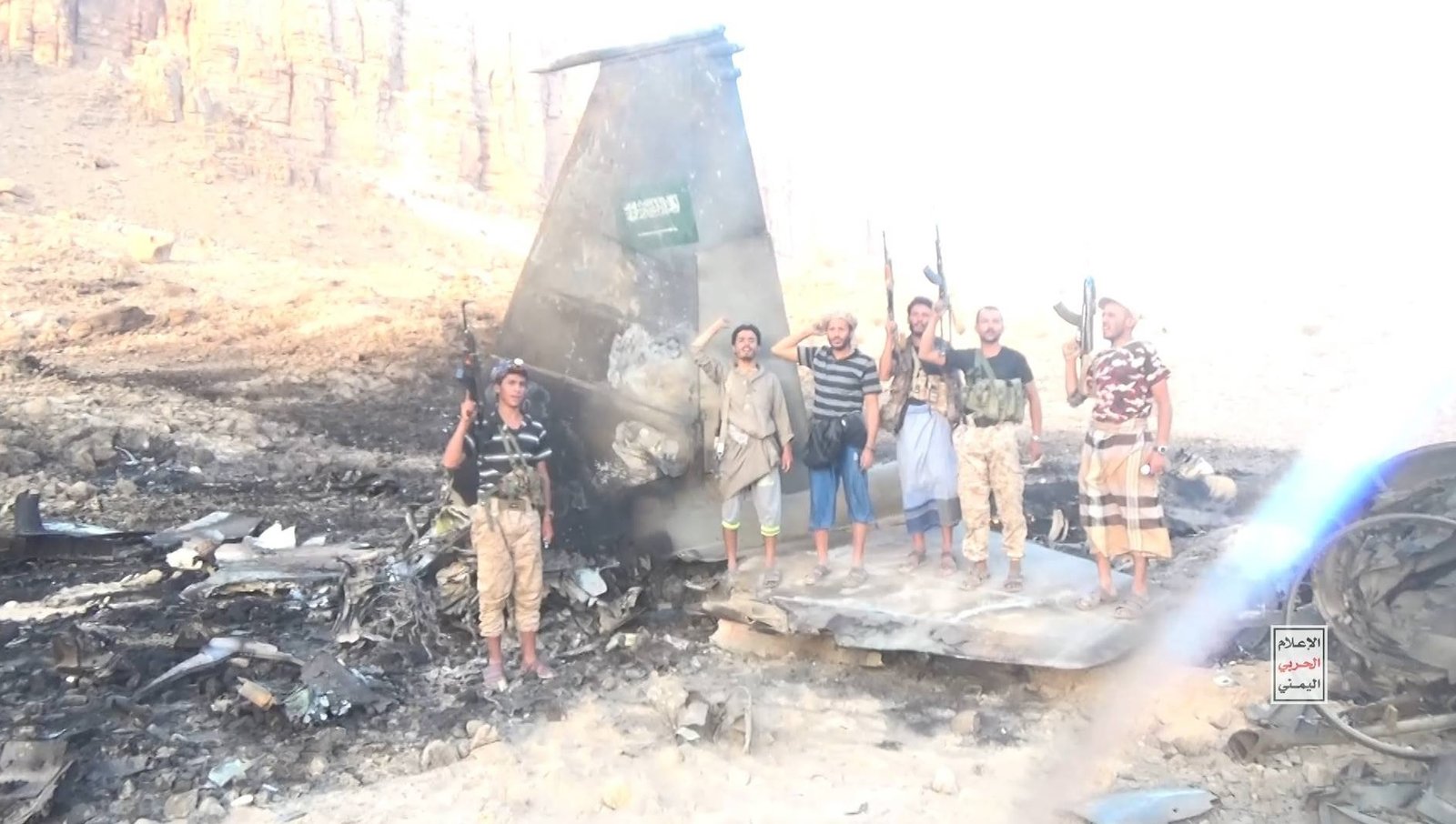
World
SANAA / MARIB — Yemen’s Ansarallah movement, commonly known as the Houthis, has claimed that its air-defense forces shot down a Royal Saudi Air Force F-15 fighter jet over Marib Governorate and later intercepted a Saudi-operated Wing Loong II unmanned aerial vehicle in the same area. The claims were announced on Wednesday by Houthi military spokesman Brigadier General Yahya Saree. Saudi authorities have not publicly confirmed the loss of the F-15, and independent verification of the reported aircraft losses was not immediately available. F-15 Downing Claimed Over Marib Saree said the Saudi F-15 was conducting operations in support of Saudi military activity over Marib when it was hit by a locally manufactured missile. Houthi military media subsequently released footage and images that it said showed the engagement and wreckage of the aircraft. The Houthi statement also said Saudi F-15 and Eurofighter Typhoon aircraft entered the area after the reported loss to search for the wreckage and locate the aircraft's crew. According to Saree, Houthi forces engaged those formations with additional locally made missiles, after which the aircraft withdrew from the area. The Houthis have described the F-15 as having been brought down by a locally produced air-defense weapon. Public reporting has not independently established the exact missile used or confirmed the aircraft's specific variant and tail number. Wing Loong II Drone Also Reported Down In a separate announcement, Houthi authorities said their air defenses later shot down a Saudi-operated Wing Loong II armed reconnaissance drone over Marib. The group said the UAV was carrying out what it described as a hostile mission when it was intercepted. Houthi military media also released images that it identified as wreckage from the drone. The reported drone interception came in the same area as the claimed F-15 loss and during the reported Saudi search activity. However, the Wing Loong II loss over Marib has also not been independently confirmed by Saudi authorities. The Houthis have previously claimed the destruction of Saudi-operated Wing Loong II drones. On September 6, the group said it had brought down a Wing Loong II over northwestern Taiz Governorate, although there was no independent confirmation of that incident. Houthi Footage Shows Reported F-15 Engagement Houthi military media released video that it said showed the interception of the Saudi fighter. The footage reportedly includes tracking of an aerial target followed by the launch of a missile and an apparent mid-air explosion. The group also released Footage of aircraft wreckage on the ground. These materials were presented by the Houthis as evidence of the reported shootdown, but the available reporting does not provide independent confirmation of the aircraft loss. High-quality footage of a Saudi F-15 fighter jet being shot down and its wreckage in Marib province - September 16, 2026Saudi Arabia will sink in Yemen pic.twitter.com/UKMy9Zjo43 — ابراهيم ناجي Ibrahim Naji (@Ibrahym22Nagi) September 16, 2026 Saudi-Houthi Air Activity Intensifies The reported incidents came amid increased air activity between Saudi Arabia and Houthi forces. Saree claimed that Saudi aircraft had carried out more than 450 airstrikes during the week across several Yemeni provinces, including Marib, Taiz, Lahij, Al-Jawf, Hajjah, Saada and Al-Bayda. He said the operations involved Saudi F-15 and Typhoon aircraft and resulted in civilian casualties. These figures and casualty claims were part of the Houthi statement and have not been independently verified. The latest claims also followed a separate incident near Mecca on September 15. Saudi Arabia said its air defenses intercepted and destroyed a Houthi drone south of the city before it entered restricted airspace. Houthi officials denied targeting Mecca or other Islamic holy sites and said their operations were directed against military and oil-related targets. The Saudi-led coalition has not confirmed the reported F-15 or Wing Loong II losses over Marib. As a result, the aircraft claims remain unverified pending independent evidence or an official Saudi statement.
Read More → Posted on 2026-09-16 16:30:58Search
Top Trending in 24 Hours
-
 North Korea Fires Short-Range Ballistic Missile Toward Sea of Japan After Freedom Edge 26
-
 India’s xTerra Robotics Launches Indigenous DHAV-Hy Wheeled-Legged Quadruped for Industrial Inspection
-
 U.S. Army Awards $10.64 Million Contract to Ukrainian Drone Maker Skyeton for Raybird Systems
-
 U.S. Space Force Seeks Rapid-Response Satellites for Close-Range Orbital Inspections
-
 U.S. Government Seizes Almasirah.net, Houthi-Linked News Website
-
 BEL Showcase X-Band Multi-Function Radar for QRSAM to Japanese Delegation
-
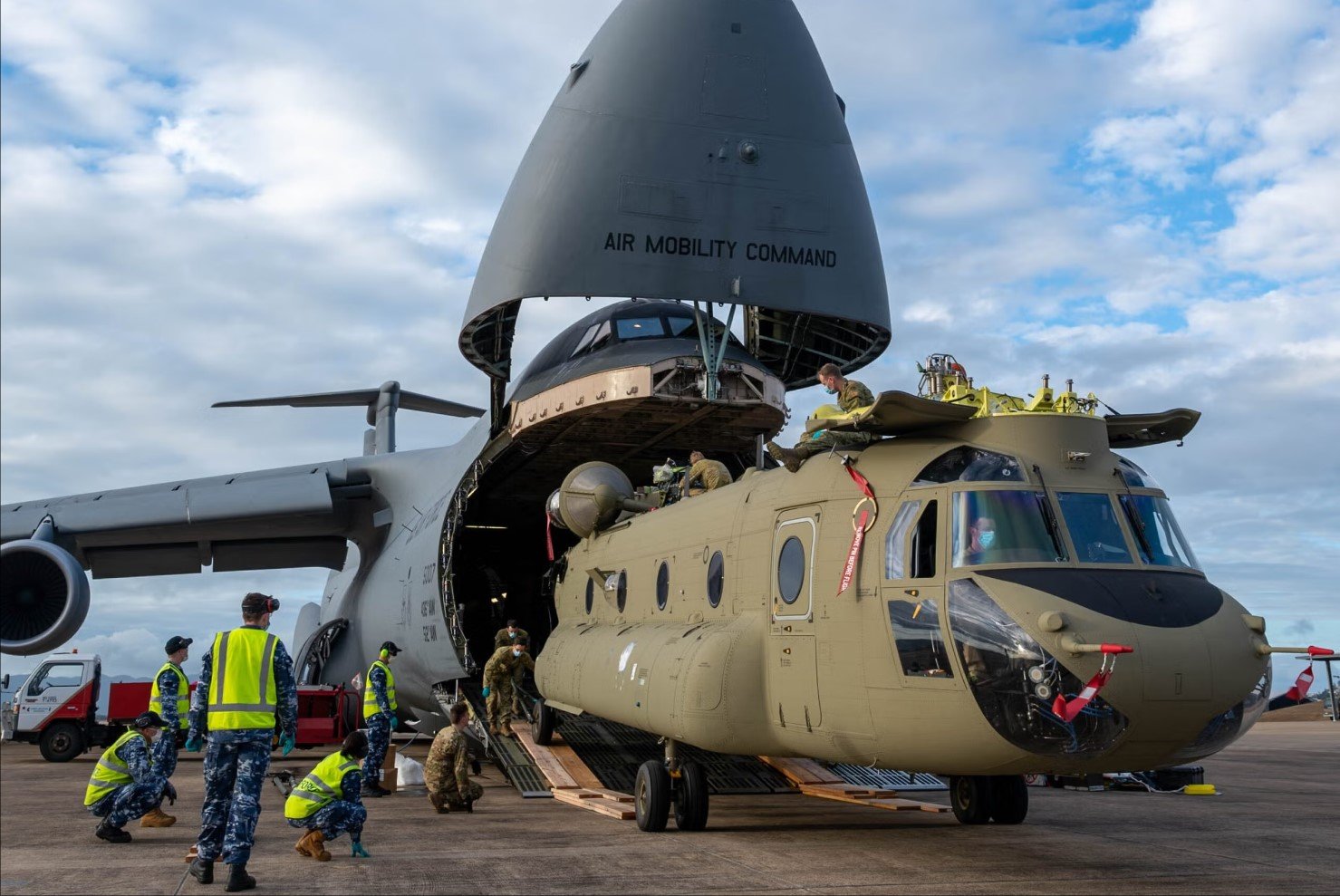 U.S. Delivers First CH-47F Chinook to Egypt Under 12-Helicopter Deal
-
 IRGC Experts Visit Bab El-Mandeb to Oversee Radar Installation and Tunneling, Houthi Sources Say
Top Trending in 4 Days
-
 Satellite Images Show Saudi Arabia Building Emergency Bypass Around Damaged East-West Oil Pipeline Station
-
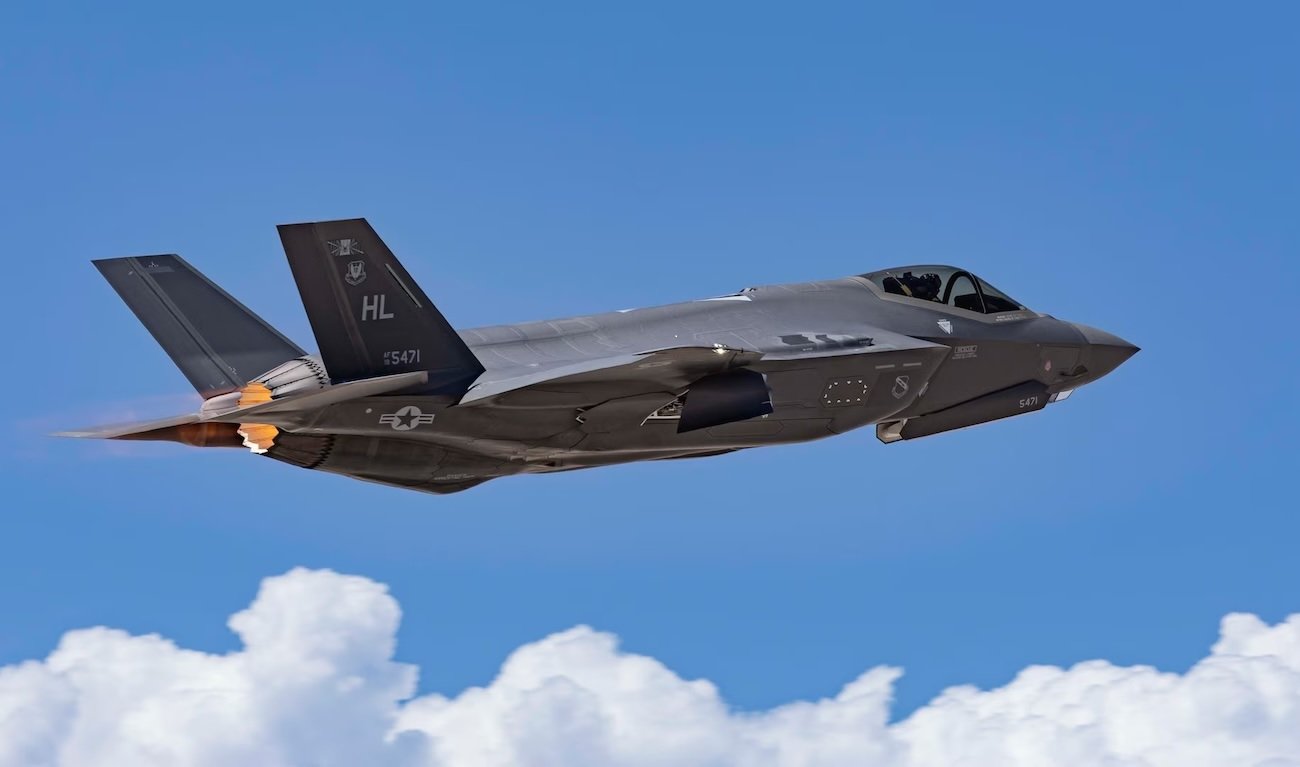 Sensitive F-35 Components Diverted to Hong Kong, Some Parts Missing
-
 Italian Eurofighter Damaged in Houthi Attack on Saudi Arabia’s King Fahd Air Base
-
 U.S. Secures Permanent Military Rights in Greenland in Historic Security Pact with Denmark
-
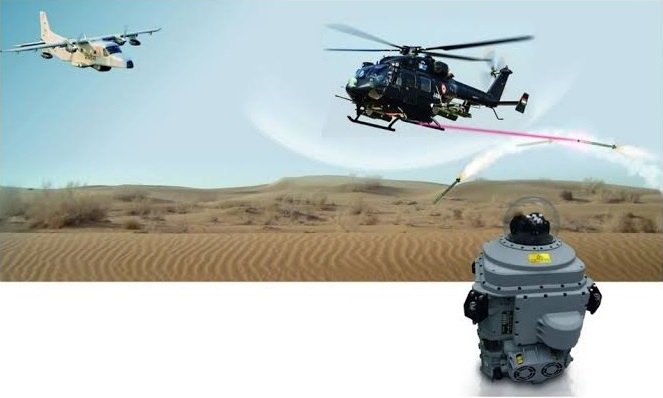 BEL Signs Export Deal with Elbit Systems for Directed Infrared Countermeasure Sub-Assemblies, Secures ₹648 Crore in Additional Orders
-
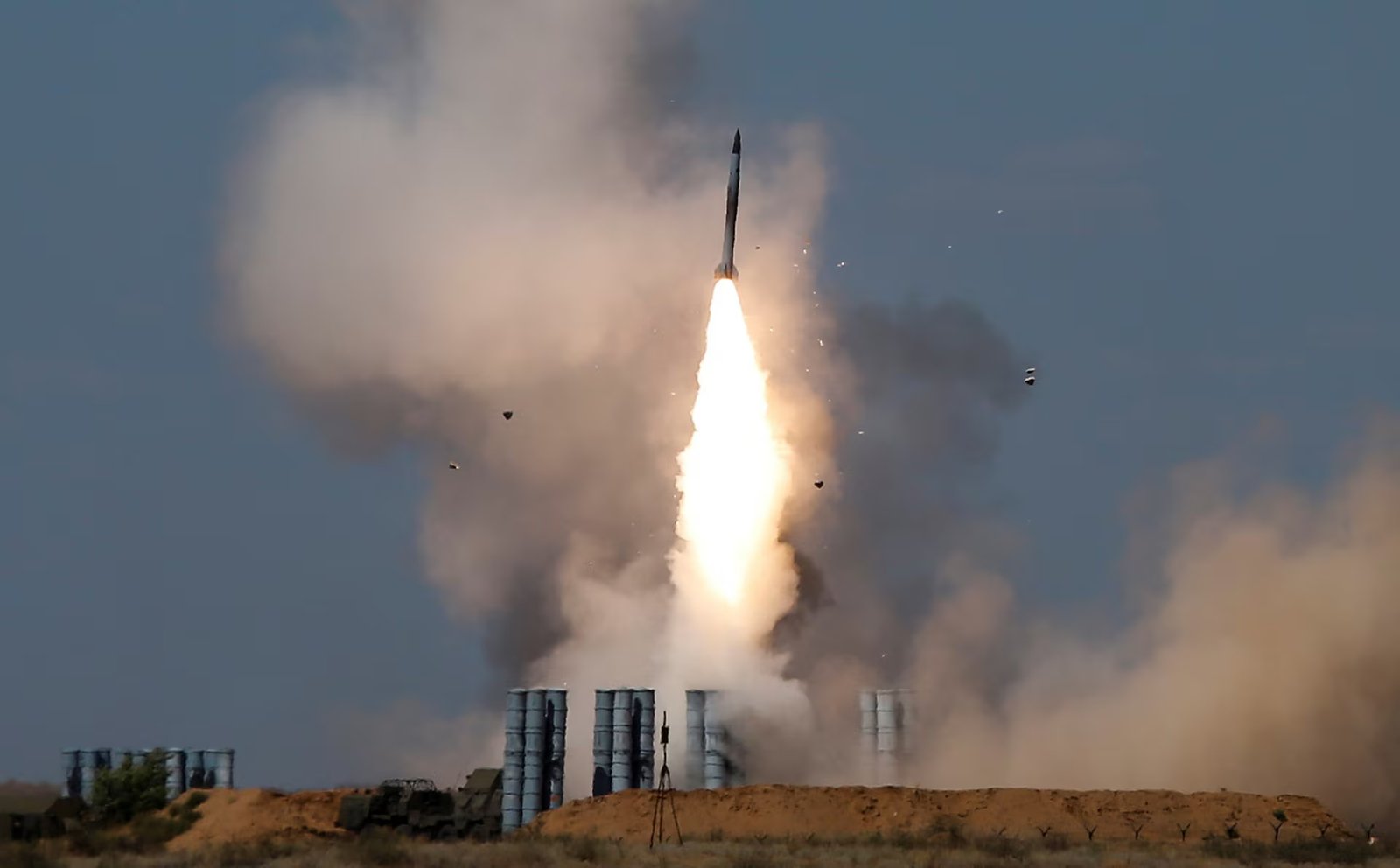 U.S. Approves Potential $2.68 Billion Air Defense Package for Ukraine Including S-300 Clone Missiles
-
 China Privately Urges Iran to Restrain Houthis After Saudi Appeal
-
 Israeli Firm Arbe Robotics Unveils Alerion High-Resolution 4D Radar for Counter-Drone Operations