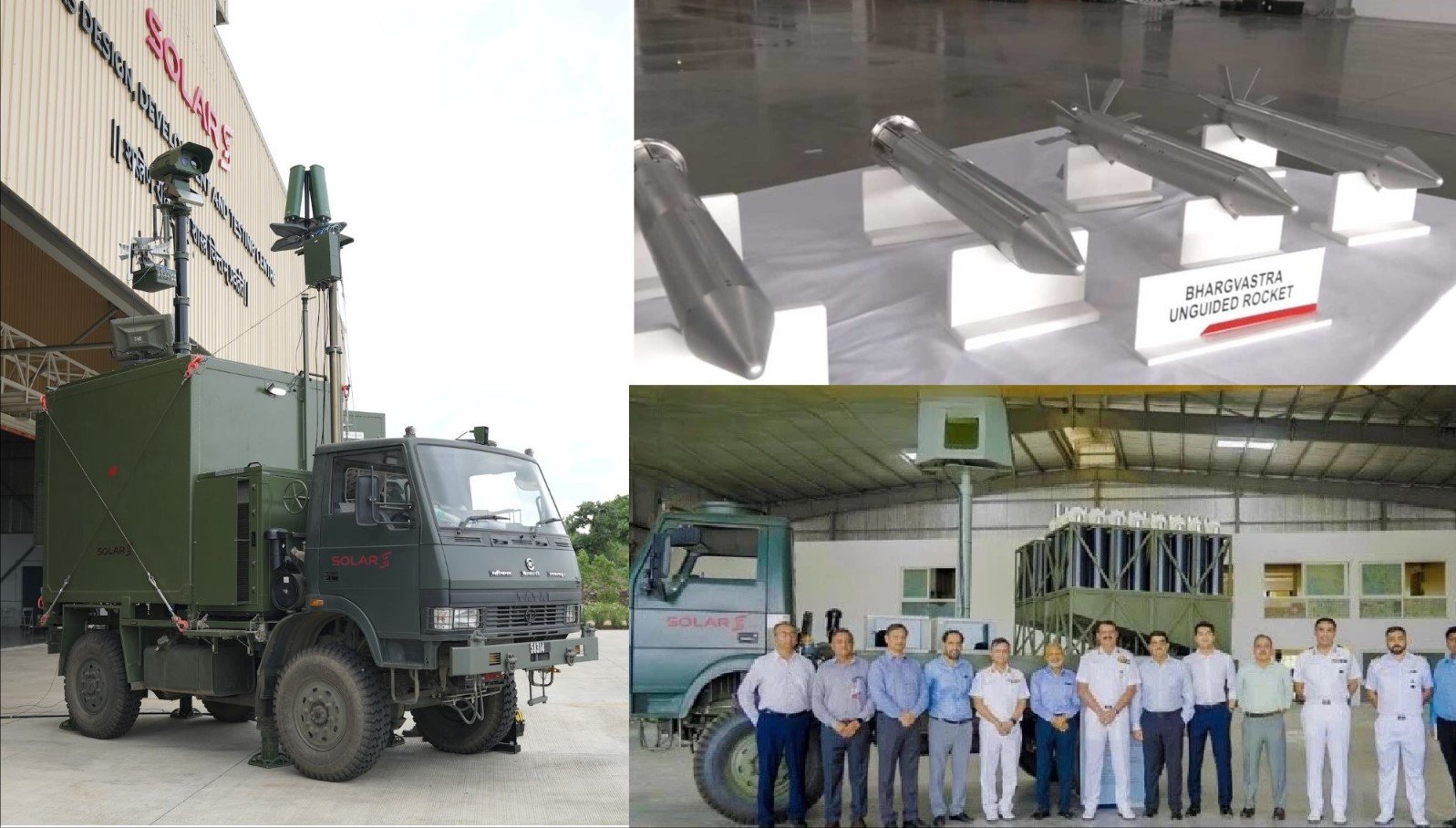
NAGPUR, MAHARASHTRA — Solar Defence and Aerospace Ltd. (SDAL), a subsidiary of Solar Industries India Limited, has demonstrated its indigenous Bhargavastra vehicle-mounted counter-swarm drone system to a visiting Indian Army team in Nagpur. The July 24 demonstration was conducted as part of a status review under a Project Sanction Order (PSO) of the Ministry of Defence's Make-II initiative, which supports industry-funded prototype development.
#WATCH | Nagpur, Maharashtra: Solar Defence and Aerospace Ltd. (SDAL) demonstrated "Bhargavastra", an indigenous, vehicle-mounted, multi-layered Counter-Swarm Drone System designed to provide affordable and highly effective protection against the rapidly growing threat of… pic.twitter.com/IefshrHa2J
— ANI (@ANI) July 24, 2026
Indigenous Hard-Kill Counter-Drone System
Bhargavastra has been developed entirely in India to counter the growing threat posed by weaponised drones, loitering munitions and autonomous drone swarms. Unlike conventional soft-kill systems that rely on electronic jamming or spoofing, Bhargavastra uses a hard-kill approach, physically intercepting and destroying aerial threats, including autonomous drones that can resist electronic countermeasures.
The system has been developed in collaboration with Economic Explosives Limited for its kinetic engagement capability.
Multi-Layer Engagement Capability
Bhargavastra features a two-layer interception architecture designed to engage different types of aerial threats.
The first layer uses unguided micro-rockets to neutralise dense drone swarms within a blast radius of about 20 metres. The second layer employs precision-guided micro-missiles capable of engaging evasive or high-value targets at ranges of up to 2.5 kilometres.
According to the company, a single 7.5-ton class all-terrain launcher vehicle can carry 64 guided and unguided munitions arranged in 8×8 cassettes. The launcher is designed to fire multiple rounds in rapid succession, enabling simultaneous engagement of multiple targets while providing 360-degree coverage.
Advanced Detection and C4I Network
The system's Command and Control Vehicle (CCV) integrates a Command, Control, Communication and Intelligence (C4I) architecture equipped with:
- A primary radar
- An Electro-Optical/Infrared (EO/IR) surveillance and tracking system
- Passive Radio Frequency (RF) sensors
These sensors provide multi-layer detection, tracking and classification of aerial threats before automatically assigning targets to the launcher.
According to SDAL, the radar can detect:
- Medium-to-large unmanned aerial vehicles (UAVs) at distances of up to 10 kilometres
- Micro-drones at distances of around 6 kilometres
The company stated that the complete process from target recognition to interception takes less than 16 seconds.
Indian Army Observes Full System Demonstration
During the July 24 demonstration, SDAL presented the complete Bhargavastra configuration, including the Command and Control Vehicle and launcher vehicle.
To evaluate the system, the company flew a live swarm of drones. The radar and sensor suite successfully detected the targets, while the C4I system generated a real-time air situational picture, issued a drone attack alert and automatically assigned targets to the launcher.
The complete firing sequence and targeting process were demonstrated to the visiting Indian Army officers. However, no live rocket firing was carried out, as firing within the plant premises was restricted because of safety protocols.
Designed for Multiple Operational Environments
Bhargavastra has been designed for deployment across a wide range of operational conditions, including:
- Plains
- Deserts
- Mountainous terrain up to 5,000 metres above mean sea level
The system also features an open architecture designed for integration with the Indian Armed Forces' existing network-centric operations, including compatibility with air defence networks such as Akashteer.
By using micro-rockets and micro-missiles instead of larger surface-to-air missiles, Bhargavastra is intended to provide a more cost-effective solution for countering drone threats.
Development Status
SDAL, based in Nagpur, developed Bhargavastra entirely in India. Earlier component trials were conducted in 2025 at the Seaward Firing Ranges in Gopalpur, Odisha.
The company said internal trials are expected to be completed within the next two to three months, after which the system will be ready for user trials.
The July 24 demonstration marked another stage in the evaluation of the indigenous counter-swarm drone system under the Ministry of Defence's Make-II programme.
Source : ANI
——— End of Article ———