WASHINGTON — A civil nuclear cooperation agreement signed between the United States and Saudi Arabia has quickly become the focus of debate after questions emerged over uranium enrichment and a subsequent statement by President Donald Trump that appeared to change key aspects of the agreement.
On July 22, U.S. Energy Secretary Chris Wright and Saudi Energy Minister Prince Abdulaziz bin Salman signed a Section 123 agreement in Washington under the U.S. Atomic Energy Act. The agreement establishes the legal framework for American companies to support the development of Saudi Arabia's civilian nuclear power program.
Saudi Arabia considers nuclear energy a key part of its Vision 2030 economic diversification strategy. The kingdom currently uses a significant portion of its crude oil for domestic electricity generation and aims to expand nuclear, solar, and wind energy to reduce domestic oil consumption, increase oil available for export, and lower carbon emissions.
Michael Ratney, former U.S. Ambassador to Saudi Arabia and now a senior adviser at the Center for Strategic and International Studies (CSIS), wrote in a commentary published on July 23 that Saudi Arabia's interest in nuclear power is driven primarily by economic and energy needs rather than prestige.
Questions Over Uranium Enrichment
Discussion surrounding the agreement intensified after press reports indicated that Saudi Arabia could eventually pursue domestic uranium enrichment following a multiyear study on its commercial viability.
Saudi Arabia has domestic uranium deposits and has repeatedly expressed interest in developing the entire nuclear fuel cycle, from uranium mining to reactor fuel production, instead of relying entirely on foreign suppliers.
Uranium enrichment is considered a sensitive technology because it can produce fuel for civilian nuclear reactors but, at higher enrichment levels, can also produce material suitable for nuclear weapons. According to the information discussed following the agreement, only a limited number of countries currently operate uranium enrichment facilities.
The reported possibility of future enrichment raised concerns among nonproliferation experts because the agreement does not require Saudi Arabia to adopt the nonproliferation "gold standard," under which a country legally commits not to pursue domestic uranium enrichment or fuel reprocessing. It also does not require Saudi Arabia to adopt the International Atomic Energy Agency's (IAEA) Additional Protocol, which provides for expanded inspection authorities.
Matthew Kroenig, a nonproliferation expert at the Atlantic Council, argued that allowing Saudi Arabia to obtain enrichment capabilities would be a strategic mistake. Alicia Sanders-Zakre, Head of Policy at the International Campaign to Abolish Nuclear Weapons (ICAN), also expressed concern, describing the arrangement as lacking stronger nonproliferation safeguards.
Ratney noted that even if a domestic enrichment facility would require significant investment and many years to develop, Saudi Arabia places considerable political importance on maintaining the option to pursue it.
Trump's Statement Introduces New Questions
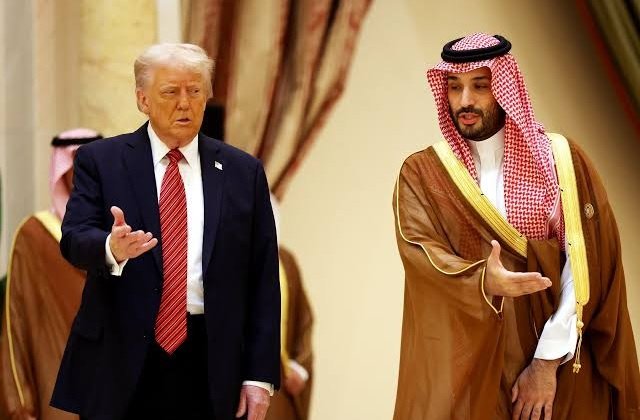
The day after the agreement was signed, President Donald Trump posted on social media that the nuclear agreement would be linked to Saudi Arabia normalizing relations with Israel under the Abraham Accords. He also stated that the agreement would not include uranium enrichment and would be for non-military purposes only.
The statement came after U.S. officials had publicly announced the agreement without mentioning normalization as a formal condition. Ratney said the move introduced additional uncertainty into an agreement that was already attracting scrutiny.
He wrote that the statement appeared to be an effort to respond to criticism from nonproliferation advocates and Israeli officials following the announcement.
Ratney also noted that Saudi Arabia has consistently maintained that normalization with Israel depends on concrete progress toward the establishment of a Palestinian state, a position that remains unchanged.
Congressional Review
The agreement will now undergo a 90-day review by the U.S. Congress. Lawmakers can block the agreement only by securing a veto-proof majority in both the House of Representatives and the Senate.
The nuclear agreement follows several other areas of expanding U.S.-Saudi cooperation during the current administration, including agreements involving F-35 fighter jets and economic partnerships in artificial intelligence.
As the congressional review proceeds, discussions are expected to continue over uranium enrichment, nonproliferation safeguards, and the diplomatic conditions surrounding the agreement. While the framework establishes cooperation on Saudi Arabia's civilian nuclear energy program, several policy and implementation questions remain under review.
——— End of Article ———