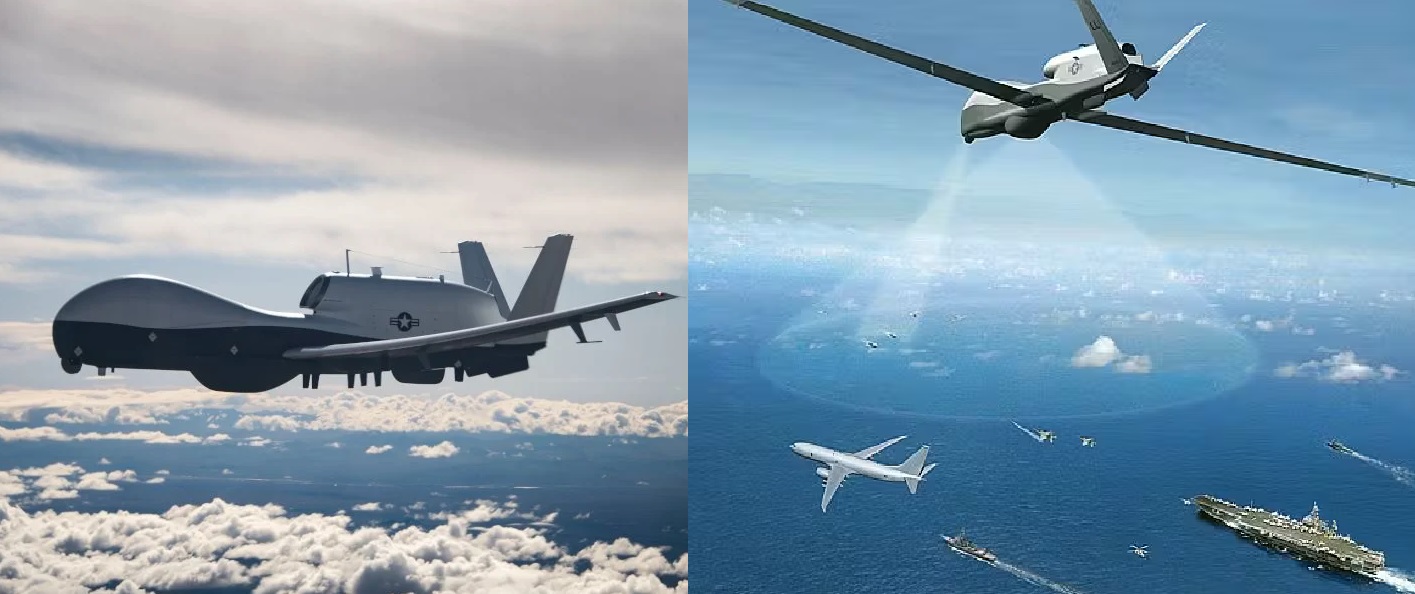
Northrop Grumman has successfully proven the capabilities of its MQ-4C Triton unmanned aircraft system by navigating the challenging and extreme conditions of the Arctic Ocean. This recent flight demonstration showed how the Triton’s advanced navigation system, designed to function in high-latitude and austere environments, could operate deep within the Arctic Circle. The test, which underscores Triton’s role as a critical intelligence, surveillance, reconnaissance, and targeting platform, highlights its unique ability to perform high-altitude, long-endurance missions in one of the most demanding regions of the world.
The test flight originated in Deadhorse, Alaska, and pushed nearly 100 miles from the North Pole, a distance that presents unique challenges for any aircraft. The MQ-4C Triton relied on Northrop Grumman's proprietary navigation systems and mission management computer, along with newly upgraded operational flight software. It was able to maintain precision navigation throughout the five-hour flight, gathering critical data while staying entirely within U.S. and Canadian airspace.
One of the key aspects of this flight was the validation of ground-based GPS alignment procedures. This feature allows Triton to operate from runways located above 70 degrees north latitude, making it a reliable asset for missions in the High North. This capability is especially significant for future operations as Arctic regions become more strategically important for both national security and international interests.
Triton’s design makes it an optimal choice for Arctic operations. As a high-altitude, long-endurance aircraft, it flies at altitudes above 50,000 feet, well above the turbulent winds and icy conditions that affect aircraft operating at lower altitudes. Triton’s operational flexibility allows it to avoid the performance limitations faced by medium-altitude platforms, which generally operate between 10,000 and 30,000 feet. Triton’s endurance, which exceeds 24 hours in a single mission, further sets it apart, making it ideal for extended operations in regions like the Arctic.
The MQ-4C Triton is outfitted with multiple sensors that allow for a wide range of mission capabilities, from maritime patrol to signals intelligence, and even search and rescue operations. These sensors, capable of operating simultaneously, provide a wealth of real-time intelligence, giving Triton the ability to exponentially increase mission output compared to other aircraft. Moreover, the system is equipped with advanced de-icing and anti-icing technology, ensuring it can safely conduct missions in extreme weather conditions, a necessity when flying in the cold, harsh Arctic environment.
In the words of Jane Bishop, Vice President and General Manager of Northrop Grumman’s Global Surveillance Division, "Flight operations in austere and frigid conditions present unique navigation challenges. Our demonstration highlights Triton’s ability to successfully perform in that challenging environment."
U.S. Navy Capt. Josh Guerre, Triton program manager, echoed this sentiment: “Arctic regions are an increasingly important theater of operations with unique threats and environments. We are ready to support those mission sets for domestic and international customers.”
This Arctic test flight comes on the heels of a similar demonstration conducted over the Gulf of Alaska in June 2023 during the Northern Edge exercise. There, Triton showcased its powerful radar capabilities, accurately detecting and tracking targets in challenging high-sea conditions with impressive weapon-relevant precision. These ongoing demonstrations serve to highlight Triton’s adaptability and reliability, further cementing its position as a critical asset for maritime surveillance.
While the U.S. Navy has been the primary user of the Triton, the aircraft is also being built for the Royal Australian Air Force, and other allies are taking note of its capabilities. With the growing importance of Arctic and maritime domains, nations may consider acquiring uncrewed surveillance aircraft like the Triton, which has proven itself capable of operating in these regions’ most extreme and unpredictable environments.
Beyond its high-altitude operation and long-endurance, the Triton is designed to work in some of the harshest climates on the planet. Its ability to avoid performance restrictions that typically hamper lower-altitude aircraft in the Arctic is key, and its advanced anti-icing systems ensure that it remains mission-ready, even in extreme conditions.
The successful Arctic demonstration reinforces the MQ-4C Triton’s role as a pioneering unmanned surveillance system, uniquely suited to tackle the demands of an evolving global security landscape, particularly in the increasingly critical Arctic theater.
——— End of Article ———