DAEGU, South Korea / ABU DHABI, UAE — June 12, 2026 : The United Arab Emirates (UAE) has launched an accelerated airlift operation to transport a new Cheongung-II air defense battery and accompanying interceptor missiles from South Korea, bypassing maritime routes disrupted by the ongoing closure of the Strait of Hormuz.
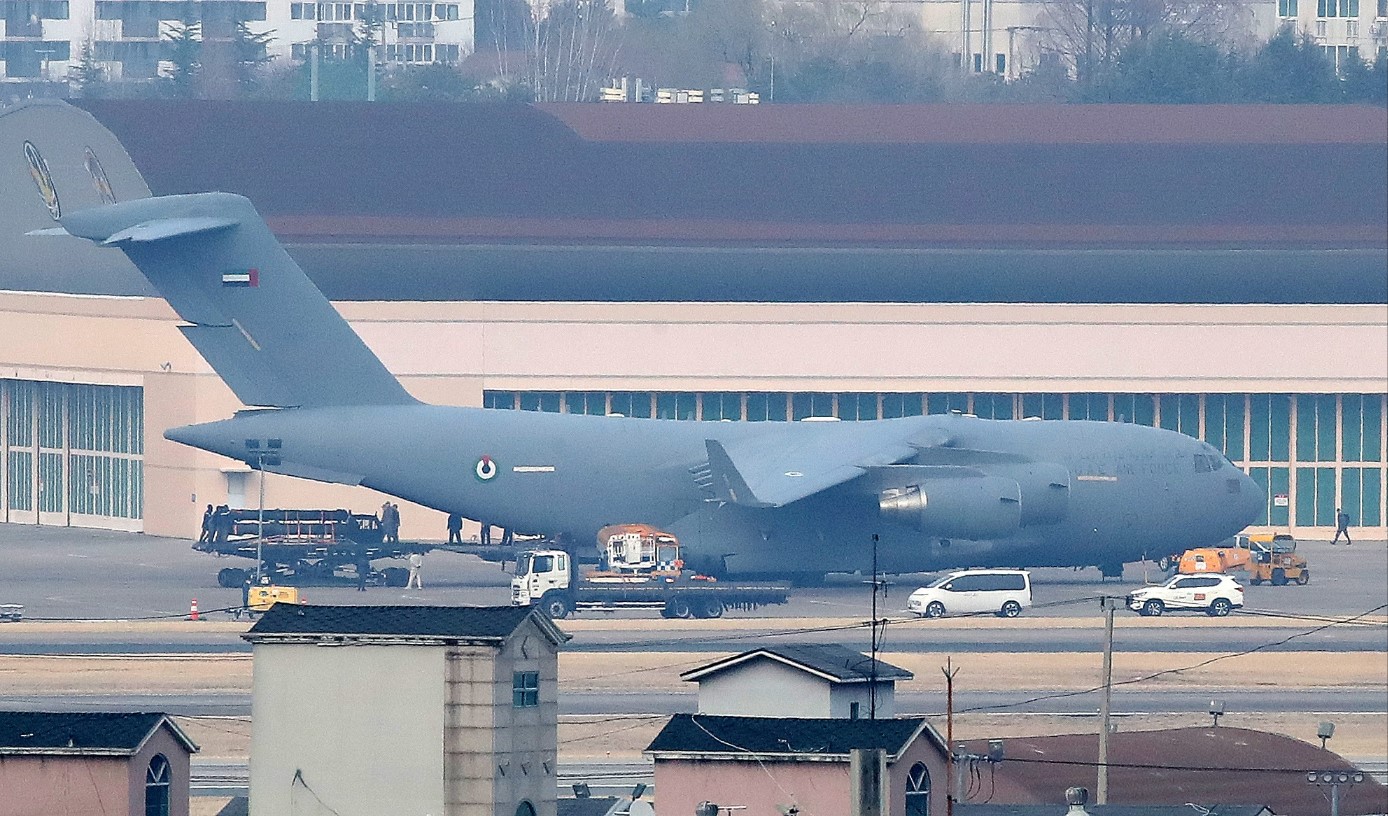
According to South Korean military and defense industry sources, the UAE has deployed a fleet of eight C-17 Globemaster III military transport aircraft to move the complete air defense system from Daegu Air Force Base to the Gulf region. At least one UAE Air Force C-17 was observed at the base on June 12 as loading operations commenced.
The aircraft are arriving sequentially to transport the battery's launchers, radar systems, engagement control stations, and interceptor missiles. The airlift is expected to accelerate delivery by approximately one month compared with the original contract schedule.
Blockade Forces Shift From Sea to Air Transport
Under normal circumstances, heavy military equipment such as air defense batteries is transported by sea due to lower costs and larger cargo capacity. However, the closure of the Strait of Hormuz, one of the world's most strategically important maritime chokepoints, has left the UAE without a practical shipping route for receiving the equipment.
The waterway, located between Iran and Oman, handles approximately 20 percent of global seaborne oil trade and serves as a critical route for commercial and military logistics in the Gulf region.
The C-17 Globemaster III, which can carry approximately 77,500 kilograms (170,000 pounds) of cargo, provides the UAE with an alternative means of transporting the system. Because a complete Cheongung-II battery consists of multiple large components, several flights are required to move the entire package.
Combat Experience Drives Urgent Delivery
The decision to accelerate delivery follows the system's recent operational use in the UAE. Earlier this year, the UAE's two deployed Cheongung-II batteries were activated during missile and drone attacks targeting the Gulf region.
Operating alongside U.S.-supplied Patriot air defense systems and Israeli Arrow missile defense systems, the South Korean-made batteries reportedly launched around 60 interceptor missiles during combat operations.
Defense reports indicate the systems successfully intercepted 29 of 30 designated aerial targets, including Iranian ballistic missiles, achieving an estimated 96 percent interception rate. The performance has reportedly reinforced confidence in the system and contributed to Abu Dhabi's request for expedited delivery of additional batteries under its existing contract.
Second Emergency Airlift in 2026
The current operation follows an earlier emergency resupply mission conducted in March 2026, when a UAE Air Force C-17 transported approximately 30 KM-SAM Block II interceptor missiles from South Korea.
Those missiles were reportedly drawn directly from South Korea's Air Force reserves to replenish UAE stockpiles depleted during the initial wave of attacks. While the March operation focused on missile resupply, the current mission involves the transport of an entire operational battery, making it significantly larger in scope.
Cheongung-II System Capabilities
The Cheongung-II, also known internationally as the KM-SAM Block II, is a medium-range surface-to-air missile defense system developed by South Korea's Agency for Defense Development.
Production of the system is shared among several South Korean defense firms. Hanwha Aerospace manufactures the launcher vehicles, LIG Nex1 produces the interceptor missiles and engagement control system, while Hanwha Systems supplies the multifunction radar.
Each battery consists of:
- Four mobile launcher vehicles, each carrying eight ready-to-fire interceptor missiles
- One multifunction AESA radar capable of 360-degree target tracking
- One engagement control station
The system is designed to engage aircraft, cruise missiles, and ballistic missiles at ranges of approximately 40 to 50 kilometers and at altitudes of up to 40 kilometers. It utilizes hit-to-kill technology, destroying incoming targets through direct impact rather than explosive fragmentation.
Defense analysts often compare the system's role to that of the U.S. Patriot PAC-2, although the Cheongung-II is generally considered a lower-cost alternative.
Major Export Success for South Korea
The battery currently being airlifted represents the third unit delivered under the UAE's $3.5 billion contract signed in January 2022 for a total of 10 Cheongung-II batteries. The agreement was the largest guided-weapons export contract in South Korean history at the time.
Since then, the system has secured additional export orders across the Middle East. In February 2024, Saudi Arabia signed a $3.2 billion contract for 10 batteries, followed by Iraq, which agreed to purchase eight batteries under a $2.8 billion deal in September 2024.
South Korean officials have stated that the system's recent combat performance in the UAE has generated interest from several additional countries, although no further customers have been publicly identified.
Strengthening Regional Air Defense
The ongoing airlift highlights the UAE's efforts to strengthen its layered air defense network amid continuing regional security challenges. By transporting the system by air rather than waiting for maritime routes to reopen, the UAE will be able to integrate the battery into operational service more quickly and expand its missile defense coverage.
The operation also underscores the growing defense partnership between the UAE and South Korea, which has expanded significantly since the signing of the 2022 Cheongung-II agreement and includes training, logistical support, and long-term defense cooperation programs.
——— End of Article ———