WASHINGTON, — June 12, 2026 : The U.S. Space Force has awarded contracts worth a combined $437.7 million to Viasat and Intelsat General Communications LLC for the production of the first two operational satellites under the Protected Tactical SATCOM-Global (PTS-G) Swarm 1 program. The awards mark a significant step in the modernization of U.S. military satellite communications, shifting away from reliance on a small number of large satellites toward a more distributed and resilient architecture.
The contracts, issued through the Space Systems Command (SSC), cover the design, manufacturing, integration, testing, launch, and on-orbit checkout of the two satellites. The program is intended to provide secure, jam-resistant communications for U.S. and allied military forces operating in contested environments.
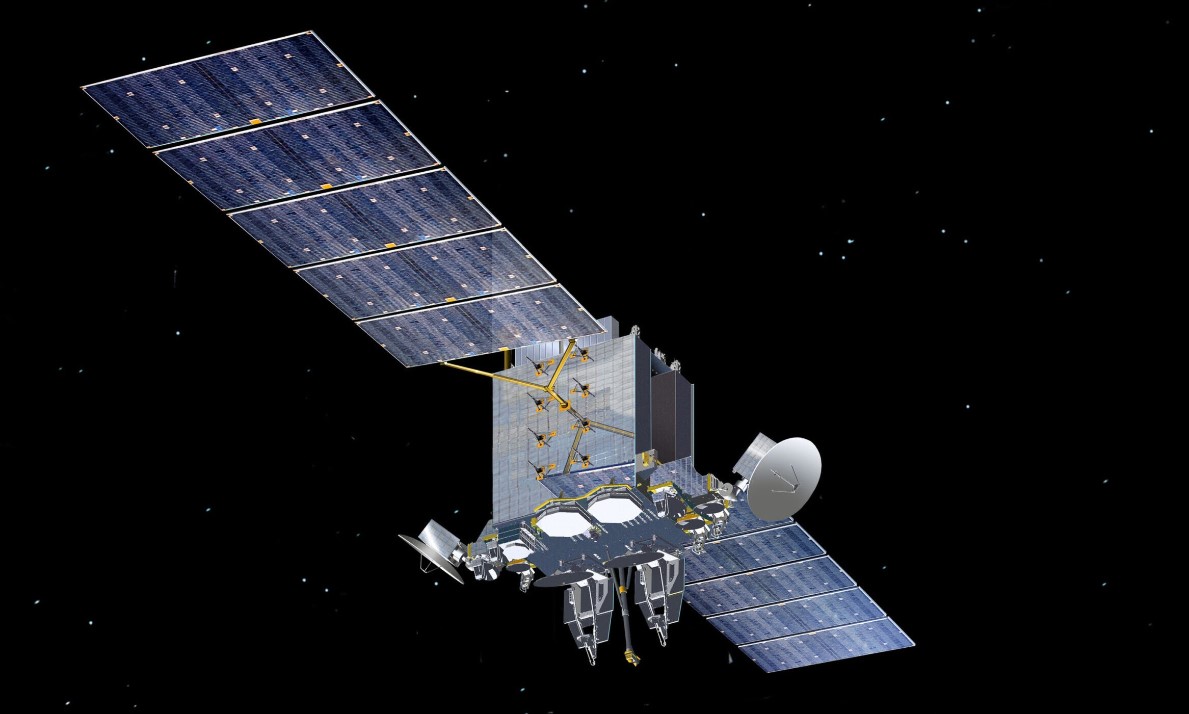
Under the agreement, Viasat, headquartered in Carlsbad, California, will build, launch, and operate a dual-band X/Ka-band mini-GEO satellite, while Intelsat will be responsible for delivering the second spacecraft. Both satellites will operate in geosynchronous Earth orbit (GEO) at approximately 35,786 kilometers above the equator, providing continuous coverage across large geographic regions.
Transition to a Distributed GEO Architecture
The PTS-G Swarm 1 initiative is part of the Space Force’s broader effort to develop a more resilient satellite communications network capable of operating in increasingly contested space environments. The system is designed to supplement and eventually assume missions currently handled by the Advanced Extremely High Frequency (AEHF) constellation.
The AEHF network consists of six large satellites, each weighing around 6,168 kilograms, and has provided secure and survivable communications for U.S. military forces since the first satellite entered service in 2010. While highly capable, the satellites occupy fixed orbital positions and represent substantial investments, making them attractive targets for emerging threats such as electronic warfare, jamming, spoofing, cyberattacks, and directed-energy systems.
The new PTS-G architecture distributes communications capabilities across smaller, maneuverable satellites operating within GEO. By spreading mission functions among multiple spacecraft, the Space Force aims to reduce vulnerabilities associated with single-point failures and improve operational resilience against potential adversaries.
Dual-Band Communications Capability
A key feature of Viasat’s satellite is its ability to operate simultaneously in both X-band and Ka-band frequencies.
X-band is widely used for military tactical communications, command-and-control networks, and radar applications due to its reliability and resistance to adverse weather conditions. Ka-band, meanwhile, supports significantly higher data throughput, enabling broadband communications and data-intensive military operations.
The dual-band design allows military users to switch between frequency bands or use them simultaneously, improving operational flexibility while reducing susceptibility to frequency-specific interference, jamming, or spoofing attempts.
The satellites will support both Protected Tactical Waveform (PTW) and non-PTW communications, enabling compatibility with existing military communications infrastructure while providing enhanced anti-jam capabilities for future operations.
Commercial Technology Supporting Military Missions
Viasat’s satellite design draws heavily from technologies developed for the company’s ViaSat-3 commercial broadband constellation. By leveraging an existing commercial platform, the company aims to shorten development timelines, lower costs, and reduce technical risks compared with building an entirely new spacecraft design.
The contract also includes five years of post-launch operations and sustainment services, covering satellite control, tracking, telemetry, command functions, network operations, maintenance, and cybersecurity protection. These services are intended to ensure secure operation throughout the satellite’s initial service life.
Craig Miller, President of Viasat Government, said the award reflects the company’s experience in delivering resilient dual-use satellite systems and its understanding of Space Force operational requirements.
Company officials stated that the satellite architecture builds upon work completed during the program’s initial design maturation phase in 2025, when Viasat developed a low size, weight, and power GEO platform capable of supporting flexible communications coverage and dynamic mission requirements.
Program Structure and Funding
The broader PTS-G program is being managed through a $4 billion Indefinite Delivery, Indefinite Quantity (IDIQ) contract vehicle. In July 2025, the Space Force selected five companies—Boeing, Viasat, Northrop Grumman, Astranis Space Technologies, and Intelsat—to participate in the program’s initial design phase.
The Swarm 1 production awards to Viasat and Intelsat represent the first operational satellite procurement under the initiative. The competitive acquisition approach is intended to maintain a diverse industrial base while reducing reliance on a single supplier.
Budget documents show the Space Force allocated nearly $237 million for PTS-G research and development in fiscal year 2026, with an additional $150 million requested for fiscal year 2027. The shift in funding priorities reflects the program’s transition from concept development and design activities to hardware production and deployment.
Current planning calls for the first Swarm 1 satellites to launch in 2028, with initial operational capability (IOC) expected around 2029 and full operational capability targeted for 2031. Work under the current contracts is expected to continue through March 2029.
Strengthening Protected Military Communications
The PTS-G program is intended to provide secure global communications for military forces operating across land, sea, air, cyber, and space domains. By combining protected waveforms, maneuverable GEO satellites, and commercial technology, the Space Force seeks to improve the survivability and flexibility of its communications architecture while ensuring compatibility with existing systems.
The Swarm 1 satellites represent the first operational step toward a distributed protected SATCOM network designed to maintain connectivity in contested environments and support future military communications requirements.
——— End of Article ———