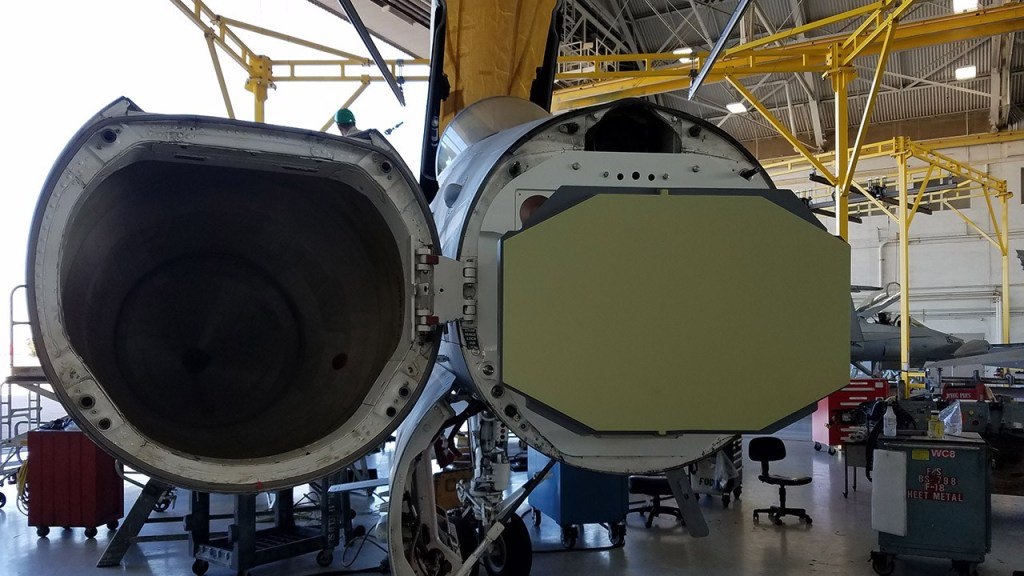
LINTHICUM HEIGHTS, Md., — June 12, 2026 : Northrop Grumman Systems Corp. has been awarded a $14.2 million contract modification by the U.S. Department of Defense to continue supplying AN/APG-83 Scalable Agile Beam Radar (SABR) systems for the U.S. Air Force’s F-16 Fighting Falcon fleet, supporting ongoing efforts to modernize the service’s fourth-generation fighter aircraft.
The latest contract modification increases the total cumulative value of the radar procurement and support program to approximately $1.8 billion. According to the Department of Defense, work associated with the contract will be carried out at Northrop Grumman’s facility in Linthicum Heights, Maryland, with completion of the current phase scheduled for May 31, 2031.
Under the agreement, Northrop Grumman will provide additional AN/APG-83 SABR Active Electronically Scanned Array (AESA) radars, a key component of the U.S. Air Force’s broader F-16 Radar Modernization Program (RMP). The program is designed to enhance the combat effectiveness and operational lifespan of the Air Force’s large inventory of F-16 aircraft as they continue to serve alongside newer fifth-generation platforms.
Advanced AESA Technology for the F-16
The AN/APG-83 SABR is a multifunction AESA fire-control radar developed as a replacement for the legacy APG-66 and APG-68 pulse-Doppler radars used on older F-16 variants. The system incorporates technologies derived from Northrop Grumman’s advanced radar programs for the F-22 Raptor and F-35 Lightning II, specifically the AN/APG-77 and AN/APG-81 radar families.
By integrating fifth-generation sensor technology into the F-16, the Air Force is able to significantly improve the aircraft’s situational awareness, target detection, and mission effectiveness without the need to acquire entirely new aircraft.
One of the radar’s key advantages is its ability to fit within the F-16’s existing structural, power, and cooling limitations. This allows the system to be installed as a direct replacement for older radars without requiring extensive modifications to the airframe, reducing upgrade costs and minimizing aircraft downtime.
Enhanced Detection and Targeting Capabilities
The AN/APG-83 provides a range of operational improvements over earlier radar systems. The radar offers extended detection and tracking ranges, enabling pilots to identify and engage airborne and surface threats at greater distances.
The system also features high-resolution synthetic aperture radar (SAR) mapping, allowing aircrews to generate detailed ground imagery for precision targeting missions in all-weather conditions. This capability enhances the F-16’s effectiveness in both air-to-air and air-to-ground operations.
Another major advantage is the radar’s interleaved multi-mode operation, which allows pilots to simultaneously track airborne and surface targets while maintaining situational awareness in complex operational environments. The AESA architecture also provides improved resistance to electronic warfare and jamming attempts, increasing survivability in contested battlespaces.
Additionally, the radar can track multiple targets simultaneously and support advanced weapons employment, helping maintain the combat relevance of the F-16 against modern threats.
Supporting Long-Term Fleet Modernization
The continued procurement of the AN/APG-83 remains a central element of the U.S. Air Force’s strategy to extend the operational life of its F-16 fleet. Hundreds of F-16C/D aircraft, including Block 40/42 and Block 50/52 variants, are planned to receive the upgraded radar under ongoing modernization efforts.
The radar modernization program has also supported upgrades for Air National Guard units, improving homeland defense capabilities and enhancing the aircraft’s ability to detect and respond to emerging threats, including low-flying cruise missiles.
In May 2026, Northrop Grumman announced the delivery of its 1,000th AN/APG-83 SABR radar, marking a significant production milestone and reflecting continued demand from both domestic and international customers.
Beyond the United States, the AN/APG-83 serves as the baseline radar for the F-16V Viper configuration and has been selected by several allied nations for their own F-16 modernization programs. Countries including Taiwan and Singapore have adopted the system to improve the capabilities of their existing fighter fleets.
The latest contract award underscores the U.S. Air Force’s continued investment in upgrading its proven F-16 fleet, ensuring the aircraft remains interoperable with fifth-generation platforms while providing a cost-effective solution for maintaining combat readiness and operational effectiveness well into the coming decades.
——— End of Article ———