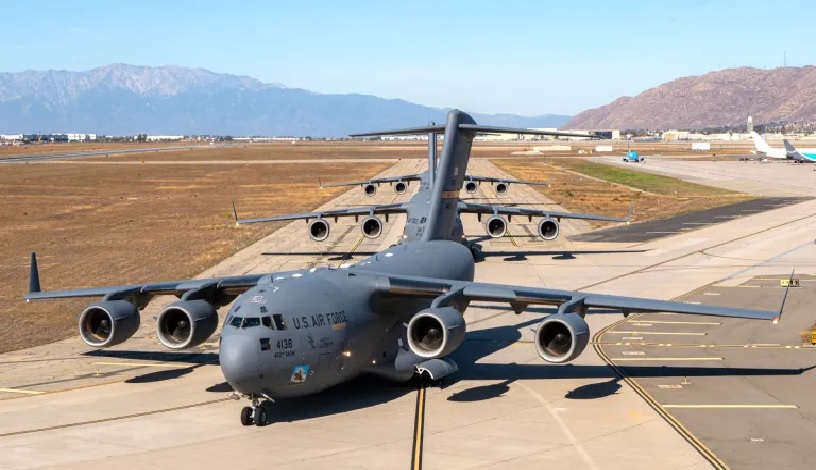
WASHINGTON, — June 12, 2026 : The United States is facing growing concerns over the future of its strategic airlift fleet as aging transport aircraft continue to support high operational demands worldwide. Discussions about potentially restarting production of the Boeing C-17 Globemaster III have gained momentum, but defense officials and industry experts say such a move would be costly and technically challenging.
Congress Orders Feasibility Assessment
The U.S. House Armed Services Committee has directed the U.S. Air Force to provide a detailed assessment by March 1, 2027, on the feasibility of reopening the C-17 production line. The review will examine tooling availability, supplier network viability, workforce requirements, production timelines, and restart costs.
Boeing has confirmed ongoing discussions with at least one international customer and several other interested countries regarding potential new C-17 aircraft. However, the company noted that talks remain in the early stages.
The original C-17 production line in Long Beach, California, closed after the final aircraft was delivered in 2015, and the facility has since been repurposed.
A 2013 RAND Corporation study estimated that restarting production could require approximately $8 billion before any aircraft could be delivered. Analysts believe actual costs today could be significantly higher due to inflation and supply chain challenges.
Airlift Fleet Under Pressure
The U.S. Air Force currently operates about 222 C-17A Globemaster III aircraft with an average age of around 22 years, alongside 52 C-5M Super Galaxy aircraft averaging approximately 37 years in age.
These aircraft form the backbone of U.S. military logistics, transporting troops, heavy equipment, armored vehicles, missile systems, and humanitarian aid worldwide.
Years of operations in Afghanistan, support missions for Ukraine, deployments in the Indo-Pacific, and operations across the Middle East have accelerated wear on the fleet.
No Immediate Replacement Available
The United States currently has no direct replacement for the C-17 and C-5 fleets.
Commercial cargo aircraft such as converted Boeing 777 and Boeing 747 freighters cannot operate effectively from short or austere runways near combat zones. The European Airbus A400M Atlas provides strategic and tactical transport capabilities but carries significantly less payload than the C-17.
The Air Force's Next Generation Airlift (NGAL) program is intended to eventually replace both fleets. Current plans envision production beginning around 2038, with initial operational capability targeted for 2041. Under current projections, the C-17 could remain in service until approximately 2075.
China and Russia Continue Production
While U.S. production ended more than a decade ago, China and Russia continue manufacturing heavy military transport aircraft.
China has expanded production of the Xi'an Y-20, with around 100 aircraft reported in service or produced, including tanker variants.
Russia continues production of the Ilyushin Il-76MD-90A at the Aviastar-SP facility. The plant delivered seven aircraft in 2025 and plans to increase production in the coming years.
Strategic Implications
Strategic airlift remains essential to U.S. military operations, particularly in regions such as the Western Pacific, where forces and equipment must be moved across long distances.
Unlike China and Russia, which can rely heavily on land-based logistics networks, the United States depends on strategic airlift to transport personnel, munitions, spare parts, and equipment overseas.
Without an active production line, every retirement, major accident, or potential combat loss reduces available airlift capacity. As a result, Congress, the Air Force, and industry leaders continue to evaluate options for maintaining long-term strategic mobility while advancing future modernization programs.
The C-17 Globemaster III remains one of the U.S. military's most important transport aircraft, capable of carrying up to 170,900 pounds (77,519 kilograms) of cargo while operating from short and austere airfields worldwide.
——— End of Article ———