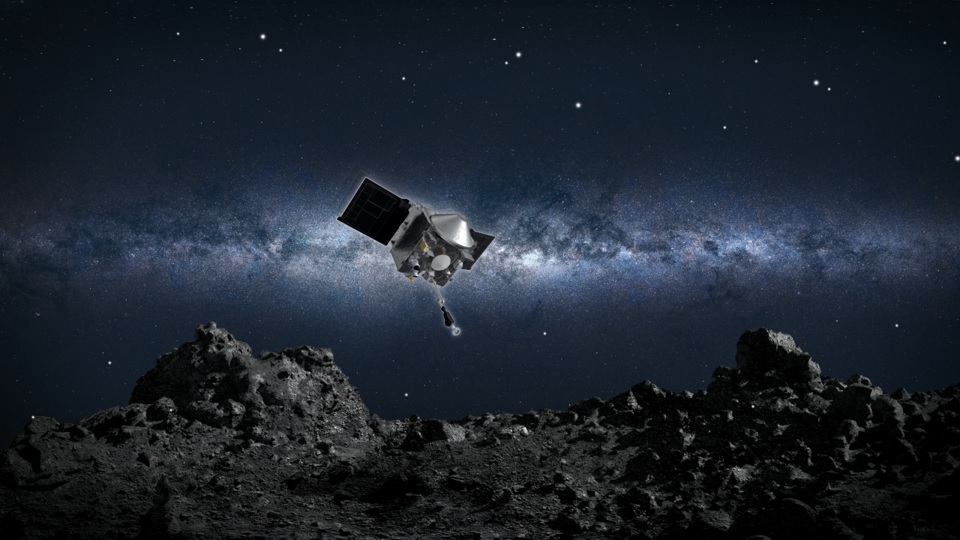
In 2029, an asteroid named Apophis is set to make a close pass by Earth, sparking both scientific excitement and public intrigue. Discovered in 2004 by astronomers Roy Tucker, David Tholen, and Fabrizio Bernardi at Arizona’s Kitt Peak National Observatory, Apophis quickly gained attention due to early concerns about a potential collision with Earth. However, NASA has since determined that while Apophis will come extremely close—within 19,794 miles (31,860 kilometers) of Earth’s surface—it will not pose any direct threat. Instead, this close encounter offers a rare scientific opportunity, which NASA plans to seize by redirecting its OSIRIS-APEX spacecraft to study the asteroid in detail.
From Bennu to Apophis: The OSIRIS-APEX Mission
The OSIRIS-APEX spacecraft is not a new vessel but a rebranded version of OSIRIS-REx, which successfully gathered samples from asteroid Bennu in 2023. Following the completion of that mission, NASA decided to extend the spacecraft's life by tasking it with a new goal: to study Apophis as it approaches Earth.
Originally launched as OSIRIS-REx (Origins, Spectral Interpretation, Resource Identification, Security-Regolith Explorer), the spacecraft was renamed OSIRIS-APEX (OSIRIS-APophis EXplorer) after the decision to redirect it to Apophis. The spacecraft will rendezvous with Apophis shortly after the asteroid’s flyby in April 2029, making it an integral part of NASA’s broader efforts to understand near-Earth objects.
The Flyby of a Lifetime
What makes Apophis’s 2029 flyby so intriguing is how close it will come to Earth. On April 13, 2029, the asteroid, measuring approximately 1,100 feet (340 meters) in width, will zip past our planet at a distance closer than many satellites orbit. Earth’s gravity will slightly alter Apophis’s trajectory, but scientists are confident in their predictions, ruling out any possibility of an impact. The asteroid will pass by at a speed of around 19 miles per second (31 kilometers per second), offering a unique chance to study its structure and composition in unprecedented detail.
The OSIRIS-APEX spacecraft will begin taking images of Apophis as it closes in, providing critical data on its surface, rotation, and chemical makeup. During this time, Earth-based telescopes will also monitor the asteroid closely. However, shortly after the flyby, Apophis will become difficult to observe from the ground, as it will be too close to the Sun in the sky. This is where OSIRIS-APEX comes in—its proximity will allow it to gather data that Earth-based instruments cannot.
Mapping Apophis and Stirring Up Its Surface
In June 2029, after the initial flyby, OSIRIS-APEX will formally rendezvous with Apophis for an extended 18-month mission. The spacecraft is equipped with a suite of advanced instruments—cameras, spectrometers, and a laser altimeter—to conduct a thorough investigation of the asteroid. One of its most exciting tasks will involve flying just 16 feet (5 meters) above Apophis’s surface and firing its thrusters to dislodge rocks and dust. This maneuver will give scientists a peek beneath the asteroid’s surface, revealing materials untouched by space weathering.
This aspect of the mission mirrors a similar technique used during the OSIRIS-REx mission at Bennu. However, unlike its predecessor, OSIRIS-APEX will not collect a sample from Apophis. Instead, its mission is to provide a detailed map of the asteroid and analyze its surface composition, which will offer new insights into the asteroid’s structure and history.
Apophis: A Stony Relic from the Early Solar System
Apophis belongs to a class of stony, or "S-type," asteroids, made primarily of silicate rock and metallic materials like nickel and iron. Radar observations suggest it has a peanut-like shape, possibly indicating it consists of two lobes that may have formed through a past collision. Apophis is a near-Earth asteroid, originating in the asteroid belt between Mars and Jupiter but gradually pulled into a closer orbit by the gravitational influence of planets like Jupiter.
Apophis rotates once every 30 hours, and it exhibits a wobble known as “non-principal axis rotation,” where the asteroid also rocks back and forth about its long axis. Scientists hope that the close encounter with Earth will modify Apophis's spin rate and possibly even cause structural changes, offering a natural experiment in how planetary gravity can influence an asteroid’s dynamics.
Why Study Apophis?
The study of Apophis offers more than just academic curiosity. Near-Earth asteroids like Apophis hold clues about the early solar system’s formation, as well as the dynamic processes that have shaped our cosmic neighborhood over billions of years. Moreover, understanding the physical characteristics and trajectories of asteroids is critical for planetary defense efforts. While Apophis won’t impact Earth in 2029, the data gathered by OSIRIS-APEX will improve our ability to predict and respond to potentially hazardous asteroids in the future.
As Apophis makes its historic flyby, scientists will be watching closely—not just to study the asteroid itself, but to glean insights into the broader population of near-Earth objects. In a sense, Apophis is not only an asteroid of scientific interest but also a key to understanding the future of asteroid science and planetary defense.
The OSIRIS-APEX mission represents the cutting edge of our efforts to study asteroids and safeguard Earth from potential future impacts. Through this mission, we’ll learn more about Apophis and, by extension, the complex forces that govern the solar system's many wandering bodies.
——— End of Article ———