On a quiet Tuesday afternoon in Lebanon, Hezbollah fighters were caught off guard as their pagers—used as low-tech communication devices to avoid detection—exploded in a devastating, coordinated strike. The blasts resulted in the deaths of at least nine individuals and injured over 2,800 people, sending shockwaves throughout Hezbollah strongholds. The devices, crucial to Hezbollah’s internal communication system, had been secretly modified with hidden explosives in a covert operation attributed to Israel’s intelligence agency, Mossad.
The Role of Gold Apollo Pagers
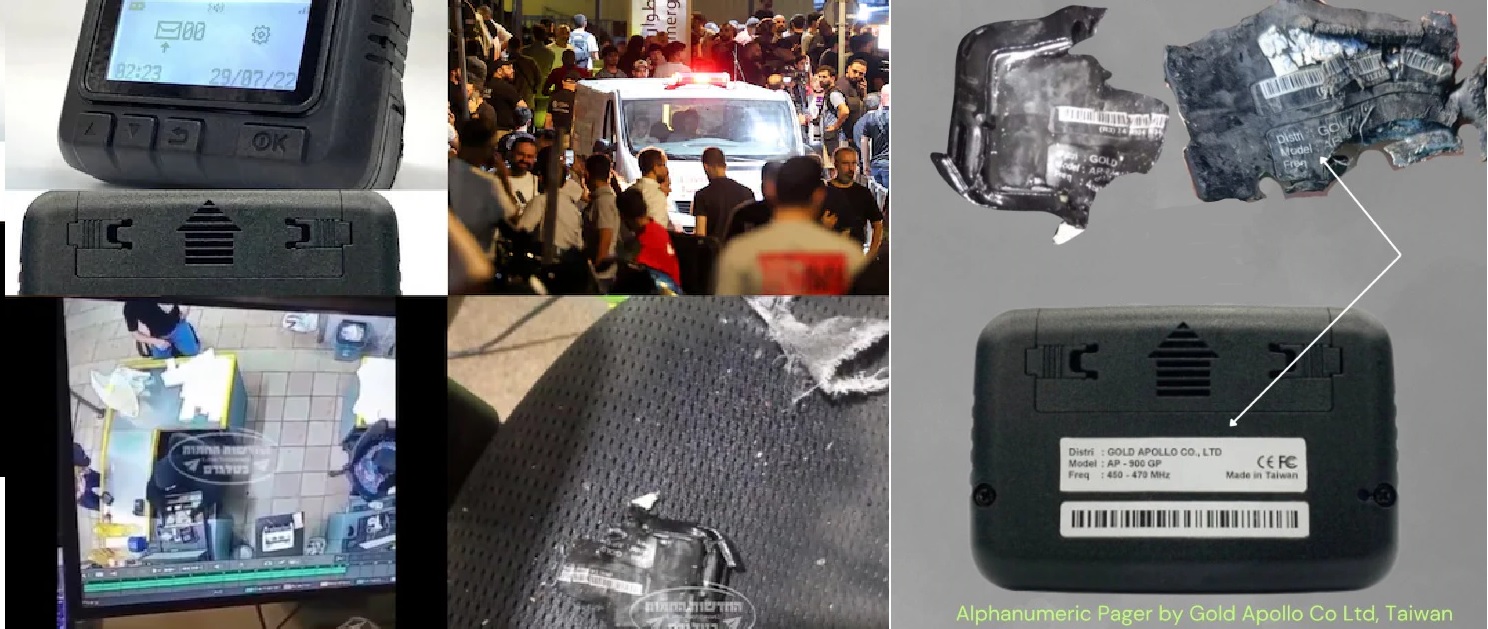
The devices in question were manufactured by **Gold Apollo**, a Taiwanese company, but the pagers used in this deadly attack were produced under a European license by **BAC Consulting**, a firm based in Hungary. Hezbollah had procured the pagers months earlier, believing that their low-tech nature would keep them safe from electronic surveillance. However, in a sophisticated infiltration of Hezbollah’s supply chain, Israeli operatives managed to embed explosives inside the pagers. These bombs remained dormant for months, completely undetected, until they were triggered by a coded message sent through Hezbollah’s own communication network.
The Explosions: Targeting Hezbollah Strongholds
The explosions primarily took place in Hezbollah’s stronghold in Beirut’s southern suburbs and the Bekaa Valley, starting around 3:30 p.m. local time. The detonation was widespread but controlled, targeting Hezbollah members in close proximity to the devices without causing extensive damage to infrastructure. Eyewitnesses described chaotic scenes of people collapsing on the streets, suffering from severe injuries to their faces, hands, and torsos. Hospitals were quickly overwhelmed, with hundreds of injured civilians and Hezbollah fighters crowding emergency rooms across Lebanon.
According to Lebanese security officials, Mossad had planned the operation with precision, embedding the explosive components during the manufacturing process at BAC Consulting, long before the pagers reached Hezbollah. When a seemingly ordinary message was sent out from Hezbollah leadership, the hidden explosives were activated remotely, causing the lethal blasts.
Hezbollah’s Counterintelligence Failure
For Hezbollah, this incident marks one of the largest counterintelligence failures in its history. The organization, which had prided itself on its secretive and robust communication protocols, found itself exposed. Jonathan Panikoff, a former U.S. national intelligence officer, described the event as “the most significant counterintelligence breach Hezbollah has faced in decades.”
Israel, which has neither confirmed nor denied involvement, is known for its capability in covert operations, particularly against adversaries like Hezbollah. The operation has been interpreted as a direct message to Hezbollah’s leadership, demonstrating that even their most secure communication channels are vulnerable. Amos Yadlin, a former head of Israeli military intelligence, emphasized that this attack was not just about causing casualties but about undermining Hezbollah’s confidence in its internal security.
Denial by Gold Apollo
In the wake of the attacks, Gold Apollo, the Taiwanese company whose name appears on the pagers, swiftly denied involvement. Gold Apollo founder **Hsu Ching-kuang** clarified that while the pagers bore his company’s branding, they were actually manufactured by the Hungarian firm BAC, which holds a license to use Gold Apollo’s trademark in certain regions. Hsu noted that the company had received strange remittances from the Middle East, suggesting that the supply chain may have been compromised at that stage, but he did not elaborate further.
Images of the destroyed pagers, obtained by **Reuters**, appeared to show models consistent with Gold Apollo’s AP924 series, though these specific pagers were produced and sold by BAC under the Gold Apollo brand. This allowed the operation to remain covert, as Hezbollah had no reason to suspect foul play when acquiring what they believed to be harmless, low-tech devices.
Hezbollah’s Reaction and Future Retaliation
In the aftermath of the attack, Hezbollah’s leadership has vowed revenge, though specifics about how and when they might retaliate remain unclear. This incident has rocked the organization’s internal security protocols, leaving Hezbollah scrambling to investigate how its communications were compromised. Hezbollah has long relied on such low-tech methods, including pagers, to avoid Israeli spyware, but this event demonstrates that even these measures are no longer reliable.
Hezbollah leader **Hassan Nasrallah** had previously warned against using mobile phones, fearing Israeli surveillance, and encouraged the use of pagers for critical communications. Now, with that system thoroughly compromised, Hezbollah must rethink its entire communication strategy, raising concerns about its operational security moving forward.
A New Chapter in the Israel-Hezbollah Conflict
The pager bombings are the latest escalation in the long-standing conflict between Hezbollah and Israel. This covert operation underscores Israel’s ability to strike at the heart of Hezbollah, even in its most secure spaces. While the attack was devastating for Hezbollah, experts believe it is unlikely to lead to an all-out war, though smaller retaliatory attacks from Hezbollah are expected.
Former U.S. intelligence officer **Matthew Levitt** notes that while the attack will cause short-term disruption within Hezbollah, it will not fundamentally change the group’s strategies or its long-term goals. Nevertheless, the success of Israel’s operation sends a powerful message to Hezbollah and other groups in the region: no matter how deeply hidden, they remain within Israel’s reach.
As tensions continue to simmer between these long-time adversaries, the pager explosions may be a harbinger of more covert operations to come. Both Israel and Hezbollah are known for their clandestine activities, and this latest chapter adds a new layer of complexity to an already volatile situation.
——— End of Article ———