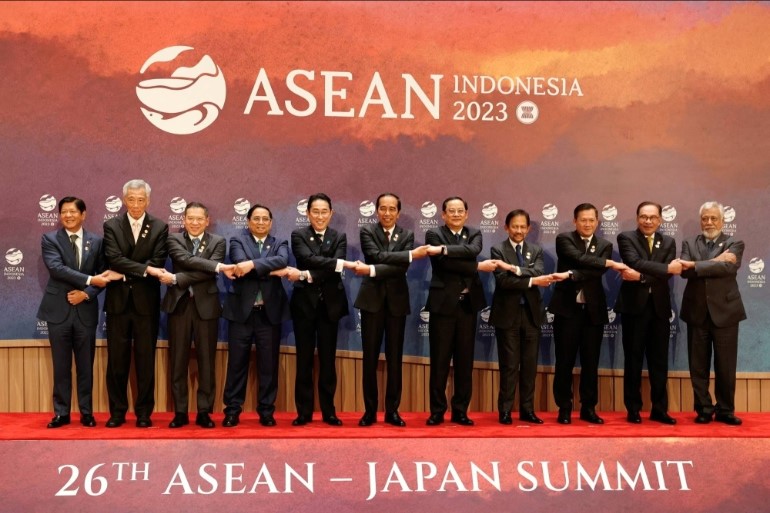
Defense News - Leaders from Southeast Asia and Japan reached a consensus on Sunday to enhance collaboration in maritime security in response to the escalating assertiveness of Beijing, notably demonstrated in recent confrontations with Philippine vessels. Beijing expansive claims over the South China Sea, a crucial trade route, and its increasing use of vessels to enforce these claims have raised concerns among regional nations and Washington.
While not explicitly naming China, Japan and the Association of Southeast Asian Nations (ASEAN) affirmed their commitment to "strengthen dialogue and cooperation for the maintenance of maritime security and safety, maritime order based on the rule of law," according to a joint statement released after a summit in Tokyo.
As a staunch ally of the United States, Japan, which faces its own territorial disputes with China, has been bolstering defense spending and expanding security partnerships across the Asia-Pacific region. On Saturday, Japan announced plans to deepen ties with Malaysia and allocate 400 million yen ($2.8 million) for "warning and surveillance" equipment.
In the preceding month, Japan committed to assisting the Philippines in procuring coastguard vessels and supplying a radar system. Discussions are underway to permit troop deployments on each other soil. Last week, Japan expressed "serious concern" over "dangerous actions" following a tense encounter between Philippine and Chinese vessels at contested reefs, involving a collision and the use of water cannons by Chinese ships.
Philippine President Ferdinand Marcos, in an interview with Japan NHK broadcaster on Saturday, noted that the situation in the South China Sea has become increasingly complex. Japanese Prime Minister Fumio Kishida remarked on Sunday, "We are at a turning point in history, and the free and open international order based on the rule of law is facing serious challenges."
Kishida emphasized Japan commitment to addressing global crises alongside ASEAN countries, referring to them as linchpins of the free and open Indo-Pacific—a term used by the US and its allies.
In addition to maritime security, Japan and ASEAN leaders agreed to enhance supply chain resilience and deepen cooperation on climate change across various sectors, including energy, critical minerals, space, artificial intelligence, and cybersecurity.
During a dinner he hosted on Saturday, Kishida announced the launch of an initiative for the "next generation automotive industry," aiming to maintain ASEAN position as the world leading hub for automotive production and export.
Notably absent from the ASEAN summit, which marked 50 years of ties with Japan, was Myanmar. The country has been excluded from high-level meetings since the military coup in 2021. President Marcos stressed the need for proactive engagement to address the worsening violence and the plight of the people of Myanmar.
——— End of Article ———