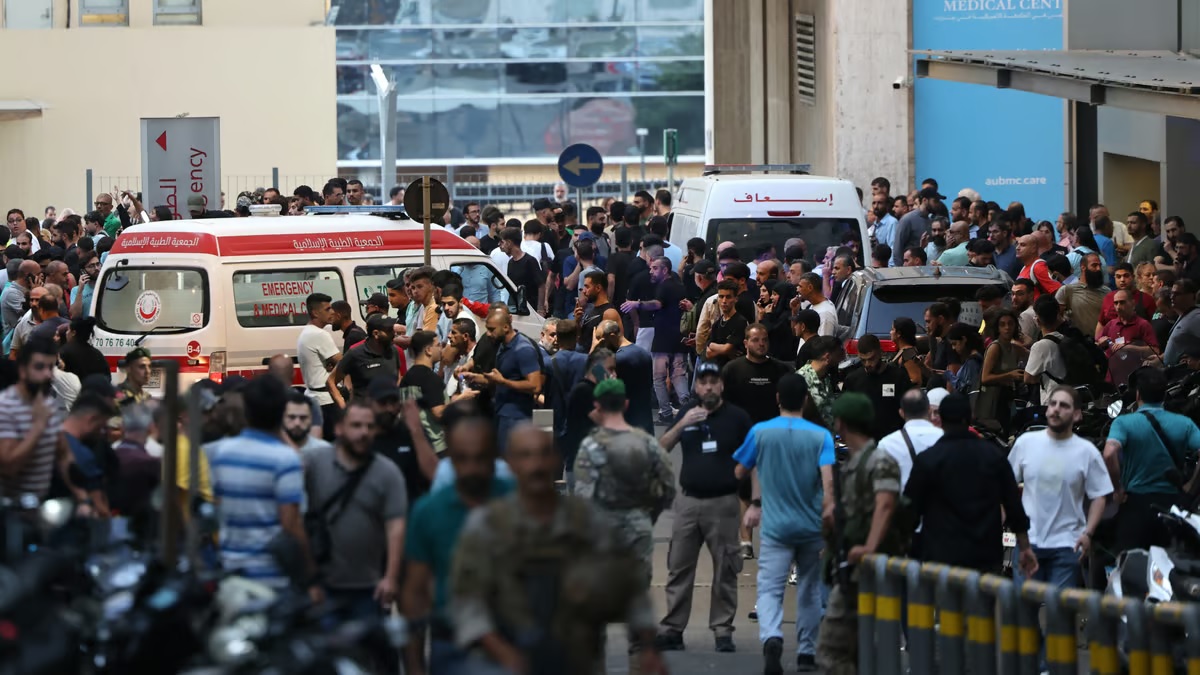
Tensions in the Middle East reached new heights as Hezbollah accused Israel of carrying out a covert, devastating attack on its members through the use of explosive-laden pagers. The devices, embedded with explosives allegedly modified by Israel’s Mossad, were triggered remotely, causing widespread casualties across Lebanon and Syria. According to initial reports, nine people were killed and over 3,000 were injured in the coordinated blasts. Both Hezbollah and the Lebanese government have condemned the attack, while the Israeli military has not officially commented on the incident.
The explosions come amid heightened tensions between Israel and Hezbollah, especially following the October escalation in Gaza. Since the start of the conflict between Israel and Hamas, Hezbollah—an Iran-backed militant group based in Lebanon—has been sporadically firing rockets and drones into Israel’s northern regions in a show of solidarity with the Palestinians. In response, Israel has launched airstrikes targeting Hezbollah positions, killing both commanders and fighters. These exchanges of fire, combined with the recent pager explosions, have raised fears that the conflict between Israel and Hezbollah could expand into a full-scale war.
Hezbollah's Retaliation: Drums of War Growing Louder
Hezbollah, which wields significant military power, has vowed to retaliate. The scale of this operation is seen as one of Hezbollah’s worst counterintelligence failures in decades. Intelligence experts, such as Jonathan Panikoff, have described the incident as a critical blow to the group, which prides itself on its strong spy networks.
Hezbollah has issued a stern warning to Israel, with its officials promising "fair punishment" for what they call an act of aggression. The group has lost both fighters and civilians in this attack, which has galvanized its leadership into action. Lebanese officials, too, have expressed outrage, with Information Minister Ziad Makary condemning the explosions. “This is not just a security breach,” declared a senior Hezbollah figure, Hussein Khalil, “this is an attack on an entire nation.”
This sentiment reverberates across Lebanon, as the country braces itself for potential further escalation. Many fear the pager attack might be a prelude to a broader, more intense conflict.
Israel-Hezbollah Conflict: Escalating Danger
The dynamics between Israel and Hezbollah are fraught with historical tension. Hezbollah, which has grown into a military force with capabilities that rival those of many national armies, poses a serious challenge to Israel’s northern borders. The group, with thousands of trained fighters and advanced weaponry, is a formidable foe. Its elite Radwan Unit, specialized in cross-border incursions, has garnered experience in battlefields such as Syria and poses a significant threat to Israeli security.
Despite Hezbollah’s public statements that it doesn’t seek full-scale war, it remains ready for confrontation if necessary. Experts warn that this conflict could be far different from past encounters. Unlike Gaza, southern Lebanon presents a terrain that is more challenging, with hills, valleys, and an underground infrastructure that makes it harder for Israeli forces to strike accurately. Additionally, Hezbollah's vast rocket and missile arsenal, which numbers over 150,000, far surpasses that of Hamas. On the first day of the October conflict, Hezbollah is estimated to have fired 4,300 rockets into Israel, and analysts expect that number to rise exponentially should war break out.
Israel, however, is preparing for the worst. Defense officials have been meeting frequently, with plans to expand their military efforts to counter Hezbollah. Although the conflict with Hamas has primarily focused on Gaza, Israel’s leadership has been clear that any escalation in the north could result in a wider operation.
The Threat of Regional War
Many fear that the recent pager attack could trigger a larger war. Hezbollah’s ties to Iran and its involvement in multiple regional conflicts make it a key player in the broader Middle Eastern political landscape. With its military strength and advanced technology, Hezbollah has positioned itself as a significant force capable of challenging Israeli defenses.
Israel has already begun widening its objectives to include neutralizing Hezbollah’s threat. In recent weeks, Israeli airstrikes have targeted Hezbollah commanders and fighters in Lebanon. Now, with the threat of open conflict looming larger than ever, Israel has announced that its focus has shifted to ensuring the safe return of northern residents who have fled the border areas due to ongoing hostilities.
In previous years, Israel and Hezbollah have engaged in short, intense conflicts, but a broader, more sustained war could result in devastating consequences for both sides. Analysts note that Hezbollah’s ability to strike deep into Israeli territory, combined with its underground infrastructure and hidden armaments in towns and villages, could lead to a prolonged conflict with high civilian casualties.
Despite efforts by international players, particularly the United States, to prevent such an escalation, the situation remains highly volatile. Some experts believe that neither side wants an all-out war at this moment, but as the pager explosions demonstrate, a single incident can rapidly spiral into wider violence.
Uncertainty Ahead: Can Israel Handle the Threat?
The big question now is whether Israel is prepared for the possibility of facing Hezbollah’s full force. While Israel’s air defense systems have proven capable of handling rocket barrages from Hamas, Hezbollah represents a much more substantial threat. The group’s missile capabilities are not only larger but also more sophisticated, and it remains to be seen whether Israel can effectively manage such an onslaught.
With tensions escalating and both sides locked in a dangerous standoff, the situation between Israel and Hezbollah could tip into a much larger conflict at any moment, putting the entire region on edge. The world will be watching closely, as the next steps taken by both Israel and Hezbollah could decide the future of peace or war in the Middle East.
——— End of Article ———