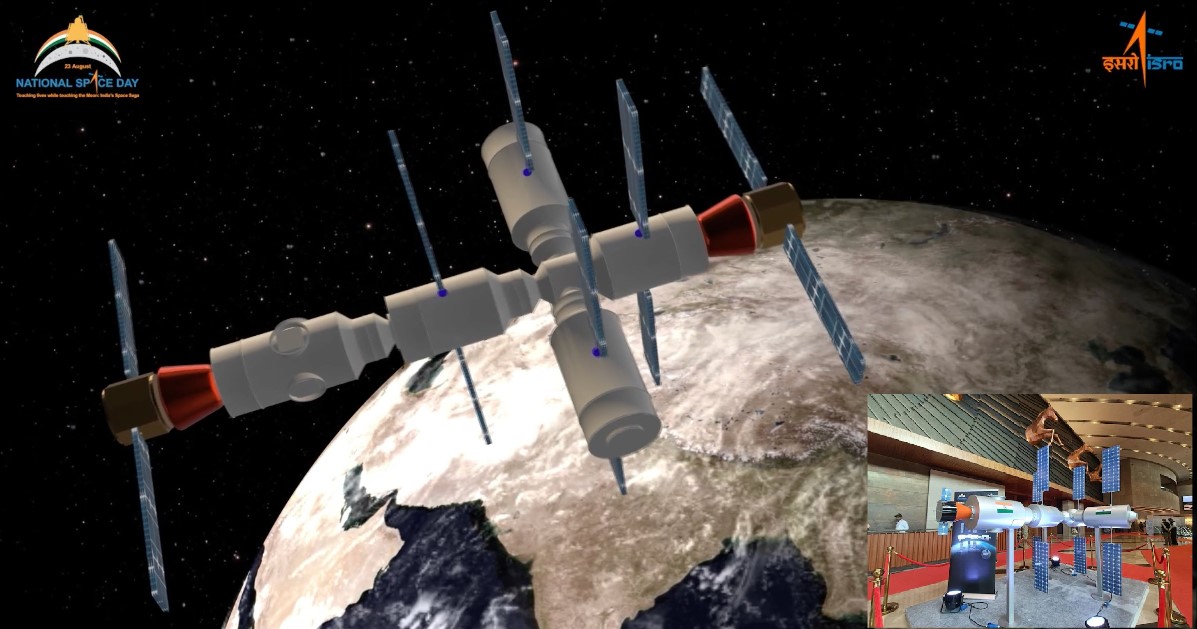
India is on the cusp of entering a new era in space exploration with the approval of its own space station, the Bharatiya Antariksh Station (BAS). In a major decision, the Union Cabinet, chaired by Prime Minister Narendra Modi, has greenlit the development of the BAS, marking a pivotal step for India's ambitions in space. The first module of BAS, known as BAS-1, is scheduled for launch by December 2028, significantly advancing India's capabilities for long-term space missions and microgravity research.
The Bharatiya Antariksh Station is set to be a key national space-based facility, allowing Indian scientists and researchers to conduct experiments in microgravity and explore technologies crucial for extended human space missions. This approval extends the Gaganyaan program, India’s flagship human spaceflight mission, which was originally conceived in 2018 with a focus on sending astronauts to low Earth orbit (LEO). With BAS now in the pipeline, the Gaganyaan program’s scope has been revised to include new missions aimed at developing and testing the technologies required to build and maintain a space station.
BAS is not just about human spaceflight but about laying the groundwork for India's long-term ambitions in space exploration. The project, led by ISRO with collaboration from national agencies, academia, and industry, will demonstrate India’s technological prowess in sustaining human missions in LEO for longer durations. To achieve this, eight missions will be undertaken as part of the Gaganyaan program by 2028, which will include both crewed and uncrewed flights, as well as precursor missions to validate the technologies for BAS.
ISRO’s ambitious timeline includes launching four Gaganyaan missions by 2026, focusing on building the necessary human spaceflight technology. These missions will be crucial stepping stones in ensuring India has the expertise required to build and operate the BAS. Following these, an additional four missions dedicated to BAS will be launched to demonstrate and validate the technologies for the space station.
By 2035, BAS is expected to be fully operational, making India one of the few nations to possess such a space infrastructure. The Bharatiya Antariksh Station will not only boost India’s space research capabilities but also open new avenues for scientific innovation and technological advancements in fields like materials science, biology, and astrophysics, which are uniquely impacted by the conditions of microgravity. Furthermore, BAS could become a hub for international collaborations, allowing scientists from around the world to conduct research in India's state-of-the-art facility.
The project will also have significant economic implications. The government has allocated an additional ₹11,170 crore to the Gaganyaan program, bringing its total funding to ₹20,193 crore. This increase underscores the importance of the project, not only for India’s space exploration goals but also for the country's broader technological and economic landscape. The development of BAS will stimulate growth in high-tech industries, generate employment, and foster innovation in fields such as robotics, automation, and materials technology.
The BAS project aligns with India's broader vision for space exploration in the “Amrit Kaal,” a term referring to India’s golden era leading up to 2047, marking 100 years of independence. As part of this vision, India aims to conduct a crewed lunar mission by 2040, further demonstrating its capabilities in space exploration. With nations around the world, including the United States, Russia, and China, making significant investments in space infrastructure, India’s BAS will position the country as a significant player in human space exploration.
For India's youth, the BAS project offers an exciting opportunity to engage in cutting-edge science and technology fields. The program is expected to inspire a new generation of scientists, engineers, and space professionals, providing a platform for careers in space research and technology development. The innovations and breakthroughs achieved through the BAS will not only benefit the space sector but will also have far-reaching applications in other industries.
In conclusion, the Bharatiya Antariksh Station represents a bold step forward for India's space program. With the launch of its first module in 2028, BAS will serve as a symbol of India's growing prowess in space exploration and technological innovation. As India prepares for this new frontier, the station promises to bring scientific, economic, and social benefits, reinforcing India’s place in the global space community.
——— End of Article ———