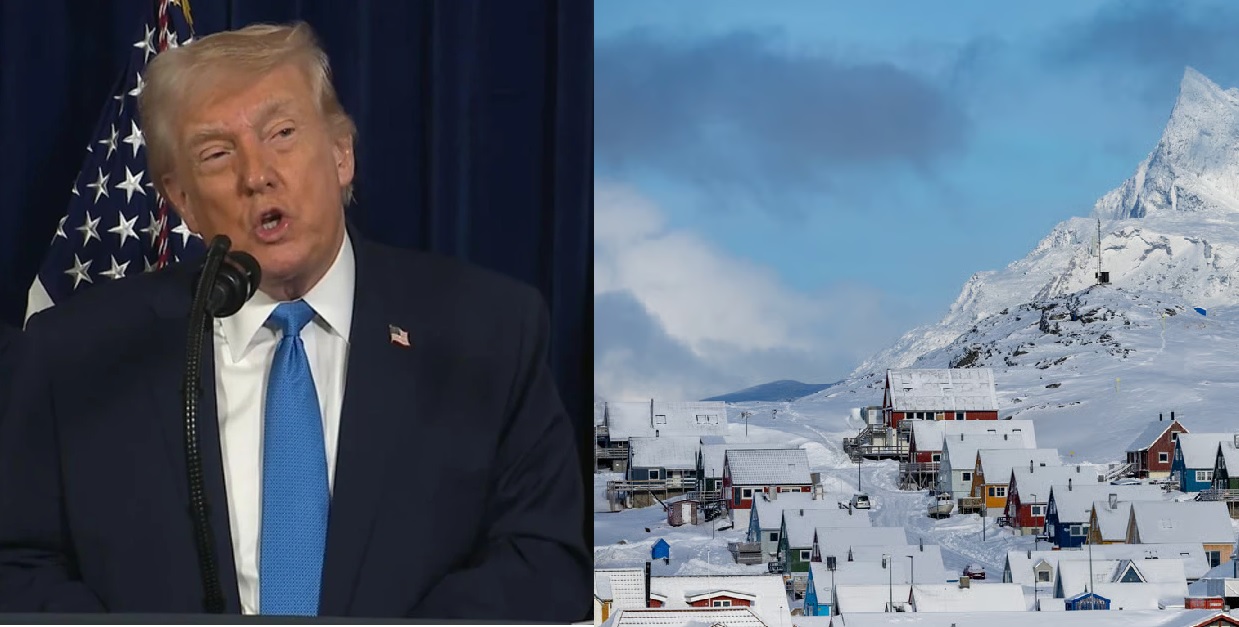
Washington : President Donald Trump has reignited one of the most controversial foreign policy debates of his presidency, openly arguing that the United States should acquire Greenland and confirming through the White House that no option has been ruled out — including the use of force. The renewed push has triggered sharp reactions in Denmark and Greenland, raised alarms within NATO, and drawn scrutiny from U.S. lawmakers.
According to Reuters, the Trump administration is now actively discussing financial incentives aimed directly at Greenland’s population as part of a broader effort to persuade the semi-autonomous territory to break away from Denmark and align with Washington. Sources cited by the agency say U.S. officials have debated offering one-time lump-sum payments ranging from $10,000 to $100,000 per resident, a proposal that would collectively cost the U.S. government an estimated $5–6 billion, based on Greenland’s population of approximately 57,000 people.
A Strategic Argument Framed as National Security
Trump has repeatedly described Greenland as vital to U.S. national security, citing its strategic location in the Arctic and growing geopolitical competition in the region. Speaking aboard Air Force One over the weekend, the president claimed the island was “covered with Russian and Chinese ships all over the place,” arguing that Denmark lacks the capacity to defend it adequately.
“We need Greenland from the standpoint of national security, and Denmark is not going to be able to do it,” Trump said, reiterating a view he has expressed multiple times since first floating the idea during his earlier term.
White House Press Secretary Karoline Leavitt confirmed Wednesday that the idea of acquiring Greenland is being “actively discussed by the president and his national security team.” When asked whether military force could be ruled out, Leavitt declined to do so, stating that “all options” remain under consideration.
She also noted that the concept is not unprecedented. “The acquisition of Greenland by the United States is not a new idea. This is something that presidents dating back to the 1800s have said is advantageous for America’s national security,” Leavitt said.
Payments, Precedents, and Political Momentum
Sources told Reuters that while the notion of compensating Greenlanders directly has circulated for years, discussions have taken on new urgency in recent weeks. The administration reportedly believes there is political momentum following a recent high-profile U.S. operation that led to the arrest of Venezuela’s leader Nicolás Maduro, an action that has already drawn fierce debate in Washington.
Trump allies have framed the Greenland proposal as a “business transaction,” arguing that the cost would be modest when compared with long-term strategic gains, including access to Arctic shipping routes, rare earth minerals, and expanded U.S. military reach. Greenland is known to possess significant untapped natural resources, which are becoming increasingly valuable as climate change opens new areas of the Arctic.
Despite these arguments, officials caution that the plan remains at a preliminary stage. Even at the higher end of proposed payments, the initiative would face formidable legal, diplomatic, and political obstacles.
Denmark, Greenland Push Back
Greenland is a self-governing territory within the Kingdom of Denmark, and both Copenhagen and Nuuk have consistently rejected the idea of any sale or transfer of sovereignty. Polls indicate that a majority of Greenlanders oppose becoming part of the United States.
Greenland’s Prime Minister Jens-Frederik Nielsen responded angrily after Trump once again raised the prospect of acquisition. “Enough is enough … no more fantasies about annexation,” Nielsen wrote in a Facebook post, underscoring that Greenland’s future can only be decided by its own people.
In a separate statement, Greenland’s government emphasized that “Greenland belongs to its people. It is for Denmark and Greenland, and them only, to decide on matters concerning Denmark and Greenland.”
Diplomatic and NATO Implications
U.S. Secretary of State Marco Rubio has announced plans to meet Danish officials next week to discuss Greenland, signaling that diplomatic channels remain active even as rhetoric escalates. Any attempt at forced annexation would pose a profound challenge to NATO, given Denmark’s membership in the alliance and Greenland’s existing defense agreements with the United States.
Analysts warn that such a move could fracture alliance unity at a time when Arctic security is already strained by increased Russian and Chinese activity.
Domestic Backlash in the United States
Within the U.S., Democrats have sharply criticized the administration’s approach, accusing Trump of recklessness and of bypassing Congress on matters that could lead to armed conflict. Lawmakers argue that any attempt to use force or authorize massive expenditures would require explicit congressional approval.
For now, the Greenland proposal remains an extraordinary idea at an early stage — one that blends strategic calculation, political provocation, and unprecedented financial inducements. Whether it evolves into a formal diplomatic initiative or remains a contentious talking point may depend as much on reactions in Nuuk and Copenhagen as on debates in Washington.
——— End of Article ———