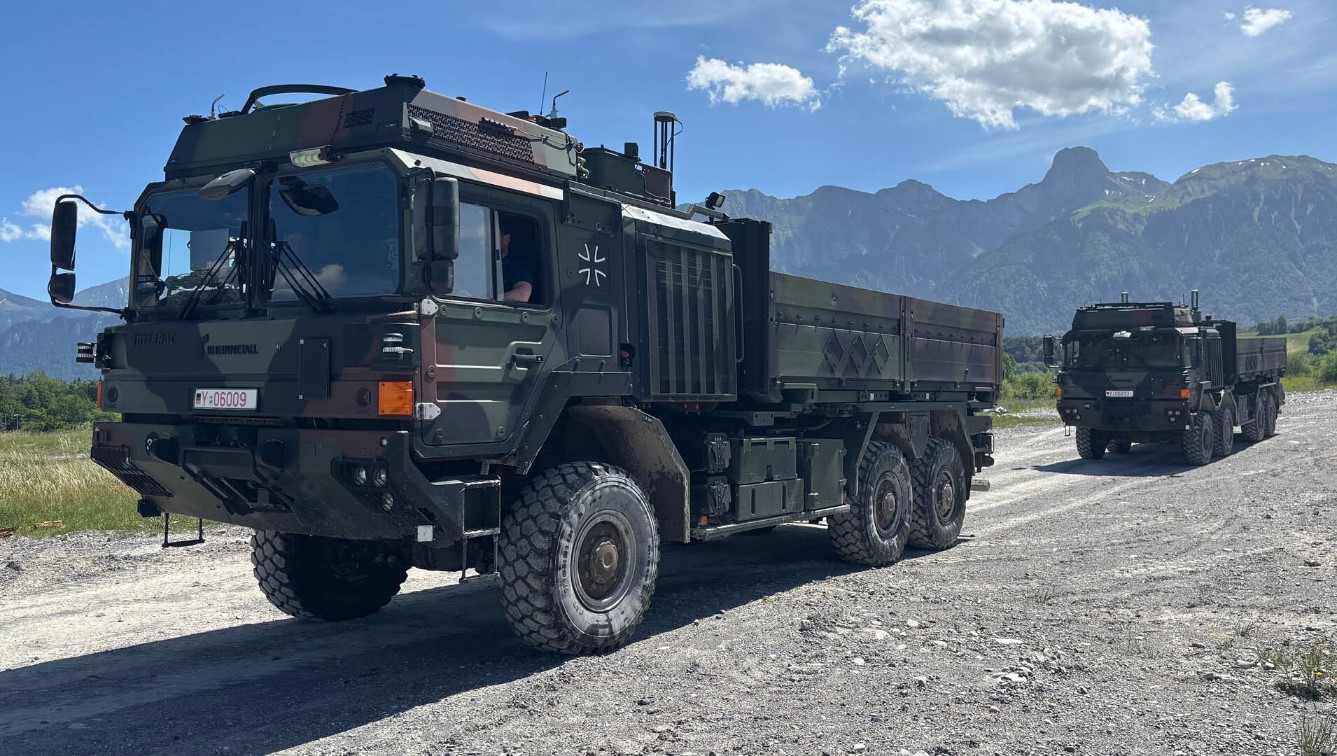
BERLIN — Rheinmetall MAN Military Vehicles GmbH (RMMV) has assumed full responsibility for the InterRoC VII (Interoperable Robotic Convoy VII) research project on behalf of Germany's Federal Office of Bundeswehr Equipment, Information Technology and In-Service Support (BAAINBw).
InterRoC VII is the latest phase of the long-running InterRoC research program, which focuses on developing highly automated convoy technologies for military logistics. The project builds on earlier InterRoC demonstrations that used HX2 military trucks to test autonomous leader-follower convoy operations, where multiple vehicles travel together with minimal human intervention.
Focus on Autonomous Military Logistics
The primary objective of InterRoC VII is to further develop highly automated convoy control systems capable of supporting military logistics in demanding operational environments. The project is also designed to test interoperable vehicle formations, allowing different types of military vehicles to operate together safely and autonomously.
Key areas of development include:
- Efficient automation technologies
- Advanced perception and decision-making functions
- Robust route planning for mixed (heterogeneous) vehicle formations
The technologies are intended to improve the reliability and safety of military logistics operations, particularly in off-road environments and areas where communications are limited or disrupted.
A major focus of the project is enabling autonomous convoy operations in GNSS-denied environments, where satellite navigation systems such as GPS are unavailable or intentionally jammed. This capability is considered important for military operations in environments affected by electronic warfare or navigation interference.
HX Military Trucks Equipped With Autonomous Technology
For the InterRoC VII project, RMMV is using vehicles from its established HX family of military logistics trucks. The vehicles are equipped with Rheinmetall's modular PATH sensor kit and a fully integrated drive-by-wire system, allowing software to control steering, braking, and acceleration through the vehicle's existing architecture.
The PATH autonomy system is designed with an open system architecture, enabling the integration of additional sensors, artificial intelligence-based software, and mission-specific algorithms as the technology evolves. This modular approach provides a scalable platform that can be adapted for future military requirements.
Driveblocks Supports AI and Environmental Perception
As part of the project, Driveblocks GmbH is contributing software and artificial intelligence technologies focused on environmental perception and object classification.
Its system combines camera and LiDAR sensor data with AI models to detect and understand complex three-dimensional environments. The technology is designed to operate in challenging conditions, including unstructured terrain, dense vegetation, dust, snow, and varying visibility, helping autonomous vehicles make reliable navigation decisions in difficult operational settings.
Lessons From ELROB 2026 Integrated Into Project
RMMV assumed responsibility for InterRoC VII shortly before achieving a top placement in the "Convoy Scenarios" category at the European Land Robot Trial (ELROB) 2026, held at the Thun military training area in Switzerland.
ELROB is one of Europe's leading field trials for testing unmanned ground systems and autonomous military technologies under realistic operating conditions. According to Rheinmetall, capabilities demonstrated during the competition are being directly incorporated into the ongoing development of the InterRoC VII program.
Building on Earlier InterRoC Research
The InterRoC research series began around four years ago to explore technologies and operational requirements for future autonomous military logistics vehicles. Earlier project phases equipped HX trucks with autonomy kits to evaluate automated convoy operations in realistic conditions.
Previous demonstrations included joint testing in Germany and the United States, where researchers validated leader-follower convoy concepts using autonomous logistics vehicles.
With InterRoC VII, the research program continues to expand its focus on improving military supply chains through automation while reducing risks to personnel during logistics missions in demanding operational environments.
The project also supports broader Bundeswehr efforts to modernize and digitize military mobility through the integration of autonomous technologies. Rheinmetall and BAAINBw have not disclosed financial details or a timeline for completion of the current research phase.
Sources: Rheinmetall
——— End of Article ———