WASHINGTON — The U.S. Senate Armed Services Committee has advanced a proposal to provide $40 million for the U.S. Marine Corps to integrate and test General Atomics' Bullseye cruise missile as part of the Fiscal Year 2027 National Defense Authorization Act (NDAA).
The proposed funding is allocated for the Marine Corps' technology demonstration and prototyping efforts. The initiative is intended to evaluate the missile's operational capabilities while supporting the Pentagon's broader effort to field affordable, mass-produced long-range precision weapons for future military operations, particularly in the Indo-Pacific region.
The proposal must still pass the remaining stages of the congressional legislative process before becoming law. If approved in the final NDAA, the funding would enable the Marine Corps to conduct integration and demonstration activities to determine how the Bullseye missile could support future operational requirements.
Bullseye Cruise Missile Designed for Long-Range Precision Strike
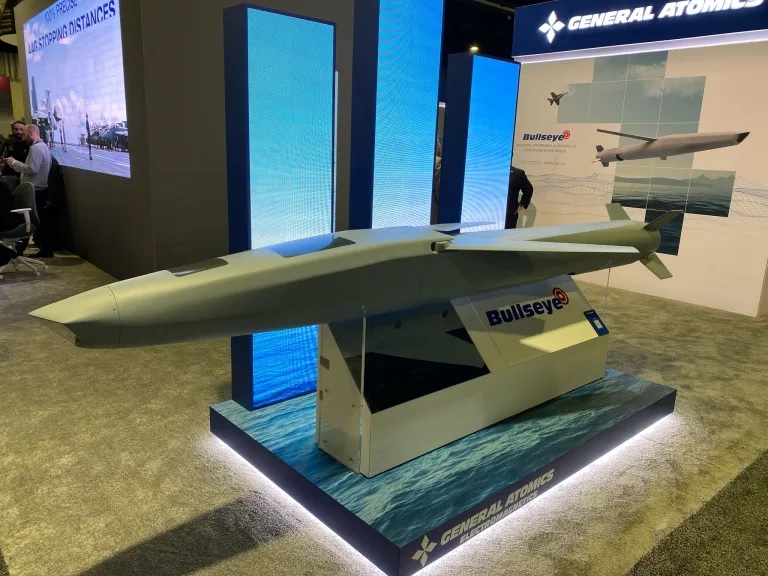
The Bullseye cruise missile was publicly introduced by General Atomics during the Sea Air Space 2025 exhibition. The missile is derived from Rafael Advanced Defense Systems' Ice Breaker cruise missile and is planned for domestic production at General Atomics' manufacturing facility in Tupelo, Mississippi.
The company says domestic production will strengthen U.S. supply chains while supporting faster manufacturing and sustained production capacity for future defense requirements.
Bullseye weighs less than 1,000 pounds, measures approximately 13 feet (4 meters) in length, and is designed to engage both ground and maritime targets at ranges exceeding 300 kilometers (186 miles).
The missile follows a high-subsonic, sea-skimming, and terrain-following flight profile to improve survivability in contested environments. It is equipped with an imaging infrared (IIR) seeker and is designed to continue operating in GPS-denied environments using terrain contour matching and scene-matching navigation. It also includes a man-in-the-loop capability that allows operators to abort or retarget a mission after launch when required.
Focused on Marine Corps Operations in the Indo-Pacific
The proposed funding aligns with the Marine Corps' effort to strengthen the capabilities of its Marine Littoral Regiments, which are designed to operate in contested maritime environments across the Western Pacific.
The 12th Marine Littoral Regiment, based in Japan, has already begun fielding the Navy-Marine Expeditionary Ship Interdiction System (NMESIS) equipped with the Naval Strike Missile. Meanwhile, the 3rd Marine Littoral Regiment, based in the Philippines, has demonstrated similar long-range strike capabilities during military exercises.
According to General Atomics, Bullseye is intended to provide an additional long-range precision strike option for these forward-deployed forces, supporting operations in areas where anti-access and area denial (A2/AD) systems present operational challenges.
Company promotional material has also highlighted the missile's potential role in addressing current and future security challenges in the South China Sea, including scenarios involving People's Liberation Army facilities on artificial islands.
Multiple Launch Options
One of the key features of the Bullseye program is its ability to operate from a variety of launch platforms, providing flexibility across different military services.
The missile is designed for:
- Air launch from fighter aircraft, including the F/A-18 Hornet.
- Ground launch, with integration work currently underway for the M142 High Mobility Artillery Rocket System (HIMARS) and the M270 Multiple Launch Rocket System (MLRS).
- Sea launch through a containerized system known as "Bullseye in a Box," which carries four missiles inside a standard shipping container.
Earlier this year, General Atomics also presented concepts for deploying these containerized launch systems aboard amphibious assault ships. The approach supports ongoing U.S. Navy efforts to increase fleet firepower through modular, containerized weapon systems, providing additional flexibility for future naval operations.
Supporting Pentagon Efforts to Expand Precision Weapon Stocks
The Bullseye program is part of the Pentagon's broader effort to increase inventories of cost-effective, mass-producible precision-guided weapons while strengthening domestic manufacturing capacity.
General Atomics has emphasized that the missile is designed for scalable production within the United States, supporting government efforts to improve supply chain resilience and maintain adequate inventories of long-range strike weapons.
If the proposed funding is approved by Congress, the Marine Corps will begin integration and demonstration activities to assess Bullseye's suitability for future operations, particularly in support of expeditionary forces operating across the Indo-Pacific region.
——— End of Article ———