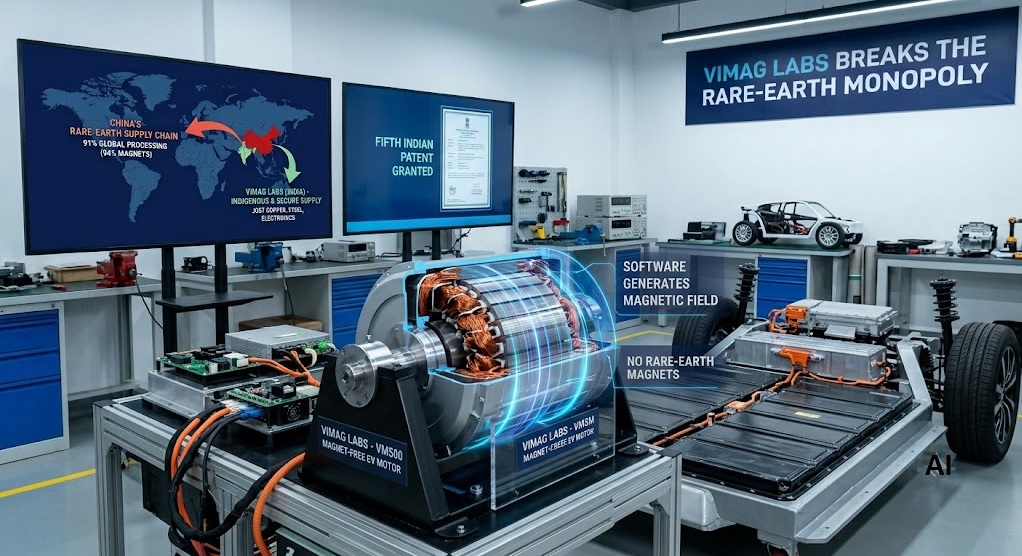
BENGALURU — Bengaluru-based deep-tech startup Vimag Labs has secured its fifth Indian patent for a new electric motor technology that operates without using rare-earth permanent magnets, marking a significant development for India's electric vehicle (EV) industry. The patented technology could help reduce the global automotive sector's dependence on China's dominant rare-earth magnet supply chain.
The newly granted patent, titled "A Robust Rotating Transformer Excited Synchronous Motor and Its Control," protects the core architecture of Vimag Labs' Virtual Magnet Synchronous Motor (VMSM) platform. The company says the technology replaces conventional permanent magnets with a software-controlled electromagnetic system while maintaining performance comparable to existing EV motors.
Rare-Earth Dependence in the EV Industry
Most modern electric vehicles (EVs) use Permanent Magnet Synchronous Motors (PMSMs) because of their high efficiency, compact size, and strong performance. These motors rely on powerful rare-earth permanent magnets, primarily made from materials such as neodymium, which are embedded inside the rotor to generate torque.
However, the global supply chain for these magnets remains heavily concentrated in China.
According to the International Energy Agency (IEA), China accounts for approximately 91% of global rare-earth refining and processing and produces around 94% of the world's sintered permanent magnets. This concentration has made the global EV industry vulnerable to export restrictions, geopolitical tensions, and supply disruptions, resulting in higher prices and uncertainty for vehicle manufacturers.
For Vimag Labs co-founder and CEO Manish Seth, the idea for developing a rare-earth-free motor emerged during the COVID-19 pandemic in 2020, when a shipment of magnets required for prototype motors remained delayed at Shanghai Port for nearly three months because of lockdown restrictions.
How the Virtual Magnet Synchronous Motor Works
Unlike traditional PMSMs, the VMSM eliminates physical permanent magnets altogether.
Instead, the motor is built using standard copper, steel, and advanced electronics. The magnetic field required for operation is generated dynamically through specially designed copper coils controlled by proprietary software and power electronics.
A key feature of the technology is its Rotating Transformer Excitation system, which transfers power wirelessly inside the motor without using brushes or slip rings. This brushless design improves reliability while reducing maintenance requirements.
The company's control software continuously regulates the magnetic field in real time, effectively creating what Vimag describes as a "software-defined magnet."
Because the magnetic field is generated and adjusted through software, the motor can optimize performance for different operating conditions. The company says the software architecture also enables over-the-air (OTA) updates, allowing improvements to motor performance without changing the hardware.
Vimag Labs reports that its 6 kW continuous power prototype is capable of delivering 10 kW peak power with 48–58 Nm of torque, while targeting efficiency and performance comparable to conventional permanent magnet motors.
Years of Engineering Behind the Technology
According to the company, the patented technology represents more than 87,600 engineering hours of development.
Founded in September 2025, Vimag Labs now holds five granted Indian patents, with 10 additional patent applications and 15 trademarks currently in progress.
The startup has moved beyond laboratory development and is currently conducting pilot projects with established two-wheeler and passenger vehicle manufacturers. The company is also expanding the platform for light commercial vehicles, heavy commercial vehicles, and industrial systems ranging from 200 kW to 600 kW.
Beyond electric mobility, Vimag is exploring applications in robotics, advanced cooling infrastructure, and defense systems.
Funding and Commercial Expansion
To support commercial production, Vimag Labs recently raised $5 million in a Series A funding round led by Accel, with participation from Chakra Growth Fund and Thinkuvate.
The company has also signed a Manufacturing Memorandum of Understanding (MoU) with Jendamark Pvt. Ltd. to scale production of the VMSM platform.
Looking ahead, Vimag plans to develop its own Application-Specific Integrated Circuit (ASIC). By integrating the drivetrain control system into a single proprietary chip, the company aims to reduce dependence on external semiconductor suppliers while lowering the electronics bill of materials (BOM) cost by nearly 90%.
The company also aims to ship between 1,000 and 10,000 motor units by the end of the year.
Potential Impact on China's Rare-Earth Dominance
Vimag Labs' technology does not eliminate China's leadership in the rare-earth industry, but it has the potential to reduce dependence on rare-earth permanent magnets if adopted at commercial scale.
Today, nearly every permanent magnet EV motor manufactured worldwide relies on rare-earth materials processed in China. If automakers begin adopting magnet-free technologies such as VMSM, demand for rare-earth permanent magnets in the EV sector could gradually decline.
The impact, however, will depend on several factors, including:
- Successful large-scale commercial production.
- Proven long-term reliability and efficiency in real-world vehicles.
- Adoption by major global automotive manufacturers.
- Cost competitiveness compared with existing permanent magnet motors.
In the near term, China's position in rare-earth refining and permanent magnet manufacturing is unlikely to change significantly because the country continues to dominate global processing capacity and magnet production. However, wider adoption of alternative motor technologies by multiple manufacturers could gradually reduce China's leverage over one of the EV industry's most critical supply chains.
Supporting India's Self-Reliance Goals
By removing the need for imported rare-earth permanent magnets and relying on commonly available materials such as copper and steel, Vimag Labs' technology supports India's "Make in India" and "Atmanirbhar Bharat" (Self-Reliant India) initiatives.
If successfully commercialized, the VMSM platform could help domestic manufacturers reduce supply chain risks, improve cost stability, and strengthen India's capabilities in electric mobility and advanced motor technologies while providing automakers with an alternative to one of the industry's most concentrated global supply chains.
——— End of Article ———