WASHINGTON, D.C. — The U.S. Navy has awarded a $2.2 billion contract to Florida-based TOTE Services LLC to manage the construction of its new Medium Landing Ship (LSM) program, marking the first time the Navy has adopted a Vessel Construction Manager (VCM) model for a major shipbuilding program.
Announced on July 13, 2026, the contract could reach $2.6 billion if all contract options are exercised for the initial batch of up to eight ships.
Under the VCM approach, TOTE Services will serve as the prime contractor and report directly to the Navy's Portfolio Acquisition Executive for Maritime. Rather than the Navy managing individual shipyards and suppliers, TOTE will oversee the construction process, coordinate subcontractors, and manage suppliers across multiple U.S. shipyards using commercial shipbuilding practices.
According to the U.S. Navy, the new acquisition model is intended to improve cost control, construction schedules, and overall program performance while reducing government oversight.
"We are changing the way we do business, and leveraging commercial best practices to improve cost, schedule, and performance," said Will Mahan, performing the duties of Assistant Secretary of the Navy for Research, Development, and Acquisition. He added that adopting the commercial contracting model reduced traditional contracting timelines by nearly 50 percent.
Construction to Be Shared Across Multiple Shipyards
For the first phase of the program, the U.S. Navy has already designated two shipyards to begin construction.
Bollinger Shipyards on the U.S. Gulf Coast will build the lead Medium Landing Ship, while Fincantieri Marinette Marine in Wisconsin will construct the next four vessels. TOTE Services will determine the subcontracting strategy for the remaining three ships included in the initial eight-vessel package.
The Navy said distributing construction across multiple shipyards is part of a broader effort to strengthen the U.S. shipbuilding industrial base, which has faced workforce shortages and limited production capacity as the service seeks to expand its fleet.
During the procurement process, Crowley Government Services filed a protest, arguing that the Navy's decision to pre-select shipyards reduced the prime contractor's negotiating flexibility and increased commercial risk under the VCM model. The protest was ultimately unsuccessful.
Medium Landing Ship Designed for Marine Corps Operations
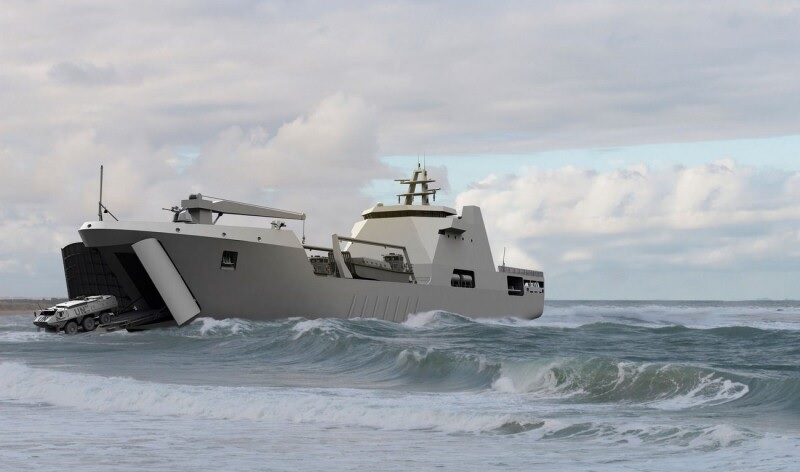
The Medium Landing Ship (LSM) is based on the Dutch-designed Damen LST-100 hull, a design already in service with the Nigerian Navy and also selected by Australia.
Each vessel will measure approximately 300 to 350 feet in length and displace between 4,000 and 6,000 tons. The ships are designed to carry around 250 Marines and have an operational range of approximately 4,000 nautical miles (7,408 kilometers).
Unlike large amphibious assault ships, the LSM has a relatively simple design and does not include the advanced defensive systems found on major surface combatants. Instead, it is intended to provide a cost-effective platform for transporting Marines, vehicles, equipment, and supplies between islands and coastal areas.
The vessels are expected to fill the operational gap between small landing craft and large amphibious warships.
Supporting the Marine Corps' Pacific Strategy
The Medium Landing Ship is a key element of the U.S. Marine Corps' Expeditionary Advanced Base Operations (EABO) concept.
Under this strategy, smaller Marine units are expected to move quickly between islands, establish temporary positions equipped with anti-ship missiles and other capabilities, and relocate before becoming vulnerable to enemy targeting.
The concept relies on a larger number of smaller, mobile vessels instead of concentrating forces aboard a limited number of large amphibious ships.
Congress Directed Use of the VCM Model
The shift to the Vessel Construction Manager (VCM) model was directed by Congress through the Fiscal Year 2026 National Defense Authorization Act, which required the Navy to adopt the approach in an effort to stabilize the Medium Landing Ship program.
The decision followed earlier procurement challenges. In 2024, the Navy canceled a previous request for proposals (RFP) after determining that submitted bids were significantly higher than expected.
TOTE Services Brings Previous Government Shipbuilding Experience
TOTE Services previously introduced the Vessel Construction Manager (VCM) model during the National Security Multi-Mission Vessel (NSMV) program for the U.S. Maritime Administration.
The NSMV program includes five training ships for U.S. maritime academies. Three vessels have already been delivered, while the remaining two are expected within the next 12 months. According to previously released program information, the commercial management approach helped achieve construction costs significantly below initial government estimates.
"This is a tremendous responsibility and a defining moment for American shipbuilding, the VCM model, and TOTE Services," said Jeff Dixon, President of TOTE Services. "The U.S. is counting on this program to succeed, and our job is clear: steward the work responsibly, cultivate the best talent and expertise, move with urgency, and deliver for the American people."
Matthew Paxton, President of the Shipbuilders Council of America, said TOTE's previous work demonstrated that combining government requirements with commercial shipbuilding practices can strengthen American shipyards and support the maritime workforce.
Construction Expected to Begin This Year
Christopher Miller, the Navy's Portfolio Acquisition Executive for Maritime, said the service is ready to move into the construction phase.
"TOTE Services will be an important partner, and we're excited to work with them to continue the momentum on this program and begin bending steel," Miller said.
Initial construction is expected to begin later in 2026, with the first Medium Landing Ship scheduled for delivery in the fall of 2029.
The U.S. Marine Corps ultimately plans to acquire a fleet of 35 Medium Landing Ships. However, future production beyond the initial eight vessels will depend on the successful execution, cost performance, and funding of the first phase.
The contract represents a significant change in the U.S. Navy's ship acquisition process by introducing commercial program management practices into a major military shipbuilding effort while supporting expansion of the U.S. shipbuilding industrial base and advancing the U.S. Marine Corps' future operational requirements.
Source : news.usni
——— End of Article ———