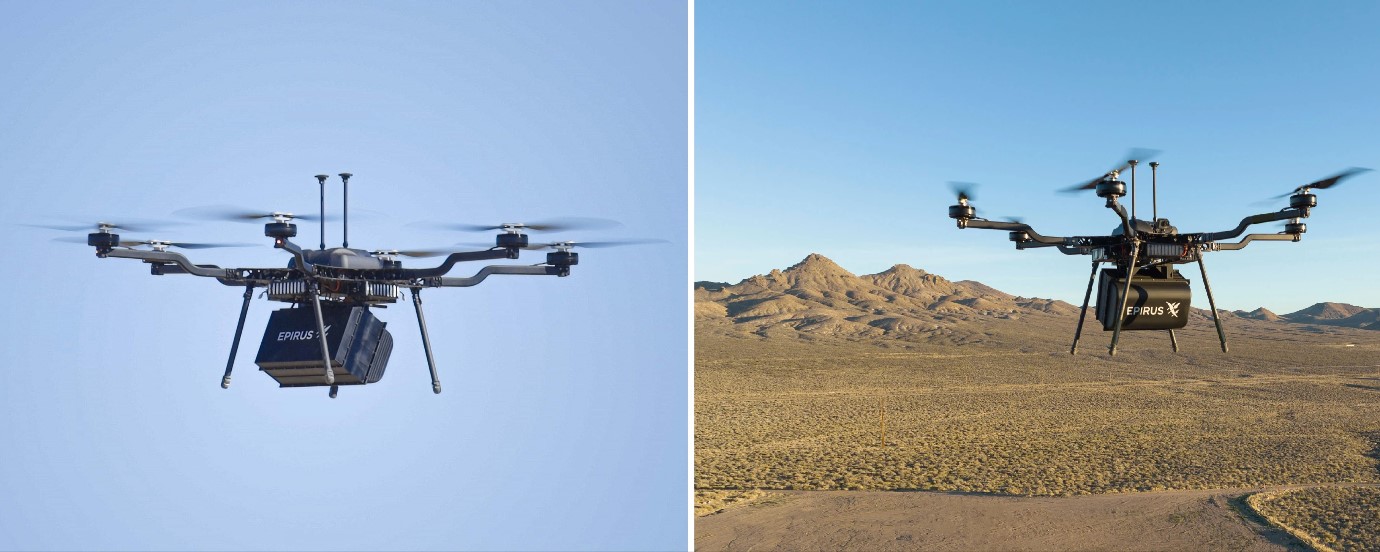
The American defence-technology company Epirus is pushing its Leonidas High-Power Microwave (HPM) Pod as a new answer to one of the hardest problems on today’s battlefields: cheap, highly manoeuvrable fiber-optic–controlled drones that shrug off traditional radio-frequency jamming. Mounted on drones, vehicles or potentially helicopters, the compact pod is designed to fry the electronics of hostile unmanned aircraft in mid-air, regardless of how they are controlled.
A Backpack-Sized Directed-Energy Weapon
According to Epirus and publicly available product information, the Leonidas Pod is a solid-state, software-defined high-power microwave weapon that miniaturises the company’s ground-based Leonidas system into a remarkably small form factor. The pod weighs under 50 pounds and is roughly the size of a large backpack, light enough to be man-carried or slung under a heavy-lift drone.
Instead of older magnetron tubes, Leonidas uses gallium nitride (GaN) semiconductor amplifier modules to generate long-pulse microwave energy. This allows a more durable beam, lower power consumption and a system that can start up or shut down in minutes rather than hours.
Epirus positions the pod as a mobile, compact counter-electronics and electronic-attack system. The pod’s open architecture is designed to integrate with existing airborne mission systems and ground fire-control networks, turning any host platform—unmanned aircraft, armoured vehicle, or potentially a helicopter—into a directed-energy node in a larger air-defence web.
How Leonidas attacks drone swarms
The Leonidas family is built to counter drone swarms rather than single aircraft. Instead of firing a kinetic interceptor at one target, Leonidas emits a cone or beam of high-power microwave energy that induces currents and voltage spikes in exposed electronics. Circuit boards, flight controllers and data links are overloaded, causing drones to fall out of the sky or lose control.
In recent U.S. demonstrations, the ground-based Leonidas system achieved a 100% kill rate against 61 drones, including knocking down a 49-drone swarm with a single pulse of electromagnetic interference. Drones in multiple flight profiles crashed after losing their control systems, underscoring the “one-to-many” nature of the weapon.
Key performance features highlighted by Epirus and independent analyses include:
-
Near-instant effects: the microwaves propagate at the speed of light and disable electronics as soon as a target enters the field.
-
Multi-shot, no-reload operation: as a directed-energy system, Leonidas is not limited by a physical magazine; it can engage waves of drones without rearming.
-
High rate of fire without overheating: the solid-state design and power-management software allow rapid successive engagements.
-
Adjustable “lethality”: operators can tailor power and beam shape in software, from selective engagement of individual drones to wide-area pulses that blanket a sector.
While detailed range and power figures remain classified, Epirus says the latest generation offers more than double the range and lethality of early prototypes, and testing has shown the underlying Leonidas technology can also disable boat motors at tactically useful distances.
Countering fiber-optic–controlled and autonomous drones
Modern frontline conflicts have seen an explosion of FPV (first-person view) attack drones that use fiber-optic reels or highly resilient data links. These systems are notoriously hard to defeat with classic RF jamming, because the control signal does not travel through the air in the usual way—or, in the case of autonomous drones, there is no live radio link at all.
Leonidas attacks the problem at a different layer. As a high-power microwave weapon, it does not care whether the drone is radio-controlled, fiber-optic-guided, or pre-programmed. It couples energy directly into the airframe’s electronics and wiring, bypassing the question of how control commands are transmitted. That makes the same pod relevant against:
-
FPV kamikaze drones with fiber-optic spools, where jamming the link is ineffective.
-
Autonomous loitering munitions, which fly pre-set routes.
-
Standard RF-controlled quadcopters and fixed-wing drones, which may be hardened against jamming but not against massive electrical surges.
Because the effect is purely electromagnetic, Leonidas can theoretically also disrupt other battlefield electronics: improvised explosive device triggers, vehicle control systems, or the sensors on loitering munitions, depending on power level and geometry. Epirus and U.S. Navy testing with Leonidas derivatives have already demonstrated the ability to stop small boat engines, hinting at broader anti-surface applications.
Mounting on drones, vehicles and future rotorcraft
The Leonidas Pod was first unveiled in early 2022 as a UAS-borne HPM system. Mounted under a heavy-lift drone, it can fly directly toward a threat axis and project a moving “bubble” of microwave energy to screen advancing troops or convoy routes.
Epirus emphasises that the pod’s form factor and mounting hardware are designed for multiple platform types:
-
On unmanned aerial vehicles, it offers high-altitude or stand-off coverage against hostile drones approaching from any direction.
-
Integrated on armoured vehicles such as the Stryker (via the related Leonidas Mobile configuration), similar HPM arrays provide mobile short-range air defence as part of U.S. Army experiments.
-
With its low weight and open architecture, the same pod-class system is marketed as adaptable to manned aircraft and helicopters, giving rotary-wing platforms the ability to escort formations with an onboard anti-drone “microwave shield”.
In all cases, the pod can switch between standby and active modes, conserving its onboard battery while loitering and only drawing full power when a threat is detected. Extended battery life, according to the manufacturer, allows it to reach the threat, engage, and return to base without external power.
Specifications and technical architecture
Detailed classified parameters are not public, but open sources paint a picture of the Leonidas Pod as a highly modular HPM node:
-
Weight & size: under 50 lb, backpack-like enclosure; small enough to fit in the back of a commercial pickup or similar military vehicle.
-
Architecture: built around Line-Replaceable Amplifier Modules (LRAMs), allowing arrays to be scaled up or down and swapped in the field.
-
Technology base: solid-state GaN power amplifiers, long-pulse HPM waveforms, software-defined waveform control and AI-driven power management.
-
Coverage: narrow “pencil beam” for precision strikes or wider beam modes for area coverage; compatible with 360-degree mounting solutions on some host platforms.
-
Power management: rapid power-up/power-down in minutes, standby modes, and thermal management aimed at eliminating overheating during repeated engagements.
Epirus describes its HPM family as deliberately magazine-independent and cost-effective compared to firing expensive surface-to-air missiles at cheap drones. The idea is to reserve kinetic weapons for high-value targets while using HPM to clear out the mass of small UAVs that saturate air defences.
Part of a wider Leonidas ecosystem
The Leonidas Pod is only one member of a growing ecosystem of HPM systems that U.S. forces are now trialling:
-
Leonidas Mobile, integrated on platforms like the Stryker to provide mobile short-range air defence.
-
Leonidas ExDECS, a more compact expeditionary system geared toward the U.S. Marine Corps and other rapidly deployed forces.
-
Leonidas H2O, a marinised variant one-third the size of the original, tested in 2024 for disabling small boat engines and countering unmanned surface vessels.
-
Leonidas AR, a recent tracked, unmanned ground vehicle that carries a Leonidas HPM array on a General Dynamics TRX robotic chassis for autonomous counter-drone operations.
The U.S. Army has already committed tens of millions of dollars under its Indirect Fire Protection Capability – High-Power Microwave (IFPC-HPM) programme to field Leonidas prototypes, some of which have been deployed to CENTCOM for real-world evaluation.
A glimpse of future air defence
As fiber-optic-guided FPV drones, autonomous munitions and mass drone swarms become standard tools of modern warfare, systems like Leonidas Pod signal a shift away from one-missile-per-target air defence.
By collapsing multiple roles—counter-drone, counter-electronics and electronic attack—into a compact, software-defined pod that can ride on drones, armoured vehicles or eventually helicopters, Epirus is betting that high-power microwaves will become as common on the battlefield as radar and jammers are today.
How quickly the Leonidas Pod transitions from demonstration videos and selected U.S. deployments to wider operational use—and whether allied militaries adopt it—will be an important indicator of how seriously armed forces are taking the “unjammable” drone threat emerging from today’s conflicts.
——— End of Article ———