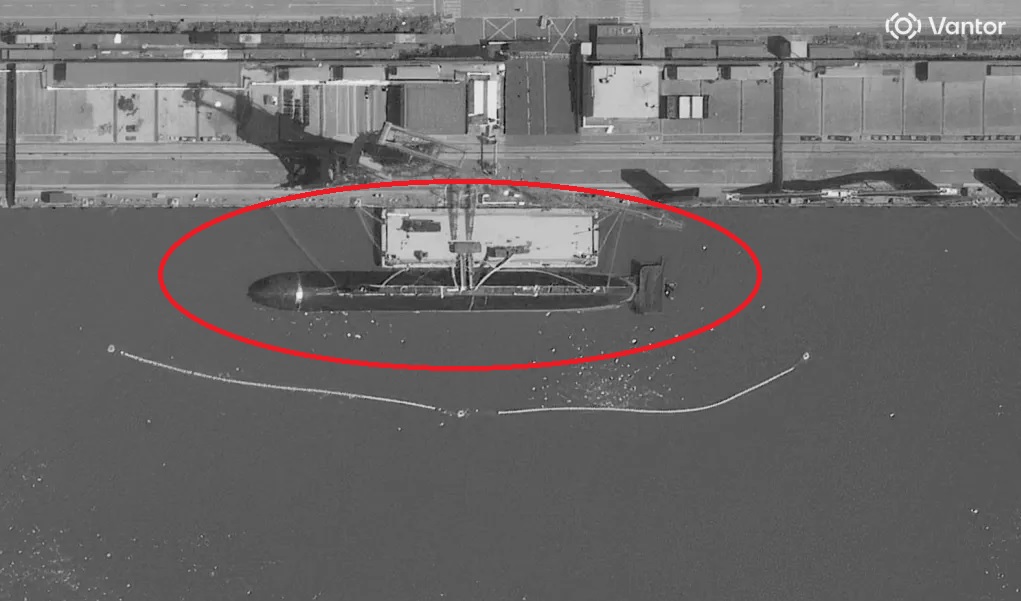
SHANGHAI, China — June 04, 2026 : Satellite imagery has revealed a previously undisclosed nuclear-powered submarine at Shanghai's Jiangnan Shipyard, unveiling what appears to be an entirely new class of Chinese submarine featuring a highly unconventional sail-less design. The discovery has attracted significant attention among defense analysts, who view the vessel as another indication of China's accelerating efforts to modernize and expand its underwater combat fleet.
Images captured on May 31 and June 1, 2026, show the submarine moored at a fitting-out basin alongside a jetty barge at the shipyard. Chinese authorities have not publicly announced the vessel, and no official designation or class name has been disclosed.
Historic First for Jiangnan Shipyard
The appearance of the submarine at Jiangnan Shipyard marks a major development for China's naval shipbuilding industry. While the Shanghai-based facility is best known for producing large surface combatants, it has not previously been associated with the construction of nuclear-powered submarines.
Until now, China's nuclear submarine production had been concentrated at Bohai Shipyard in Huludao. The successful launch of a nuclear-powered submarine from Shanghai indicates that China now possesses three operational facilities capable of building nuclear submarines, significantly expanding its industrial capacity for undersea warfare programs.
The same shipyard launched a smaller experimental sail-less submarine technology demonstrator approximately eight years ago. Analysts believe the newly spotted vessel may represent the full-scale operational evolution of concepts first tested through that earlier project.
A Radical Sail-Less Design
The submarine's most distinctive feature is its apparent absence of a conventional sail, the tower-like structure found on virtually all modern submarines.
Traditionally, the sail houses periscopes, communication masts, navigation systems, and sensor equipment, while also providing a platform for surface operations and, in some navies, enabling submarines to break through Arctic ice.
By minimizing or eliminating this structure, Chinese naval engineers appear to have prioritized hydrodynamic efficiency, stealth, and underwater performance. Defense analysts suggest that removing the sail could reduce hydrodynamic drag by as much as one-third, allowing the submarine to travel faster underwater while generating less noise.
A cleaner hull design also reduces the vessel's acoustic signature, making it more difficult for enemy sonar systems to detect and track. Analysts believe essential sensors and communication systems may be integrated directly into the hull through retractable or flush-mounted structures.
While the design may limit operations beneath thick Arctic ice due to the absence of a reinforced sail, analysts note that China's submarine force currently maintains only a limited presence in Arctic waters, reducing the operational impact of such a limitation.
Larger Than Previous Chinese Attack Submarines
According to assessments by undersea warfare analyst H.I. Sutton, the submarine measures approximately 120 meters (394 feet) in length and between 10 and 11 meters in width.
These dimensions make it significantly larger than previous Chinese nuclear-powered attack submarines, including the Type 093B, which generally measure around 110 meters in length.
For comparison, the U.S. Navy's Virginia-class nuclear-powered attack submarines are approximately 115 meters long, making the newly discovered Chinese vessel one of the largest attack-oriented submarine designs publicly observed in the country to date.
Comparison of Major Submarine Classes
| Class / Type | Length | Rudder Type | Primary Builder |
|---|---|---|---|
| New Sail-Less Submarine | ~120 meters | X-Shaped | Jiangnan Shipyard (Shanghai) |
| Type 095 (Type 09V) | ~110–115 meters | X-Shaped | Bohai Shipyard (Huludao) |
| Type 093B | ~110 meters | Cruciform | Bohai Shipyard (Huludao) |
| Virginia-Class (U.S.) | 115 meters | Cruciform | General Dynamics / HII |
Advanced X-Shaped Rudder Configuration
Another notable feature is the submarine's X-shaped rudder system, replacing the traditional cruciform tail arrangement used on many older submarine classes.
The X-form configuration has increasingly appeared on advanced submarine designs worldwide due to its ability to provide greater maneuverability, improved control at depth, enhanced efficiency, and lower acoustic signatures.
The design allows the submarine to operate more quietly while maintaining agility during high-speed underwater maneuvers.
Expected to Incorporate Advanced Quieting Technologies
Although the vessel's propulsion system remains unconfirmed, analysts believe it is most likely powered by a nuclear reactor due to its size and operational requirements.
The submarine is expected to incorporate many of the same technologies associated with China's next-generation underwater fleet, including magnetic drive systems and pump-jet propulsion technologies, also known as Rim Driven Propellers.
These systems are designed to reduce cavitation, a major source of submarine noise caused by bubbles forming around propeller blades. By minimizing cavitation, the submarine becomes significantly harder to detect using passive sonar systems.
The first Type 095 submarine is also believed to incorporate similar technologies, with some analysts suggesting it could become one of the world's quietest nuclear-powered attack submarines.
Second New Nuclear Submarine Class Revealed in 2026
The Jiangnan submarine represents the second entirely new class of Chinese nuclear-powered submarine to emerge in 2026.
Earlier this year, satellite imagery captured at Bohai Shipyard revealed what is believed to be the first example of the Type 095 (Type 09V) nuclear-powered attack submarine undergoing fitting-out.
The Type 095 is expected to replace and significantly outperform the older Type 093 class, which currently forms the backbone of China's nuclear-powered attack submarine force.
The emergence of two separate nuclear submarine designs within a single year has led analysts to suggest that China may be pursuing a dual-platform strategy for future undersea operations.
Potential Mission Roles Remain Unclear
The exact mission of the new sail-less submarine remains unknown, but analysts believe it may serve a specialized role alongside the Type 095.
While the Type 095 is expected to function as a heavily armed hunter-killer submarine, fleet escort, and carrier protection platform, the larger sail-less vessel could potentially serve as a dedicated long-range strike submarine.
Its larger hull may provide sufficient internal space for Vertical Launch Systems (VLS) capable of carrying land-attack cruise missiles, long-range precision weapons, or potentially future hypersonic missile systems.
Analysts also suggest the submarine could support intelligence gathering, surveillance missions, and forward operations beyond the First Island Chain, helping protect Chinese carrier strike groups operating deeper into the Pacific Ocean.
China's Submarine Production Continues to Accelerate
Beyond the submarine itself, analysts view its construction as evidence of China's rapidly expanding submarine production capabilities.
China has launched an estimated 15 to 20 submarines over the past five years, including several entirely new classes. Recent assessments indicate that the People's Liberation Army Navy (PLAN) now operates the world's second-largest nuclear-powered submarine fleet, behind only the United States and ahead of Russia in total numbers.
Meanwhile, the U.S. Navy continues to face challenges maintaining fleet size as older Los Angeles-class submarines retire faster than new Virginia-class submarines are delivered.
Western defense officials and naval researchers have repeatedly noted that recent Chinese submarine programs have demonstrated substantial improvements in acoustic suppression, survivability, and stealth performance, making them increasingly difficult to detect and track.
No Official Designation Yet
China has not released any official information regarding the submarine's name, designation, capabilities, or intended operational role.
However, the satellite imagery confirms that the vessel is already in the water and undergoing post-launch fitting-out activities. Its unprecedented sail-less configuration, larger dimensions, advanced control surfaces, and appearance at a new nuclear submarine production facility underscore the continuing evolution of China's undersea warfare programs.
The emergence of the vessel, alongside the recently unveiled Type 095, highlights the growing pace of Chinese naval modernization and the increasing importance Beijing is placing on expanding its underwater combat capabilities.
——— End of Article ———