PERSHORE, Gloucestershire — June 04, 2026 : On June 02, 2026 : Thales UK has successfully completed advanced field trials of its RapidDestroyer Radio Frequency Directed Energy Weapon (RFDEW), demonstrating the system’s ability to neutralise 80 drones during a series of engagement scenarios conducted in April at a test facility in Pershore, Gloucestershire.
The trials were conducted in partnership with Teledyne e2v and represent a significant development in the United Kingdom’s efforts to field advanced counter-drone and directed energy weapon capabilities. The testing focused on validating upgrades designed to improve the weapon’s effectiveness against increasingly sophisticated drone threats and swarm attacks.
Upgraded 4-Panel Effector Enhances Performance
A key objective of the latest trials was the evaluation of an upgraded 4-panel effector, a component responsible for directing high-intensity radio frequency energy toward targets.
According to Thales UK and Teledyne e2v, the new configuration enables the system to focus electromagnetic energy more precisely, increasing the amount of power delivered to the target. This improvement enhances engagement effectiveness while also extending the weapon’s operational range compared to earlier versions.
During the Pershore trials, the system engaged drones across multiple individual scenarios. Each engagement was recorded and later subjected to detailed forensic analysis. The assessment confirmed that every targeted drone was consistently defeated almost immediately after engagement.
Hard-Kill Capability Against Drones
Unlike traditional electronic warfare systems that disrupt communications or GPS signals, RapidDestroyer delivers a "hard kill" effect by physically damaging or overloading critical electronic components inside the drone.
This approach permanently disables the target, preventing it from recovering, rebooting, or returning to operation. The forensic review conducted after the trials confirmed that none of the drones were able to re-engage following exposure to the weapon’s radio frequency energy.
The capability provides an advantage over conventional jamming systems, particularly against autonomous drones or platforms that can continue operating without active communication links.
AI-Assisted Command and Control System
RapidDestroyer operates as part of a highly automated defence network and is fully integrated with Thales’ Command and Control (C2) and weapon-control software.
The system incorporates artificial intelligence (AI) to improve threat prioritisation, optimise response times and assist in managing multiple fast-moving targets simultaneously. The AI supports operators by identifying threats and recommending engagement actions, while maintaining human oversight throughout the process.
Despite the high degree of automation, a human operator remains responsible for authorising and monitoring engagements in accordance with military operational procedures.
Developed Under Project EALING
The technology behind RapidDestroyer was originally developed through Project EALING, a programme led by the UK Ministry of Defence through the Defence Science and Technology Laboratory (Dstl) and Defence Equipment & Support (DE&S), in collaboration with an industry consortium known as Team Hersa.
The project was established to explore the military potential of Radio Frequency Directed Energy Weapons, which use high-power radio waves to disable electronic systems rather than relying on kinetic interceptors or traditional electronic warfare techniques.
Thales UK leads the industrial team, while Teledyne e2v contributes expertise in microwave power technologies and high-frequency electronics.
Low-Cost Alternative to Missile Defence
One of RapidDestroyer’s most notable advantages is its low operating cost.
Unlike missile-based air defence systems that require expensive interceptors, the RFDEW operates entirely on electrical power and does not require conventional ammunition. According to Thales, the energy cost of each engagement is estimated at less than 10 pence (approximately $0.13) per shot.
This makes the system particularly attractive for countering low-cost commercial drones and large-scale swarm attacks, where the cost of using traditional missile interceptors can significantly exceed the value of the targets being engaged.
The system also reduces logistical requirements by eliminating the need to transport, store and replenish ammunition stockpiles.
Detection, Tracking and Engagement
RapidDestroyer combines wide-area surveillance radar with optical sensors to detect, track and identify aerial threats.
Once a target is identified, the system can direct focused radio frequency energy against individual drones or broaden its effect to engage multiple threats within the same area. The weapon can fire rapid successive engagements and is designed to address the challenges posed by coordinated drone swarm attacks.
The high level of automation allows the complete system to be operated by a single operator, reducing manpower requirements while maintaining operational effectiveness.
Building on Earlier Military Successes
The latest Pershore trials build upon previous testing conducted under Project EALING.
Earlier live-fire exercises at the Manorbier Range in West Wales saw the demonstrator system successfully neutralise more than 100 drones, including two simultaneous drone swarms. Those exercises involved personnel from the Royal Artillery’s 106 Regiment and 7 Air Defence Group and were among the largest counter-drone swarm trials conducted by the British Army.
The recent Pershore testing focused on validating the upgraded 4-panel effector and confirming improvements in range, energy concentration and engagement effectiveness.
Mobile System for Battlefield Protection
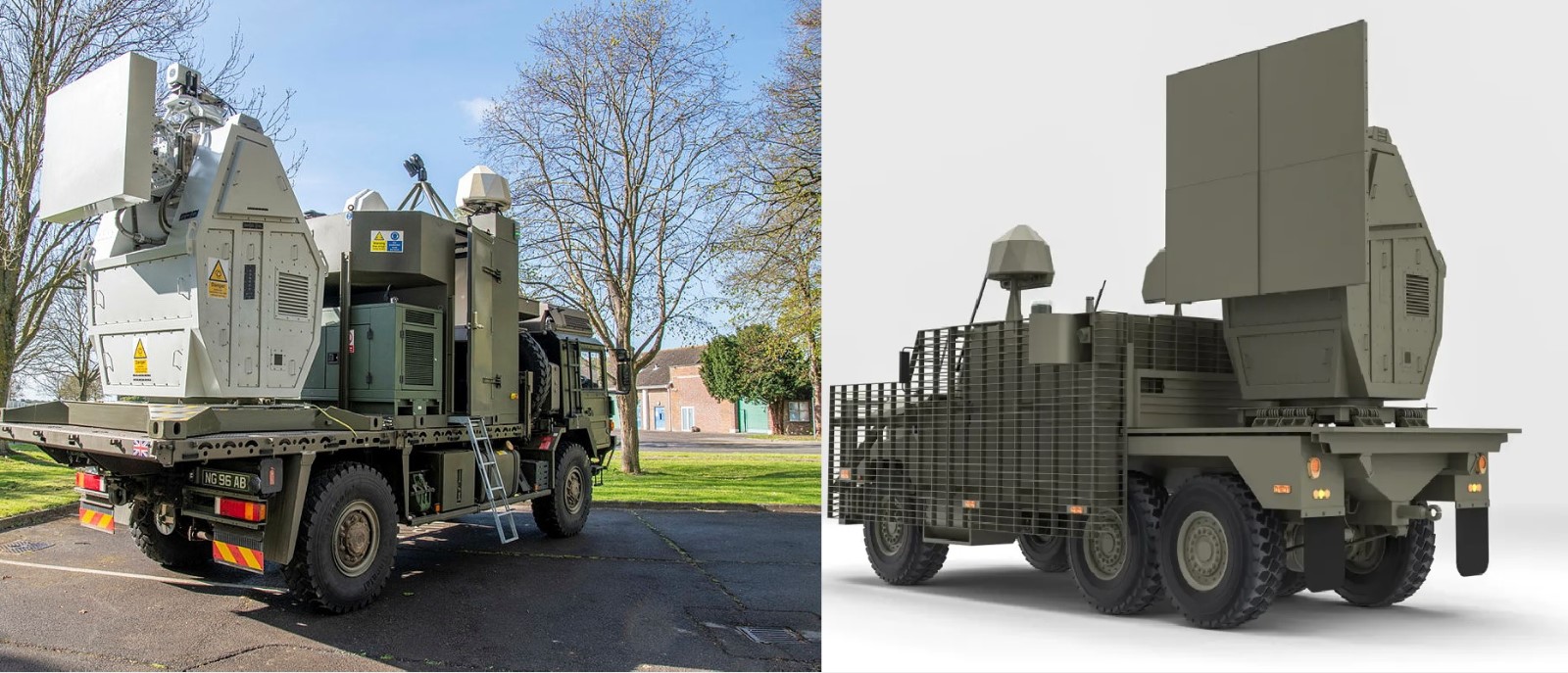
RapidDestroyer has been designed as a mobile and deployable capability that can be integrated onto multiple military platforms.
The system can be mounted on vehicles such as the RMMV HX-60 4×4 military truck, enabling protection for military convoys, forward operating bases, critical infrastructure and other high-value assets.
Its mobility allows commanders to deploy the system rapidly in response to evolving threats while maintaining protection across a wide range of operational environments.
Path Toward Operational Deployment
The successful completion of the Pershore trials marks another step toward the deployment of operational Radio Frequency Directed Energy Weapon capabilities within the UK Armed Forces.
By validating the upgraded 4-panel effector and demonstrating the consistent defeat of 80 drones, the trials confirmed improvements in both engagement range and target energy delivery. The results also reinforce the potential of directed energy systems to provide a cost-effective and sustainable layer within future air defence networks.
As drone threats continue to evolve, RapidDestroyer is being positioned as a complementary capability alongside conventional missile and gun-based air defence systems, offering a low-cost, electrically powered solution for defeating individual drones and large-scale swarm attacks.
——— End of Article ———