KIBBUTZ SASA, Israel — June 4, 2026 : Israeli survivability and armor specialist Plasan has announced the introduction of three new armored vehicle protection systems designed to address some of the most pressing threats facing military vehicles on modern battlefields. The systems—Leg Active Protection System (LAPS), Advanced Thickening Energetic Armour (ATHENA), and Top Attack Protection System (TAPS)—will make their public debut at the Eurosatory 2026 defense exhibition in Paris, scheduled to take place from June 15 to June 19, 2026.
The announcement comes as armed forces worldwide place greater emphasis on armored vehicle survivability, driven by operational lessons from recent conflicts in Ukraine and Gaza, where mines, anti-tank weapons, drones, and top-attack munitions have posed significant challenges to armored formations.
Founded in 1985, Plasan has more than four decades of experience in vehicle protection technologies and has supplied survivability solutions for widely used military platforms, including the Oshkosh JLTV and Navistar MaxxPro. According to the company, the three new systems were developed to address vulnerabilities that conventional armor solutions have struggled to mitigate effectively.
LAPS Designed to Reduce Mine Blast Injuries
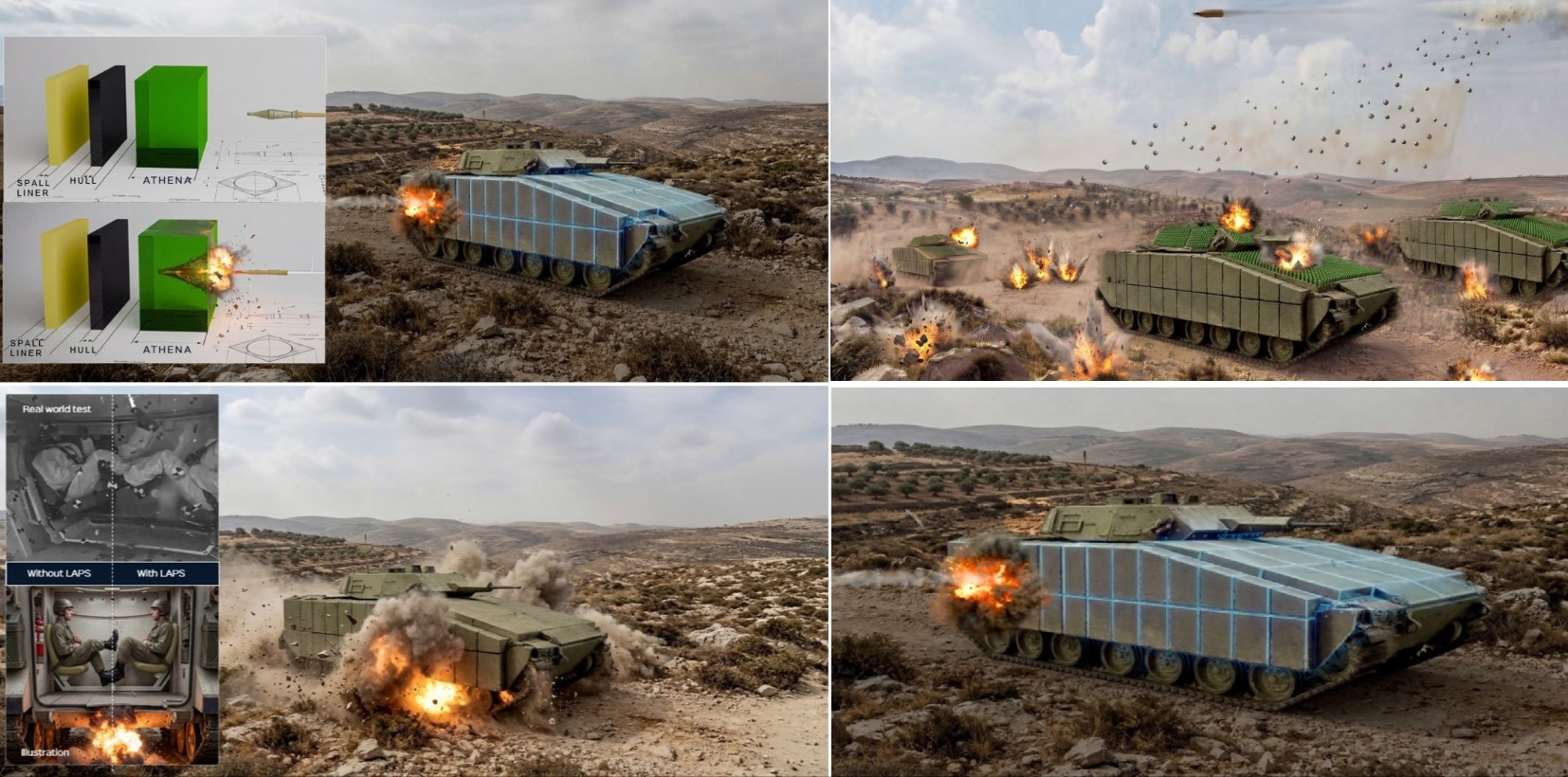
The Leg Active Protection System (LAPS) is intended to reduce severe lower limb injuries caused by underbelly mine blasts and improvised explosive devices (IEDs).
When a vehicle strikes a mine or encounters an underbody explosion, a powerful shockwave travels through the vehicle floor within milliseconds. Although modern armored vehicles employ blast-resistant hulls and reinforced flooring, residual energy can still cause serious injuries, including fractures, amputations, and soft-tissue damage to vehicle occupants.
To address this threat, LAPS is integrated directly into the vehicle’s Energy Attenuating Seat structure and utilizes an active detection mechanism capable of identifying a blast event almost instantly. Once activated, the system rapidly lifts the occupant’s legs away from the floor before the primary blast wave reaches the seating area.
Plasan stated that the technology achieves this protective response without requiring additional cabin space or significantly increasing vehicle weight. This allows manufacturers to maintain compact vehicle designs while improving crew survivability and reducing the physical effects of mine and IED attacks.
ATHENA Introduces Non-Explosive Reactive Armor Technology
The second system, ATHENA (Advanced Thickening Energetic Armour), has been developed to counter shaped-charge warheads commonly used in rocket-propelled grenades (RPGs), anti-tank guided missiles (ATGMs), and explosively formed penetrators (EFPs).
Shaped-charge weapons defeat armor by creating a concentrated high-velocity metal jet capable of penetrating steel and composite protection systems. For decades, armed forces have relied on Explosive Reactive Armor (ERA) to disrupt these penetrators. However, ERA functions by detonating outward when struck, creating fragmentation and blast effects that can endanger nearby infantry and damage external vehicle equipment.
Plasan said ATHENA provides a non-explosive reactive armor solution by combining advanced composite armor materials with a mechanically expanding interlayer. When a shaped-charge jet impacts the armor, the interlayer rapidly expands and disrupts the penetrator before it can effectively breach the vehicle's protection.
Because ATHENA does not rely on an external explosive reaction, it eliminates the collateral risks associated with traditional reactive armor while maintaining protection against shaped-charge threats. The system is intended to improve vehicle survivability while enhancing safety for troops operating alongside armored platforms.
TAPS Developed to Counter Top-Attack Threats
The third system, Top Attack Protection System (TAPS), has been designed to protect armored vehicles from threats approaching from above, an area that has become increasingly vulnerable in modern warfare.
Recent conflicts have demonstrated the growing effectiveness of drone-dropped munitions, loitering munitions, artillery submunitions, and top-attack anti-tank missiles against armored vehicles. While tanks and armored personnel carriers typically feature heavy frontal armor, their roof sections often remain comparatively less protected due to weight limitations.
TAPS is a lightweight add-on protection system mounted above a vehicle’s roof structure. The system provides an additional layer of defense against kinetic threats, artillery-delivered submunitions, and munitions arriving from elevated attack angles.
Plasan confirmed that TAPS has already undergone successful testing by multiple Western military forces and has received approval for field deployment. However, the company has not disclosed the identities of the participating nations or the specific vehicle programs involved.
Reflecting Lessons from Modern Conflicts
The introduction of LAPS, ATHENA, and TAPS reflects a broader shift in military procurement priorities as defense organizations adapt to evolving battlefield threats.
Operations in Ukraine and the Middle East have highlighted the vulnerability of armored vehicles to a wide range of threats, including mines, IEDs, anti-tank guided weapons, FPV drones, loitering munitions, and precision-guided top-attack systems. As a result, military planners are increasingly seeking layered survivability solutions that combine passive armor, active protection technologies, blast mitigation systems, and modular protection packages.
“These new solutions reflect the evolving requirements of modern battlefield survivability and the need to address increasingly complex threats targeting combat platforms,” said Gilad Ariav, Vice President of Marketing at Plasan.
“Our focus is on developing advanced survivability technologies that enhance protection while supporting operational flexibility and platform efficiency,” he added.
Expanding Global Industrial Presence
Alongside the launch of its new protection systems, Plasan continues to expand its international industrial footprint through partnerships with defense manufacturers and Original Equipment Manufacturers (OEMs) worldwide.
The company is increasing its manufacturing presence and industrial cooperation efforts across Europe and North America, with a focus on technology transfer, localized production, and collaboration with regional defense industry partners.
The unveiling of LAPS, ATHENA, and TAPS at Eurosatory 2026 is expected to draw attention from military procurement agencies and defense manufacturers seeking advanced protection technologies for future armored vehicle fleets as battlefield threats continue to evolve.
——— End of Article ———