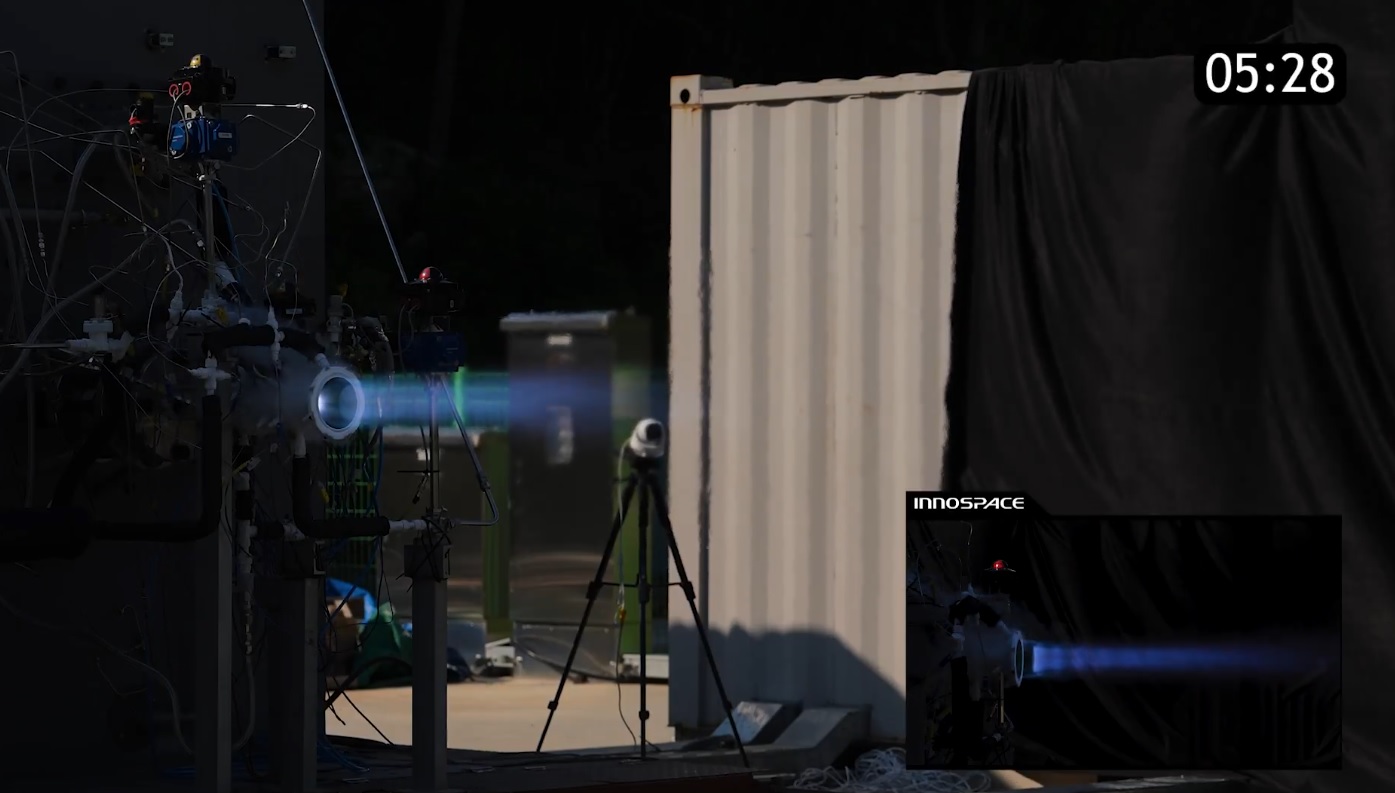
SEOUL, South Korea — June 04, 2026 : South Korean commercial space launch company INNOSPACE has successfully completed a 420-second ground combustion test of its LiMEK-04 liquid methane rocket engine, setting a new national record for the longest continuous methane engine firing conducted in South Korea.
The achievement marks a major milestone in the company's propulsion development efforts and validates a key dual-propellant regenerative cooling technology that will be used in the HANBIT-Micro launch vehicle, currently being developed for small satellite missions.
LiMEK-04 Engine Designed for HANBIT-Micro Kick Stage
The LiMEK-04 is a 0.4-ton-thrust (approximately 880 lbf) liquid methane engine specifically designed for the kick stage of the HANBIT-Micro rocket. A kick stage serves as the final propulsion system after the primary rocket stages complete their mission, enabling precise orbital insertion and accurate deployment of satellites into their designated orbits.
The successful long-duration test demonstrated both the engine's operational stability and the effectiveness of several advanced propulsion technologies that are expected to enhance future launch vehicle performance.
Dual-Propellant Cooling Technology Successfully Validated
A key objective of the recent test was the validation of INNOSPACE's independently developed dual-propellant regenerative cooling system.
Rocket engines operate under extremely high temperatures and require efficient cooling systems to protect the combustion chamber and nozzle. In regenerative cooling, propellants circulate through channels surrounding the engine before entering the combustion chamber, absorbing heat and preventing structural damage.
While conventional methane engines typically use liquid methane alone as the coolant, INNOSPACE's system simultaneously utilizes both liquid methane (fuel) and liquid oxygen (oxidizer) as cooling agents.
According to the company, this approach increases coolant flow rates by approximately 3.0 to 3.4 times compared with traditional single-propellant cooling methods.
The technology offers several advantages:
- Reduced pressure requirements, allowing stable cooling performance under lower operating pressures.
- Lower structural mass, as reduced pressure requirements enable the use of lighter propellant tanks and feed systems.
- Improved payload capability, a critical factor for small launch vehicles where every kilogram of saved weight can be allocated to payload capacity.
INNOSPACE stated that the technology could also support future applications involving reusable methane engines, orbital transfer vehicles, and space exploration propulsion systems.
Commenting on the achievement, INNOSPACE CEO Kim Soo-jong said that structural lightweighting technologies play a significant role in improving payload performance and enhancing competitiveness within the small launch vehicle market.
Methane Propulsion Gains Importance in Global Space Industry
The successful test also highlights the growing importance of methane-fueled rocket engines across the global launch sector.
Compared with traditional kerosene-based rocket fuels, methane offers several operational benefits. It burns more cleanly, produces fewer carbon deposits within engines, supports potential reusability, and provides higher performance while remaining easier to manage than liquid hydrogen.
As a result, methane propulsion has become a key technology for many next-generation launch systems being developed worldwide.
For emerging launch providers such as INNOSPACE, methane propulsion is viewed as an important pathway toward more efficient and commercially competitive launch services.
LiMEK-04 Development Reaches New Milestone
The latest record-setting test represents the culmination of a phased development program that has progressed over the past two years.
Key milestones include:
March 2024: Successful first ignition test under Technology Demonstration Model 1 (TDM#1).
May 2024: Successful combustion test reaching 237 seconds under TDM#2.
July 2025: First successful ignition using the newly integrated dual-propellant regenerative cooling system under Engineering Development Model 1 (EDM#1).
May 2026: Successful 420-second long-duration combustion test under Engineering Development Model 3 (EDM#3), establishing a new South Korean record.
The latest firing demonstrated sustained engine operation for approximately seven minutes, a duration considered important for propulsion systems intended for orbital insertion and upper-stage missions.
Supporting the HANBIT-Micro Launch Vehicle
INNOSPACE plans to integrate the LiMEK-04 engine into the kick stage of the HANBIT-Micro launch vehicle, which is being developed to serve the growing small satellite launch market.
Reliable long-duration engine performance is essential for kick-stage operations, as these systems are responsible for final orbital adjustments, satellite deployment, and mission-specific maneuvers after separation from the main rocket stages.
The company believes the successful validation of the methane engine will strengthen HANBIT-Micro's capabilities and improve its competitiveness in the expanding commercial small satellite launch sector.
Preparations Continue for Next HANBIT-Nano Launch
Alongside engine development activities, INNOSPACE is continuing preparations for its next launch mission following the early termination of its first commercial HANBIT-Nano launch in December 2025.
The anomaly occurred approximately one minute after liftoff and was subsequently traced to a first-stage electric pump failure.
Since then, the company has completed a comprehensive root-cause analysis, upgraded relevant hardware components, and implemented manufacturing process improvements aimed at increasing vehicle reliability.
INNOSPACE is currently undergoing a launch license review with the Korea AeroSpace Administration (KASA).
Subject to final approval, the company plans to conduct a follow-up HANBIT-Nano launch during the third quarter of 2026.
The mission is scheduled to lift off from the Alcântara Space Center in Brazil and will carry InnoSat-0, INNOSPACE's first in-house test satellite. The flight will also utilize a 6U-class satellite deployment system developed by SpaceBey to validate key orbital separation and deployment technologies.
Expanding South Korea's Commercial Space Capabilities
The successful 420-second combustion test provides important technical validation for INNOSPACE's future launch vehicle roadmap while demonstrating progress in the development of advanced methane-fueled rocket propulsion systems.
As the company advances both the HANBIT-Micro and HANBIT-Nano programs, the latest achievement further strengthens South Korea's growing capabilities in commercial launch services, small satellite transportation, and next-generation space propulsion technologies.
——— End of Article ———