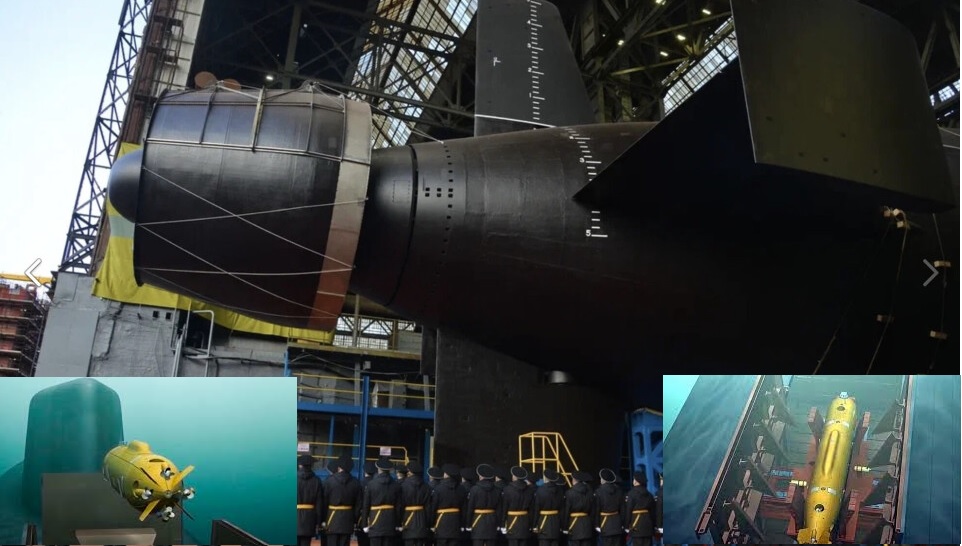
Russia has officially launched its new nuclear-powered submarine Khabarovsk, a next-generation vessel designed to carry the Poseidon nuclear-powered underwater drone system — one of the most secretive and potentially devastating weapons in Moscow’s arsenal. The launch marks a major milestone in the modernization of Russia’s naval forces and signals a new phase in underwater deterrence strategy.
A New Era in Russia’s Submarine Fleet
According to Russian Defense Minister Andrei Belousov, the Khabarovsk will play a central role in ensuring the security of Russia’s maritime borders. Built by the Sevmash Shipyard in Severodvinsk, the submarine represents the culmination of over a decade of research into autonomous undersea warfare and nuclear deterrence. Belousov emphasized that the submarine features modern armaments, robotic systems, and upgraded sensors, making it capable of operating both independently and in coordination with surface and air assets.
The Khabarovsk (Project 09851) is believed to be a special-purpose submarine, directly linked to the Poseidon system — a nuclear-powered underwater drone capable of delivering a multi-megaton warhead over intercontinental distances. Unlike traditional ballistic missile submarines, Khabarovsk is built to launch unmanned nuclear torpedoes rather than missiles, representing a dramatic shift in Russia’s undersea deterrence doctrine.
Technical Specifications and Capabilities
While many of its specifications remain classified, defense sources and satellite imagery analyses suggest that Khabarovsk shares a design lineage with the Borei-class nuclear submarines but with significant modifications.
-
Displacement: Estimated around 10,000–12,000 tons submerged
-
Length: Approximately 120 meters
-
Powerplant: A nuclear reactor based on the OK-650 series, providing near-unlimited range
-
Speed: Over 30 knots underwater
-
Crew: Around 100 personnel, though automation and robotic systems reduce operational manpower
-
Armament: Up to 6 Poseidon unmanned underwater vehicles (UUVs), each capable of carrying nuclear or conventional warheads
The Poseidon UUV itself — sometimes referred to as Status-6 — is a revolutionary concept. It’s essentially an autonomous nuclear-powered torpedo, capable of traveling at depths over 1,000 meters, with a range exceeding 10,000 kilometers, and reportedly reaching speeds of up to 100 knots. Its potential to deliver a nuclear strike without surface detection represents a new kind of second-strike capability — immune to traditional missile defenses.
Upgrades Over Previous Russian Submarines
Compared to earlier submarines like the Belgorod (Project 09852) — the first known Poseidon carrier — the Khabarovsk features a more compact design, improved stealth capabilities, and enhanced automated systems. The hull architecture has been optimized for reduced acoustic signature, while new sensor arrays and AI-assisted control systems enable autonomous mission profiles.
Where Belgorod was built as a modified Oscar-II class platform (originally designed for cruise missiles), Khabarovsk has been purpose-built from the keel up for Poseidon deployment. This makes it quieter, faster, and better suited for long-duration patrols under Arctic ice — a region where Russia is expanding its strategic footprint.
Strategic Implications
The launch of Khabarovsk is not just a technological milestone but also a strategic message. At a time of heightened tensions with NATO, the deployment of Poseidon-capable submarines enhances Russia’s second-strike survivability and complicates adversary defense planning. It effectively adds a new leg to the nuclear triad, complementing land-based ICBMs and air-launched systems with an autonomous undersea deterrent.
For the United States and its allies, this development may prompt further investment in undersea surveillance, anti-submarine warfare, and deep-sea tracking technologies. However, the challenge of detecting a Poseidon-sized object traveling deep underwater remains formidable.
The Khabarovsk submarine symbolizes the next phase of Russia’s nuclear deterrence evolution — blending nuclear propulsion, artificial intelligence, and unmanned weaponry into a single platform. With its launch, Moscow signals that it is not just maintaining parity with Western naval power, but also exploring new dimensions of strategic warfare that could redefine the balance of power beneath the oceans.
As Defense Minister Belousov stated, “The submarine Khabarovsk ensures the inviolability of Russia’s maritime borders and the strategic balance of power.”
Indeed, with Poseidon at its command, Russia’s fleet has entered a new — and potentially more dangerous — era.
——— End of Article ———