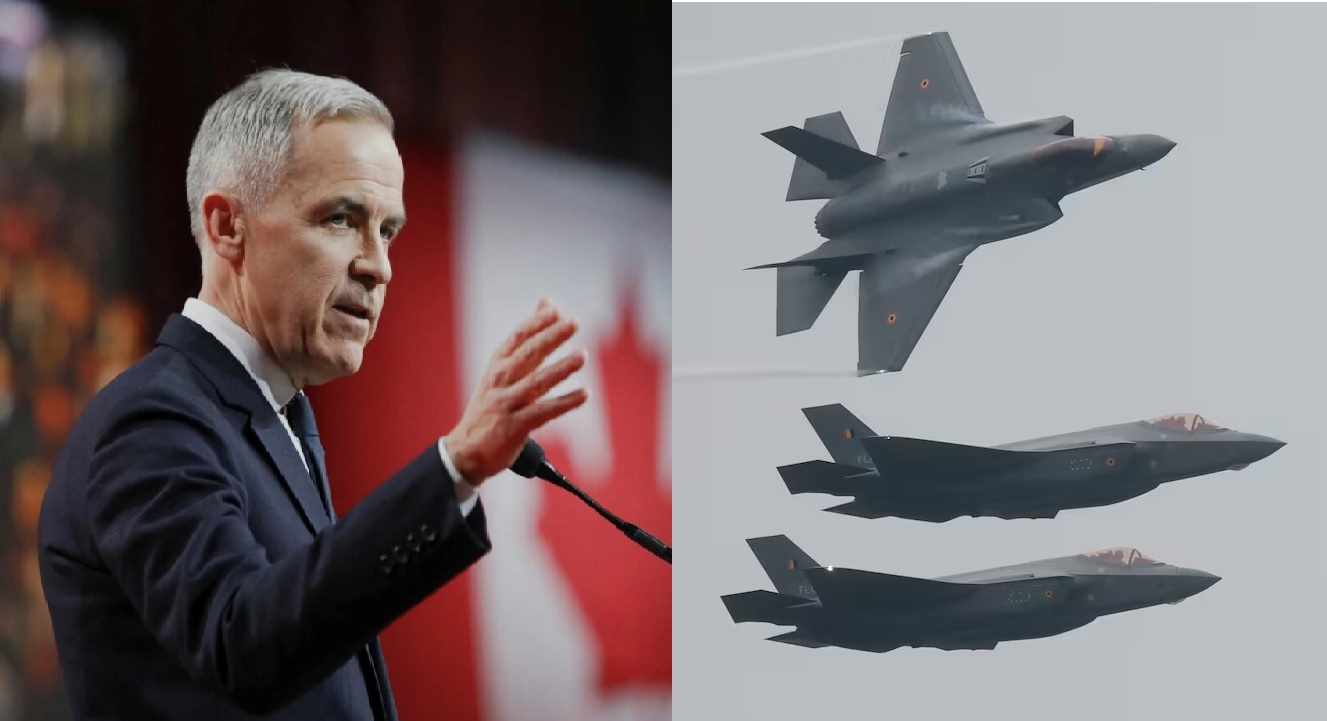
Ottawa : The Canadian government has initiated a comprehensive strategic review of its planned purchase of F-35 fighter jets, a $27 billion agreement that is now facing scrutiny over escalating costs, long-term financial exposure, and diplomatic pressure from Washington. The reassessment represents one of the most consequential defense procurement reviews in Canada’s recent history and reflects a broader effort by Ottawa to reassert control over military spending and strategic autonomy.
The agreement, signed in 2022, committed Canada to acquiring 88 F-35 Lightning II aircraft to replace the Royal Canadian Air Force’s aging CF-18 fleet. At the time of approval, the acquisition was estimated to cost between $14 billion and $19 billion. Updated government audits, however, now place the projected acquisition cost at approximately $27.7 billion, excluding several major ancillary expenses.
Escalating Costs and Budgetary Revisions
According to the Auditor General of Canada, the increase stems from higher inflation assumptions, updated sustainment costs, and revised foreign exchange projections. The report also noted that earlier cost estimates understated the full scope of expenditures required to operate the aircraft.
Further analysis by the Parliamentary Budget Officer (PBO) estimates the full life-cycle cost of the F-35 fleet—covering operations, maintenance, upgrades, and sustainment over a projected 45-year service life—at roughly $73.9 billion. The PBO cautioned that this figure does not fully incorporate the cost of infrastructure upgrades at Canadian air bases or the procurement of advanced weapons systems compatible with the aircraft. These additional requirements could add an estimated $5.5 billion to total expenditures.
Members of Parliament from multiple parties have since questioned whether the program, as structured, aligns with Canada’s long-term fiscal and defense priorities.
Diplomatic Pressure and Political Pushback
The financial reassessment has unfolded alongside heightened diplomatic friction with Washington. Officials in the administration of U.S. President Donald Trump, as well as U.S. Ambassador to Canada Pete Hoekstra, publicly warned that reducing or canceling the planned 88-jet purchase could carry consequences.
These warnings included references to potential trade measures, such as tariffs exceeding 50 percent on selected Canadian exports, and suggestions that the United States could deploy additional American fighter aircraft into Canadian airspace under the framework of NORAD to compensate for any perceived capability gaps.
Canadian lawmakers, from both government and opposition benches, characterized these statements as inappropriate interference in a sovereign procurement decision. Senior officials emphasized that Canada remains committed to continental defense obligations but retains the right to determine the composition of its own air force.
Public opinion data appears to have reinforced this position. Recent national polling indicates that approximately 72 percent of Canadians support diversifying the fighter fleet or considering non-U.S. alternatives to reduce reliance on American-controlled software, upgrades, and mission data systems.
Saab Gripen Gains Renewed Attention
As the F-35 review continues, Sweden’s Saab has emerged as the leading alternative supplier. Saab has renewed its offer of the Gripen E/F, proposing a package that includes 72 fighter aircraft and six GlobalEye airborne early-warning and surveillance platforms.
Saab’s proposal places significant emphasis on industrial participation within Canada. The company has pledged to assemble the aircraft domestically, a move it says could support approximately 12,600 Canadian jobs across manufacturing, maintenance, and supply chains.
Operational cost comparisons have also featured prominently in the debate. Saab estimates the Gripen’s cost per flight hour at between $8,000 and $12,000, compared with estimates ranging from $33,000 to $50,000 for the F-35. Canadian defense analysts have noted that the Gripen model would also allow greater national control over maintenance schedules, mission software, and technology upgrades.
International Context and Comparable Decisions
Canada’s reassessment mirrors decisions taken or considered by several other countries evaluating their participation in the F-35 program. Spain has moved away from F-35 acquisition plans, opting instead to invest in the Eurofighter Typhoon and the Future Combat Air System (FCAS). In Switzerland, lawmakers are debating the cancellation of a $9.1 billion order for 36 F-35 aircraft amid trade tensions and cost concerns. India has previously declined F-35 offers, citing limited technology transfer and strategic autonomy considerations.
Defense analysts describe these developments as part of a broader trend in which governments are weighing stealth capabilities against long-term independence in operations, logistics, and data control.
Current Commitments and Next Steps
Despite the review, Canada has reaffirmed its commitment to an initial batch of 16 F-35 aircraft already under contract, with deliveries scheduled to begin in 2026. These jets are expected to provide near-term capability continuity as the CF-18 fleet is phased out.
Parliamentary committees and defense officials are now examining options for the remaining 72 aircraft, including reducing the total order or adopting a mixed-fleet approach that would combine F-35s with an alternative platform such as the Gripen.
Government sources stress that no final decision has been made and that the review is intended to ensure affordability, operational effectiveness, and long-term sovereignty. The outcome is expected to shape Canada’s defense posture, procurement policy, and defense relationship with the United States for decades to come.
——— End of Article ———