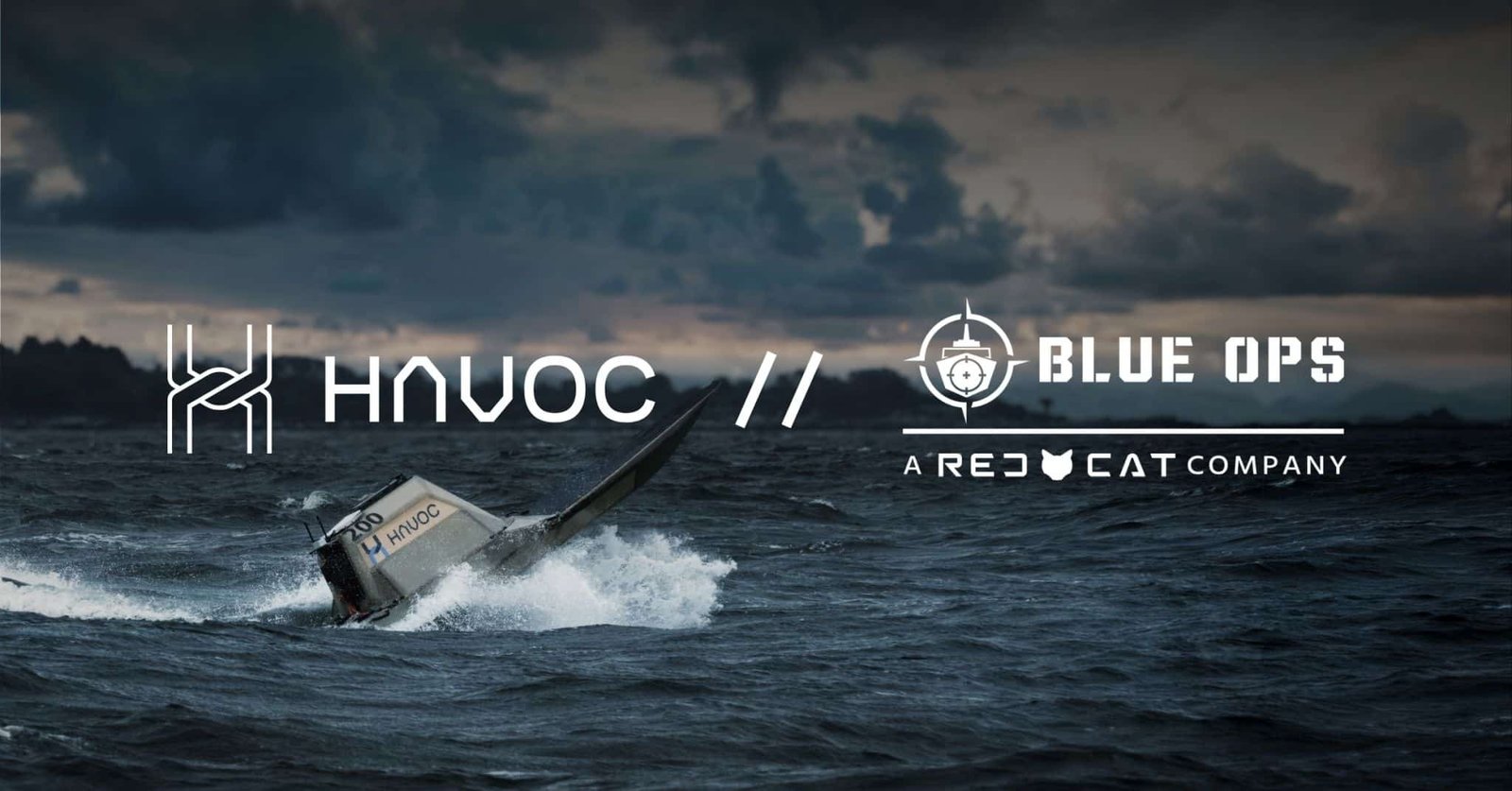
SALT LAKE CITY — Red Cat Holdings, Inc. (Nasdaq: RCAT) and Havoc have announced a strategic partnership through Red Cat’s maritime division, Blue Ops, to integrate Havoc’s collaborative autonomy software and command-and-control capabilities into Blue Ops’ uncrewed surface vessels (USVs).
The partnership will focus on the Variant 7 (V7) and other Blue Ops platforms as they are introduced. The companies aim to enable coordinated multi-vessel operations and expand autonomous capabilities for U.S. and allied defense customers.
Open Architecture and Autonomy
The integration will use Blue Ops’ Modular Open Systems Architecture (MOSA), which is designed to support the rapid integration of autonomy systems, sensors, communications, mission payloads and other technologies as requirements change.
Havoc’s collaborative autonomy technology has already been deployed on behalf of the U.S. Department of War in multiple operational settings.
“This partnership is exactly what our open-architecture strategy was built for,” said Barry Hinckley, President of Blue Ops. “Our goal is to build the best small USVs in the world while making it easy to integrate leading technologies from across the U.S. and our allies.”
Variant 7 USV
The Variant 7 is a roughly 7.8-meter mission-adaptable USV designed for intelligence, surveillance and reconnaissance, force protection, harbor and coastal security, and other payload-configurable missions.
The V7 is currently ramping into full-rate production and is designed, built and assembled in the United States. It features a Steyr engine and a hybrid jet/inboard drive system, with a range of up to 800 nautical miles, more than 60 hours of continuous unmanned endurance, and payload capacity of up to 650 kg (1,433 lb).
The vessel can reach speeds of more than 39 knots in its maximum combat configuration and supports the launch and recovery of integrated UAVs, connecting it with Red Cat’s existing ISR drone capabilities.
Joint Testing and Market Expansion
Blue Ops and Havoc plan to establish joint operational fleets at their headquarters in Florida and Rhode Island. The sites will support live demonstrations, testing, training and operational evaluation for U.S. and allied defense customers, including both single-vessel autonomy and coordinated multi-vessel operations.
“Havoc’s primary strategy is to pair our leading-edge collaborative autonomy software with platform manufacturers who have already proven innovation, excellence, and scale,” said Paul Lwin, CEO and Co-Founder of Havoc. He said Blue Ops’ open and flexible maritime systems align with Havoc’s approach to deploying collaborative autonomy.
Red Cat and Blue Ops plan to introduce Havoc’s autonomy and command-and-control capabilities to their government and commercial customers, while Havoc plans to market Blue Ops’ USV family to its own customer base.
Red Cat develops robotic systems for military, government and public safety applications across air, land, sea and space. Blue Ops was launched in 2025 and focuses on modular USVs built in the United States. Havoc was founded in 2024 and is headquartered in Providence, Rhode Island, developing software that enables autonomous systems across sea, air and land to operate together, including during communications disruptions.
No financial terms or contract value were disclosed. The partnership establishes a framework for continued technical integration, demonstrations and joint customer engagement as the companies develop autonomous maritime systems for defense and national security customers.
——— End of Article ———