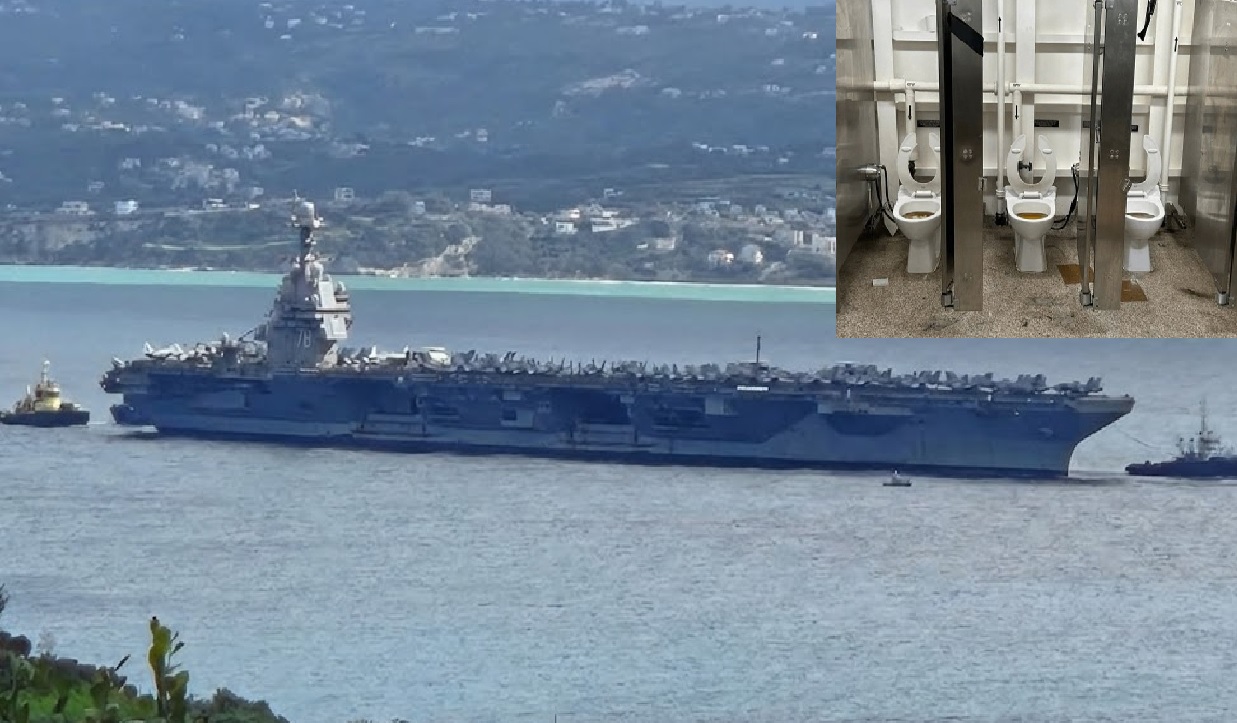
SOUDA BAY, Greece — February 23, 2026: The U.S. Navy aircraft carrier USS Gerald R. Ford (CVN-78) arrived at U.S. Naval Support Activity Souda Bay on the island of Crete on February 23 as part of its redeployment to the Middle East under U.S. Central Command. The carrier’s port call comes as the vessel continues to manage persistent malfunctions in its onboard sewage system, affecting daily life for its crew of approximately 4,600 sailors.
The Ford, the lead ship of its class and the Navy’s most advanced nuclear-powered aircraft carrier, is currently more than eight months into deployment. The ship was redirected from operations in the Caribbean under U.S. Southern Command and is now transiting toward the eastern Mediterranean and onward to the Middle East amid U.S. operational planning related to Iran.
Scope of Sewage System Failures
Investigations published by NPR and The Wall Street Journal detailed recurring breakdowns in the carrier’s Vacuum Collection, Holding and Transfer (VCHT) sewage system. The system, adapted from commercial cruise ship designs and intended to conserve water, relies on narrow piping and vacuum pressure to move waste.
The ship is equipped with approximately 650 toilets, referred to in naval terminology as “heads,” divided across 10 independent zones. According to internal communications cited in the reports, a single valve failure can disable vacuum suction across an entire zone, rendering all associated facilities inoperable.
Internal Navy emails obtained by NPR showed that 205 separate toilet breakdowns were logged over a four-day period. Hull Technicians assigned to maintenance have reportedly worked shifts of up to 19 hours to address clogs, leaks, and valve failures. Sailors have reported waiting up to 45 minutes to access functioning facilities when outages occur.
Since 2023, the Ford has required 42 external service calls related to the sewage system. Of those, 32 occurred during 2025 deployments, including multiple calls after the ship departed Norfolk on June 24, 2025. Reports indicate that repairs for individual clogs typically take between 30 minutes and two hours, depending on severity.
The recurring issues stem from both system design and operational use. Naval engineering assessments have identified the pipes as undersized, a concern previously highlighted in a 2020 review by the Government Accountability Office. The narrow pipes are vulnerable to calcium buildup from standard use and are highly susceptible to blockages caused by unauthorized materials being flushed, including brown paper towels, t-shirts, mop heads, and cleaning supplies.
Maintenance Requirements and Repair Locations
The VCHT system cannot undergo a full overhaul while the ship is at sea. Specialized maintenance procedures, including heavy chemical “acid flushes” used to remove calcium buildup, require port-based equipment and safety protocols. Each acid flush operation costs approximately $400,000.
The current stop at Souda Bay provides an opportunity for immediate maintenance and limited system restoration. The U.S. Naval Support Activity at Souda Bay, located within the NATO Marathi Pier Complex operated by the Hellenic Navy, offers deep-water berthing capable of accommodating aircraft carriers, refueling services, ammunition handling, supply operations, minor maintenance, and ship repair facilities. The base includes workshops, a fuel depot, and an ammunition depot, and has previously hosted U.S. carriers for repair work.
Permanent design upgrades to the VCHT system would require the carrier to enter drydock at a major U.S. shipyard, such as Norfolk Naval Shipyard. Navy officials have stated that upgrades are planned for future maintenance availabilities.
Transit and Operational Movements
The Ford transited the Strait of Gibraltar on February 20, 2026, entering the Mediterranean Sea after concluding operations in the Caribbean. The carrier covered approximately 2,700 kilometers from Gibraltar to Crete in 72 hours at an average speed of 21 knots.
The ship was accompanied through the strait by the guided-missile destroyer USS Mahan (DDG-72). Additional escorts, including USS Winston S. Churchill (DDG-81) and USS Bainbridge (DDG-96), remain part of the Carrier Strike Group.
While in the Caribbean, the Ford operated under U.S. Southern Command in support of Operation Absolute Resolve. Following its Mediterranean transit, the carrier is approximately one day from the Suez Canal and six days from the Arabian Sea. Upon arrival in the region, it is expected to join the USS Abraham Lincoln Carrier Strike Group, restoring a dual-carrier presence under U.S. Central Command.
Logistics and Air Wing Composition
During the Souda Bay port call, the carrier is scheduled for refueling, ammunition loading, and resupply. Multiple C-17 Globemaster III aircraft have landed at the nearby Chania airbase to support logistics operations.
Embarked aboard the Ford is Carrier Air Wing 8, which includes four F/A-18 multirole fighter squadrons, one EA-18G Growler electronic warfare squadron, and four E-2D Hawkeye airborne early warning aircraft from VAW-124, known as the “Bear Aces.”
Additional U.S. assets operating in the broader region include P-8 Poseidon maritime patrol aircraft, RC-135 Rivet Joint signals intelligence aircraft, and F-35A fighters from the 158th Fighter Wing of the Vermont Air National Guard.
Deployment Duration and Operational Status
The Ford has been deployed for 241 days, marking its second extension and placing it on track to exceed typical post-Vietnam War deployment lengths if operations continue beyond mid-April 2026.
U.S. Navy Fleet Forces Command has stated that while the sewage system failures have affected habitability conditions aboard the ship, they have not impacted combat readiness, flight operations, or mission execution capabilities. The Navy has characterized the plumbing issues as technical challenges related to system design and usage patterns, separate from operational performance.
The carrier remains underway toward the Middle East following completion of logistics and maintenance activities at Souda Bay.
——— End of Article ———