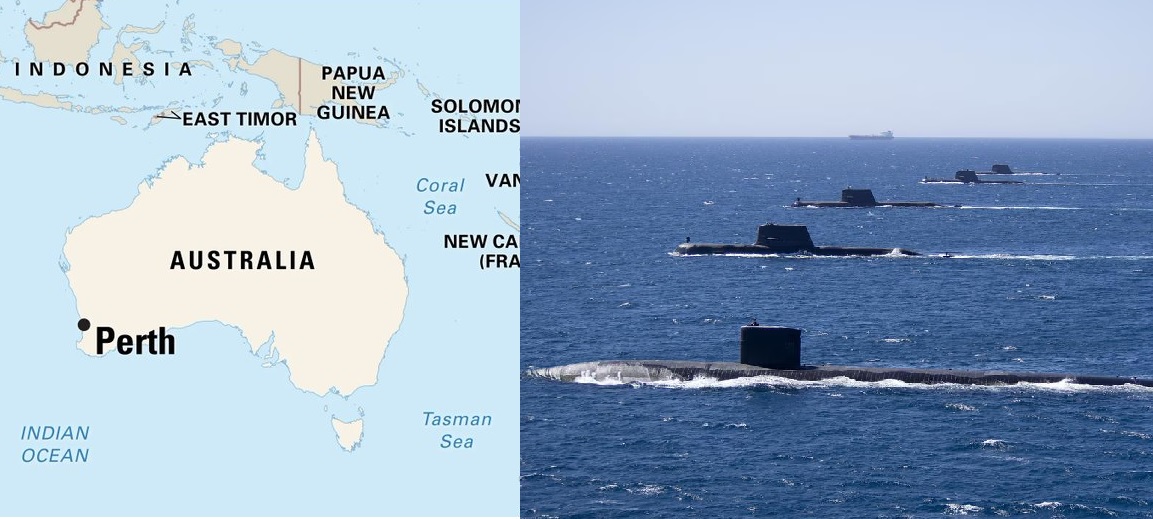
PERTH, Australia : The United States and the United Kingdom are moving toward the finalization of plans to establish a rotational deployment of nuclear-powered attack submarines in Western Australia beginning in 2027, marking a major operational milestone under the AUKUS security partnership with Australia.
The initiative, formally known as Submarine Rotational Force–West (SRF-West), is a central element of Pillar One of AUKUS, the trilateral defense framework focused on undersea warfare capabilities and long-term submarine cooperation. Under the arrangement, U.S. and UK submarines will rotate through HMAS Stirling, Australia’s primary submarine base, located on Garden Island near Perth.
According to official government frameworks and defense planning documents, the United States will rotate up to four Virginia-class submarines through the base, while the United Kingdom will deploy one Astute-class submarine as part of the same rotational cycle. The submarines will operate on a non-permanent basis, remaining under the sovereign command of their respective nations.
Strategic Purpose in the Indo-Pacific
The deployment is intended to expand allied undersea presence in the Indo-Pacific and strengthen deterrence amid ongoing regional military modernization, particularly by China. By positioning nuclear-powered attack submarines in Western Australia, the AUKUS partners aim to significantly increase the number of allied submarines operating west of the international dateline.
Defense planners say the rotational presence will also help bridge a capability gap for Australia as it prepares to acquire its own nuclear-powered submarines. Australia is expected to receive Virginia-class submarines transferred from the United States in the early 2030s, ahead of the construction of a new, domestically built submarine design under AUKUS.
In addition, basing rotations at HMAS Stirling extends the operational reach of the U.S. Navy beyond established hubs in Guam and Hawaii, providing greater flexibility for sustained undersea operations across the Indian and Pacific Oceans.
Infrastructure Upgrades at HMAS Stirling
To support SRF-West, the Australian government has committed approximately AUD 8 billion to expand and modernize infrastructure at HMAS Stirling. Planned upgrades include new submarine wharves, enhanced dry-dock and maintenance facilities, high-voltage electrical systems, and specialized infrastructure required to safely support nuclear-powered vessels.
Preparatory work is already underway, with the base hosting an increasing number of allied submarine visits and technical activities ahead of the 2027 start date.
In August 2024, Australian personnel conducted their first maintenance activities on a U.S. nuclear-powered submarine, the USS Hawaii, while it was docked at HMAS Stirling. The event marked the first time such work had been performed on Australian soil and was described by defense officials as a key readiness milestone.
Workforce Development and Training
Alongside infrastructure upgrades, AUKUS partners are expanding workforce and training programs to ensure Australia can support nuclear submarine operations over the long term. Australian sailors, engineers, and officers have begun embedding within U.S. and UK submarine crews to gain direct operational experience.
Australian personnel are currently serving aboard U.S. submarines, including the USS Vermont, as part of a structured training pipeline focused on nuclear propulsion, maintenance, and undersea warfare operations.
The Australian Submarine Agency is coordinating closely with U.S. shipyards in Pearl Harbor and UK facilities in Barrow-in-Furness to build a domestic workforce of nuclear-qualified technicians and engineers. This effort is intended to establish a sovereign industrial base capable of sustaining Australia’s future submarine fleet.
Operational Structure Under AUKUS
SRF-West represents the first of three major phases under the AUKUS “Optimal Pathway.” While the submarines will be forward-deployed for extended periods, Australian officials have emphasized that the arrangement does not create a permanent foreign military base. Instead, it is structured as a rotational presence supported by a combined workforce of Australian, U.S., and UK personnel.
Operational command of the submarines will remain with the U.S. Navy and the Royal Navy, with Australia providing basing, logistical support, and increasing levels of technical involvement as its workforce matures.
The rotational force is expected to grow gradually and reach full operational capacity by around 2031. Defense planners view the deployment as a continuous undersea deterrent that will remain in place until Australia commissions its domestically built SSN-AUKUS fleet in the early 2040s.
Once fully implemented, SRF-West is expected to play a central role in allied undersea operations across the Indo-Pacific, integrating Australian facilities into long-term U.S. and UK submarine deployment patterns while supporting Australia’s transition to nuclear-powered submarines under AUKUS.
——— End of Article ———