EMDEN, Germany : Turkish armoured forces and supporting elements have arrived in northern Germany as part of NATO Steadfast Dart 2026, marking a key phase of the Alliance’s largest exercise of the year and the first major peacetime operational test of the Allied Reaction Force (ARF). The deployment includes approximately 2,000 Turkish troops and a substantial package of vehicles and equipment, underscoring Turkey’s role in NATO’s collective defence and rapid reinforcement posture.
The arrival took place at the Port of Emden and at Wunstorf Air Base, where elements of the Turkish Land Forces’ 66th Mechanized Infantry Brigade began onward movement and reception procedures. Turkish officials confirmed that 650 personnel from the brigade are directly participating, supported by 149 vehicles, including armoured combat platforms and logistical support assets. The contingent is equipped with domestically produced systems, reflecting Turkey’s expanding defence industrial capacity.
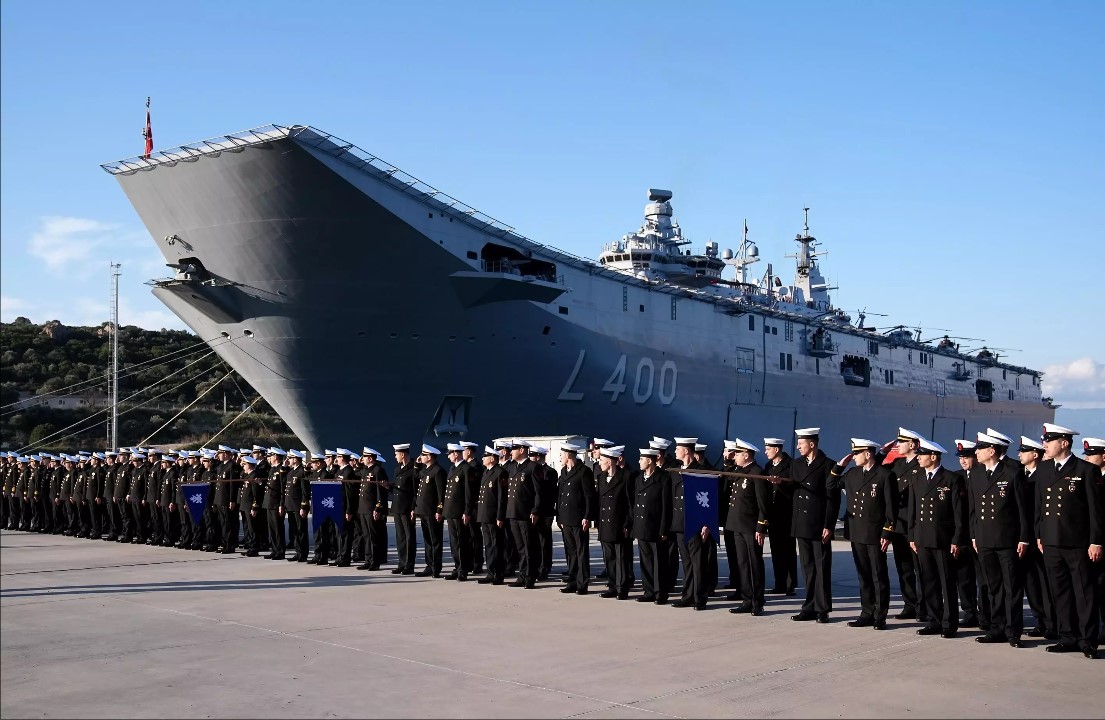
Maritime Deployment via TCG ANADOLU
For the first time, Turkish ground forces were transported to northern Europe aboard TCG ANADOLU, the Turkish Navy’s flagship multi-purpose amphibious assault ship. Acting as a command-and-control hub during the transit, the vessel departed Turkey on January 20 and sailed as part of a maritime task group that included the frigate TCG ISTANBUL, the logistics ship TCG DERYA, and the corvette TCG KINALIADA. The deployment demonstrated integrated sea lift, sustainment, and command functions over a long-distance movement.
Purpose of Steadfast Dart 2026
Steadfast Dart 2026 is designed to validate the ARF, a high-readiness, multi-domain formation created to deploy faster and with greater integration than previous NATO force structures. The exercise involves roughly 10,000 personnel from 11 allied nations—Bulgaria, Czechia, Germany, Greece, Italy, Lithuania, Spain, and Turkey—with additional support provided by Belgium, France, and the United Kingdom. Activities are focused on rapid reinforcement, command and control, and interoperability under realistic operational conditions.
Multi-Domain Integration and Interoperability
The exercise scenario is based on a near-peer adversary framework, requiring coordinated action across land, air, maritime, cyber, and space domains. For Turkey, the deployment represents a strategic mobility operation spanning more than 6,400 kilometers from home bases to the Baltic region. Turkish officials noted that the movement and integration of forces into NATO command structures form a central element of the exercise’s objectives.
Rear Admiral Zeki Aktürk, spokesperson for the Turkish Ministry of National Defense, stated that the deployment highlights the Turkish Armed Forces’ ability to project and sustain a sizeable force within the Alliance’s northern defence framework. Turkey currently holds the rotating NATO roles of Commander Amphibious Task Force (CATF) and Commander Landing Force (CLF) through June 2026, responsibilities that are being exercised during Steadfast Dart.
Scheduled Events
The exercise will progress through a series of planned milestones. On February 18, participating forces are scheduled to conduct an amphibious landing demonstration along the Baltic Sea coast at the Putlos Training Area. This will be followed on February 20 by a Distinguished Visitors Day at the Bergen Military Training Area, where NATO leadership will assess the ARF’s readiness and the effectiveness of multinational integration.
NATO officials said Steadfast Dart 2026 is intended to provide a comprehensive assessment of the Alliance’s ability to deploy, command, and sustain forces at speed, with Turkey’s participation forming a significant component of the overall evaluation.
——— End of Article ———