Space News ,U.S :- In a Century of Solar Phenomena, Where Does the April 8 Eclipse Stand?
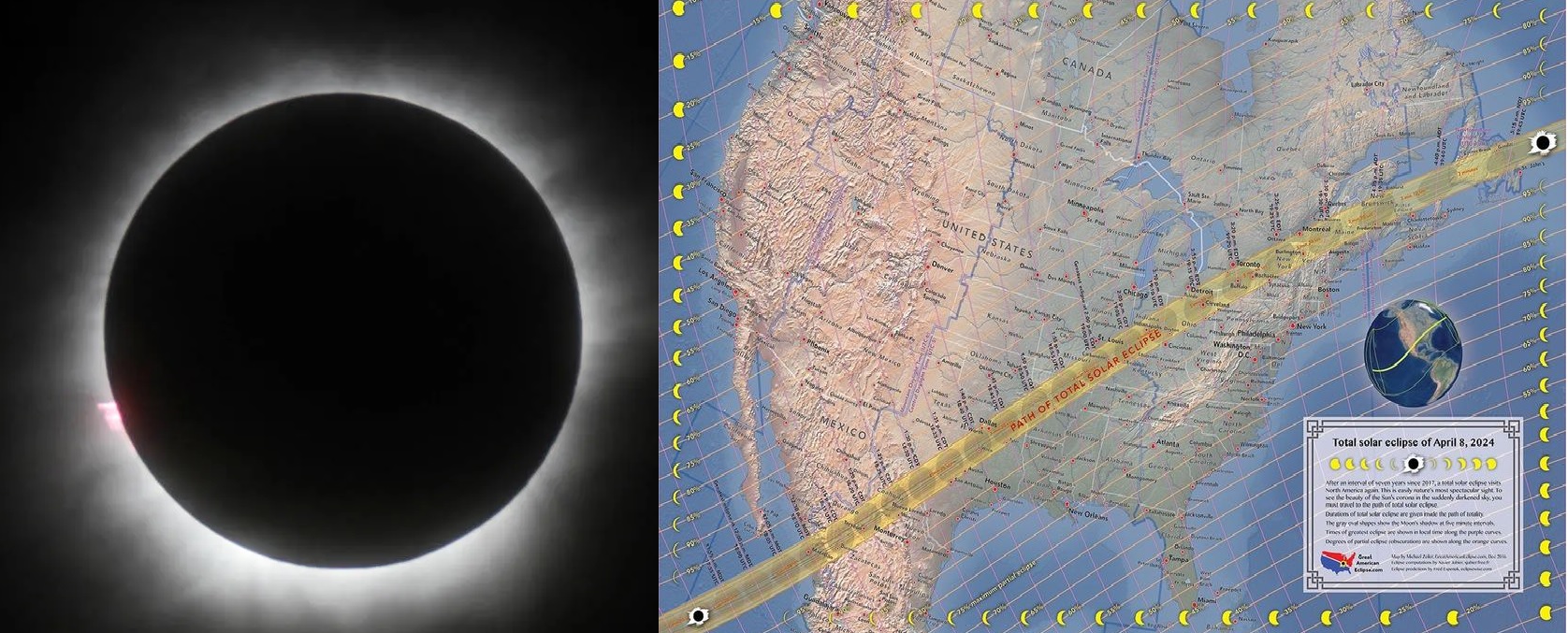
As we delve into the comparison of the "Great North American Solar Eclipse" set to grace the skies on April 8 with its predecessors over the past century, its prominence becomes strikingly evident.
Over the last 100 years, spanning from 1925 to 2024, our analysis of 75 solar eclipses, including annular-total/hybrid and non-central total eclipses, reveals an average totality duration of 3 minutes and 13 seconds. Notably, the absolute maximum potential duration of a total solar eclipse, as defined by Jean Meeus, a Belgian celestial mechanics specialist, is 7 minutes and 32.1 seconds.
The upcoming total solar eclipse on April 8, 2024, is poised to break the mold with a maximum duration of 4 minutes and 28.2 seconds in north-central Mexico. Among the sampled 75 solar eclipses, 29 belong to the exclusive "Four Minute or Greater Club," with the April 8 eclipse securing its place among the top 25% in duration.
A Century in Review: Total Solar Eclipses Over the United States (1924-2024)
| Date (UTC) | Duration | Altitude (in degrees) | Width of visible region (in miles) | Location in United States |
|---|---|---|---|---|
| Jan. 25, 1925 | 2m 02s | 18° | 107 | Sunrise MN to WI, MI, NY, PA, NJ, MA, CT, RI |
| April 28, 1930 | 0m 01s | 62° | 0.6 | Hybrid; total for CA, NV, OR, ID, MT |
| Aug. 31, 1932 | 1m 40s | 31° | 103 | VT, NH, ME, MA |
| Feb. 4, 1943 | 1m 52s | 10° | 104 | Alaska |
| July 9, 1945 | 0m 31s | 8° | 28 | Sunrise for Idaho to MT |
| June 30, 1954 | 1m 22s | 10° | 74 | Sunrise for Nebraska to SD, IA, MN, WI, MI |
| Oct. 2, 1959 | 0m 56s | 1° | 37 | Sunrise for New Hampshire & Massachusetts |
| July 20, 1963 | 1m 36s | 46° | 62 | Alaska, Maine |
| March 7, 1970 | 3m 10s | 54° | 88 | FL, GA, SC, NC, VA, MA |
| July 10, 1972 | 2m 22s | 38° | 105 | Alaska |
| Feb. 26, 1979 | 2m 46s | 24° | 191 | WA, OR, ID, MT, ND |
| July 22, 1990 | 2m 19s | 34° | 130 | Alaska (Aleutians) |
| July 11, 1991 | 4m 10s | 22° | 139 | Big Island of Hawaii |
| Aug. 21, 2017 | 2m 43s | 64° | 71 | Spanned contiguous US; Oregon to S. Carolina |
| Apr. 8, 2024 | 4m 27s | 69° | 108 | TX northeast to ME |
| 1924-2024 averages | 1m 58s | 32° | 89 |
Comparative Analysis of April 8, 2024 Eclipse: Standout Features
1. Duration: The average totality duration for the 14 United States eclipses, excluding April 8, is 1 minute and 58 seconds. Notably, only two of the 13 surpass the three-minute mark. The April 8 eclipse, with a totality lasting 4 minutes and 27 seconds in south Texas, stands out as an extraordinary event, with only the 1991 eclipse exceeding four minutes.
2. Maximum Altitude: The April 8 event boasts a remarkable sun altitude of 69° in south Texas, providing favorable conditions for clear viewing. In contrast, the average for the other 14 United States eclipses places the sun at less than half that height, at 32°.
3. Maximum Path Width: The moon's shadow during the April 8, 2024 eclipse spans 108 miles, ranking fourth among the 14 eclipses analyzed. Notably, the width of the 1979 eclipse exceeded that of 2024 by 83 miles.
4. Geographical Visibility: The upcoming April 8 eclipse is anticipated to attract a massive viewing audience, passing over metropolitan areas from Texas to northern New England. An estimated 32 million people will have the opportunity to witness this extraordinary celestial event, making it the most concentrated population exposure to a total solar eclipse in U.S. history.
Historical Context and Future Prospects
Looking beyond the century, the April 8, 2024 eclipse stands out as an exceptional event in the history of the United States. The only comparable event, in terms of totality duration, is the eclipse of June 16, 1806. Not until the total solar eclipse of August 12, 2045, will the contiguous United States experience a totality exceeding six minutes, marking a historic astronomical milestone.
As we await this forthcoming celestial spectacle, the April 8, 2024 eclipse takes its place as the finest total solar eclipse for the United States between the years 1806 and 2045.
——— End of Article ———