GENEVA — A public diplomatic dispute has emerged between the United States and France following a United Nations General Assembly vote to extend the mandate of U.N. High Commissioner for Human Rights Volker Türk for another four-year term.
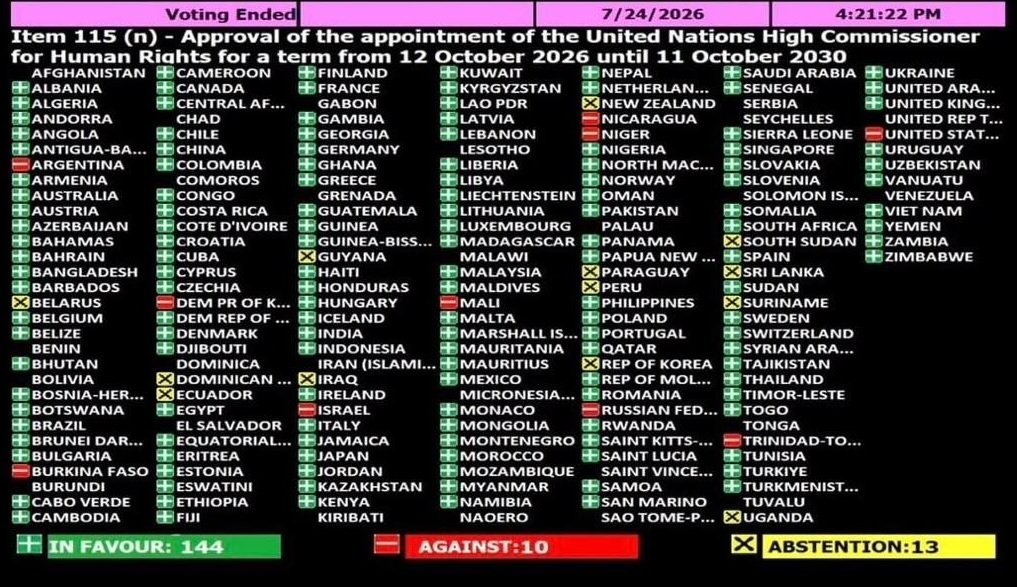
The disagreement began after the General Assembly approved the extension with 144 votes in favor, 10 against, and 13 abstentions. Türk's new term will begin on October 12, 2026, following a proposal by U.N. Secretary-General António Guterres.
The United States voted against the extension, joining Israel, Russia, Argentina, North Korea, Nicaragua, Mali, and other countries in opposing the appointment. Russia had proposed extending Türk's mandate only until the end of 2026, but that proposal was rejected. A U.S. request to postpone the vote was also rejected.
The US used to be a beacon of human rights. Not anymore. Today, it stands alongside North Korea, Nicaragua, Mali & Russia, isolated. And the world no longer listens to it.#AmericaAlone https://t.co/GLNMsYEH9n pic.twitter.com/UTVvljTMeO
— France ONU Genève 🇫🇷🇺🇳 (@FranceONUGeneve) July 25, 2026
The vote was followed by a public exchange on the social media platform X between the U.S. and French missions to the United Nations.
Before the vote, U.S. Deputy Ambassador Jeff Bartos criticized the U.N. human rights system, saying it had been "losing credibility for decades." He accused Türk of leading the institution to its "deathbed" and described the reappointment process as dysfunctional, arguing that the agenda item had been introduced at the last minute. Bartos also said the United States would reassess its engagement, participation, and funding for the United Nations.
After the vote, the Permanent Mission of France to the United Nations in Geneva responded by criticizing Washington's position.
In a post on X, the French mission stated that the United States was once a "beacon of human rights" but was "not anymore." It added that the U.S. now stood alongside North Korea, Nicaragua, Mali, and Russia in opposition to the vote and said the country was becoming increasingly isolated on the issue.
The French statement prompted a strong response from American officials.
U.S. Representative to the United Nations Mike Waltz described France's comments as "shameful." He said France had supported "someone who lectures free, sovereign democracies like the United States, the United Kingdom, and Israel, while cozying up to the most brutal oppressors in the world."
The dispute also spread to other American political figures. U.S. Congressman Randy Fine replied to the French mission's post by making a reference to France's military history, writing, "Don't you have someone to surrender to?"
Türk, an Austrian jurist, has faced criticism from several governments during his tenure. His office has repeatedly criticized Israel's military operations in Gaza and its policies toward Palestinians. Israel's Foreign Ministry has accused the Office of the High Commissioner for Human Rights of bias under his leadership.
The United States and Russia have also raised concerns about aspects of Türk's record and the timing of the reappointment process, arguing that the decision should have been left to the next U.N. secretary-general.
Despite opposition from the United States and several other countries, the General Assembly approved Türk's reappointment, securing another four-year term as the head of the U.N. human rights office.
The exchange between U.S. and French officials remained limited to public statements and social media posts following the vote. No additional official statements from either government were immediately reported.
——— End of Article ———