NEW YORK/LONDON — Global financial markets shifted on Monday as a temporary pause in U.S. military strikes on Iran pushed oil prices sharply lower, easing concerns over a wider regional conflict. The de-escalation improved investor risk appetite, sending the U.S. dollar lower against several major currencies ahead of a busy week of monetary policy decisions by the Federal Reserve, the Bank of England (BoE), and the Bank of Japan (BoJ).
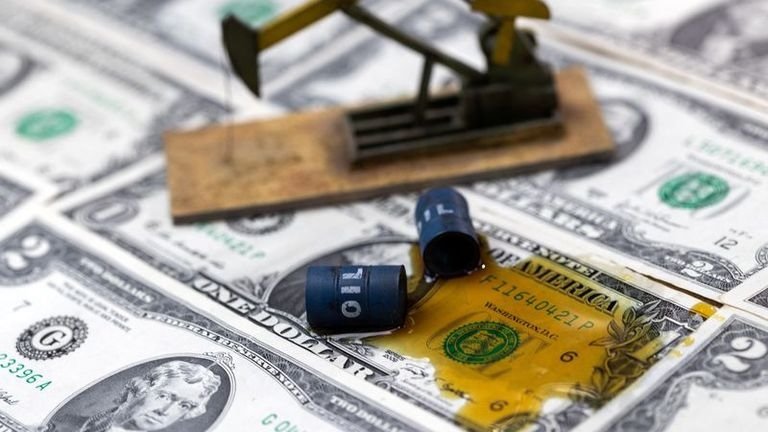
The biggest market reaction came in the energy sector. Brent crude, the global oil benchmark, fell 7.5% to settle at $89.42 per barrel after the U.S. military temporarily halted its two-week air campaign in Iran. Tehran said it would also suspend its counterattacks as long as the United States maintained the pause, raising hopes that diplomatic efforts could reduce tensions. Earlier this month, the conflict had briefly pushed Brent crude above $100 per barrel.
The sharp decline in oil prices helped improve overall market sentiment and eased concerns that higher energy costs could keep inflation elevated.
Dollar Weakens Ahead of Federal Reserve Meeting
The U.S. Dollar Index (DXY), which measures the U.S. currency against a basket of six major currencies, slipped 0.1% to 101.34.
Currency markets are now focused on the Federal Reserve's July 28-29 policy meeting, where investors are awaiting guidance on interest rates.
Federal Reserve Chair Kevin Warsh, who succeeded Jerome Powell in May 2026, has offered limited forward guidance on future policy decisions. As a result, markets have frequently adjusted their interest-rate expectations in recent weeks in response to softer U.S. inflation data and geopolitical developments in the Middle East.
According to the CME Group FedWatch Tool, traders currently assign a 33% probability that the Federal Reserve will raise interest rates by a quarter percentage point on Wednesday. That is down from 37% at the end of last week but remains about double the probability priced in one week earlier.
"It could be that the market is not particularly well-informed after this meeting because Warsh doesn't like to give forward guidance, and there is so much uncertainty, particularly with respect to how long the Iran war will last," said Jane Foley, Head of FX Strategy at Rabobank.
Despite Monday's decline, investors continue to hold a positive outlook on the U.S. dollar. Data from the Commodity Futures Trading Commission (CFTC) showed that net long positions in the dollar increased to $45.37 billion in the week ending July 20, the highest level of bullish positioning since 2015.
Later this week, investors will also closely watch the release of U.S. second-quarter Gross Domestic Product (GDP) data and core Personal Consumption Expenditures (PCE) inflation, the Federal Reserve's preferred inflation measure, for further indications on the strength of the U.S. economy.
Yen, Euro and Pound React
Against the Japanese yen, the dollar fell 0.1% to 163.645 yen, marking its sharpest daily decline since July 10. Despite the move, the yen remains close to its weakest level against the dollar in around 40 years.
The Bank of Japan is scheduled to announce its policy decision on Friday. While the central bank is widely expected to keep interest rates unchanged, analysts expect policymakers to leave open the possibility of future rate increases to help limit further weakness in the yen. So far, verbal interventions by Japanese officials have had only limited impact on the currency.
"There is a sense of walking on eggshells when the Fed and Japan's authorities are prepared to be less predictable and when there is not a great understanding of what could happen next between the U.S. and Iran," wrote Paul Mackel, Global Head of FX Research at HSBC. "We still side with favouring the dollar."
In Europe, the euro rose 0.2% to $1.130, while the British pound eased about 0.1% to $1.331 after giving up earlier gains. Even with Monday's slight decline, sterling remained on track for its second consecutive session of gains, recovering from last week's multi-week low of $1.330.
The Bank of England is expected to leave interest rates unchanged when policymakers meet on Thursday. The central bank continues to monitor inflation risks linked to recent increases in oil prices. The meeting comes shortly after Prime Minister Andy Burnham and Finance Minister John Healey formally took office.
Norwegian Crown Falls, Cryptocurrencies Rise
The decline in oil prices also affected commodity-linked currencies. The Norwegian crown, which had been among July's strongest major currencies due to higher oil prices, fell 0.6% to 9.642 per U.S. dollar.
Meanwhile, cryptocurrencies moved higher. Bitcoin gained about 1% to $65,155.60, while Ether rose 2.5% to $1,961.29, reaching its highest level since June 2.
Markets Await Central Bank Decisions
With geopolitical tensions temporarily easing, investors are now shifting their attention to a series of major central bank meetings and key U.S. economic data releases. Decisions by the Federal Reserve, Bank of England, and Bank of Japan, along with upcoming GDP and inflation figures, are expected to shape market expectations for interest rates and global financial markets in the coming days.
——— End of Article ———