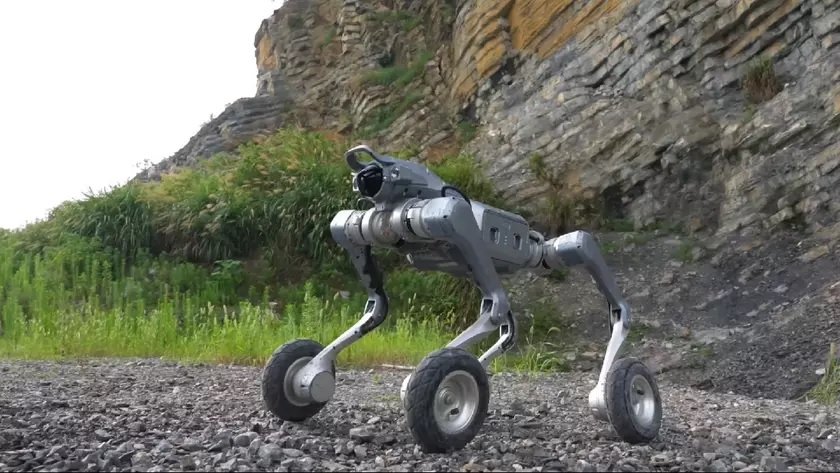
BEIJING — Chinese robotics company Unitree has introduced its latest unmanned ground vehicle (UGV), the Super Athlete AS2-W, a four-wheeled robot that combines legged and wheeled mobility. The new platform is designed to improve movement across different types of terrain by combining the obstacle-crossing ability of legged robots with the speed and efficiency of wheeled systems on flat surfaces.
According to information published on Unitree's official website, the AS2-W weighs approximately 25 kg, including its 648 Wh (15,000 mAh) battery. The robot is designed to carry a continuous payload of up to 16 kg while moving, while its structure can support a static payload of up to 150 kg when stationary.
Mobility and Performance
The AS2-W uses a hybrid wheeled-legged design with 16 degrees of freedom, 7-inch oversized wheels, and industrial-grade joint modules capable of generating up to 95 N·m of peak torque. According to Unitree, the robot can reach a maximum speed of more than 6 meters per second on flat terrain.
The company states that the robot can travel more than 30 kilometers on a single battery charge when operating without a payload, with a runtime of more than three hours. When carrying its maximum continuous payload of 16 kg, the operating range is approximately 25 kilometers, while runtime exceeds two hours.
The AS2-W is designed to move across a variety of outdoor environments. According to the manufacturer, it can climb 45-degree slopes, cross 30-centimeter stairs, and overcome obstacles up to 80 centimeters high. Unitree's demonstration video also shows the robot traveling over rocky terrain and regaining mobility after falling from elevated platforms.
Its chassis is constructed from aluminum alloy and high-strength engineering plastic and carries an IP54 rating for dust and water resistance. The operating temperature range is listed as –20°C to 55°C. Standing dimensions are 721 mm × 493 mm × 521 mm, while the supported supply voltage ranges from 36 V to 50.4 V.
Autonomous Navigation and Computing
For autonomous operation, the AS2-W uses Unitree's ISS 3.0 (Intelligent Side-follow System) navigation software. The company states that the system provides centimeter-level positioning accuracy for autonomous tracking.
The robot is equipped with a high-performance AI expansion module capable of 150 TOPS (trillion operations per second) for on-device data processing. Unitree says the platform supports developer SDKs and APIs for secondary development and integration of AI applications.
Depending on configuration, the AS2-W can also be equipped with industrial-grade 64- to 128-line LiDAR, an HD camera, dual encoders, and local air cooling. Connectivity options include Wi-Fi 6, Bluetooth 5.2, GPS, and 4G, with the company stating that GPS and 4G functions are disabled by default and require user authorization before activation.
Civilian Applications
Unitree markets the Super Athlete AS2-W primarily as a civilian platform intended for security patrols, industrial inspection, and outdoor exploration. The company also offers the robot in standard and education configurations, with custom industry solutions available for specialized applications.
Unitree states that the product includes a 12-month warranty and notes that published performance figures are based on laboratory testing and may vary under actual operating conditions. The company also advises users not to modify the robot or operate it in hazardous ways.
Reported Military Use
According to reports citing Chinese military sources, similar quadrupedal robotic platforms were deployed by the People's Liberation Army (PLA) during the China-Mongolia "Steppe Partner 2026" joint military exercise.
Chinese military personnel and state media referred to these systems as "Robotic Wolves." During the exercise, the unmanned platforms were reportedly used in combat reconnaissance and fire-support roles alongside aerial drones, armored vehicles, and artillery during simulated combat operations.
According to the reported information, these robotic platforms were used to conduct reconnaissance in hazardous areas, relay battlefield information, and support defensive operations while reducing the need to expose personnel to direct risk.
——— End of Article ———