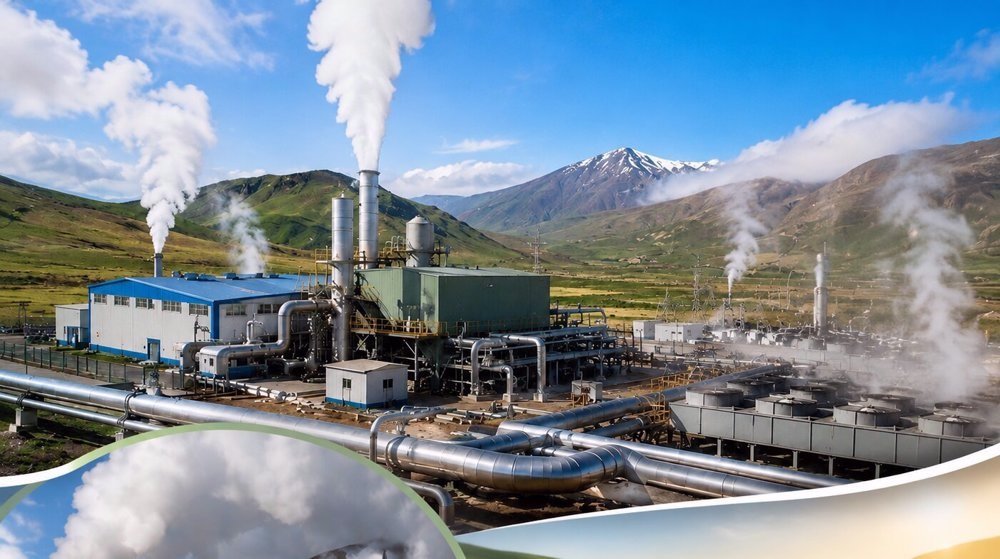
ARDABIL PROVINCE, Iran — Iran has officially connected its first geothermal power plant to the national electricity grid, marking the country's entry into geothermal electricity generation and expanding its renewable energy portfolio.
The pilot geothermal facility is located near the dormant Sabalan volcano in Meshginshahr, Ardabil Province. The project was inaugurated by Iranian Energy Minister Abbas Aliabadi after completing engineering, installation, testing, trial operations, and synchronization with the national grid.
Built with an investment of €10 million, the Sabalan Geothermal Power Plant currently generates 5.4 megawatts (MW) of electricity. Geological studies indicate the underground geothermal reservoir has the potential to support electricity generation of up to 250 MW through future expansion.
Developed After Foreign Firms Withdrew
The Sabalan geothermal project was originally planned with foreign participation. However, European companies withdrew from the project following U.S. sanctions, requiring Iranian companies to continue development using domestic engineering capabilities.
Iranian engineers adapted drilling technologies commonly used in the country's oil and gas industry to complete the geothermal wells. According to project officials, the drilling process was technically demanding because engineers had to penetrate volcanic rock to depths of approximately 3,000 meters, passing beneath a clay layer around 500 meters thick that seals the geothermal reservoir.
At those depths, underground temperatures exceed 240°C to 250°C, creating conditions suitable for geothermal power generation. The extreme heat and abrasive volcanic formations caused rapid wear on drilling equipment and fluids, leading Iranian teams to develop specialized drilling methods and domestic technical capabilities during the project.
How the Power Plant Generates Electricity
The Sabalan plant produces electricity by extracting naturally heated, pressurized water from deep underground. As the water reaches the surface, the pressure decreases, causing it to rapidly convert into steam. The steam is then directed through turbines that generate electricity before being supplied to the national power grid.
Because the geothermal fluid contains high levels of dissolved minerals and salts, it can cause corrosion and scaling in industrial equipment. To address these challenges, MAPNA Group redesigned turbine components and developed corrosion-resistant alloys and protective coatings for use at the facility.
Project planners also intend to utilize the remaining geothermal heat, estimated at 70°C to 100°C, after electricity generation. The residual heat is expected to support district heating in Meshginshahr as well as agricultural applications, including greenhouse farming and aquaculture. The remaining geothermal fluid is planned to be reinjected into the underground reservoir.
Potential for Future Expansion
Officials say the current 5.4 MW facility serves as a pilot project to demonstrate geothermal technology in Iran. The Sabalan geothermal reservoir has an estimated capacity of up to 250 MW, providing room for future development.
Government surveys have also identified 18 additional geothermal sites across Iran that could be considered for future projects. According to available studies, Sabalan is among the country's high-temperature geothermal regions suitable for commercial electricity production, while other identified areas include Mahallat and the Makran region.
Strengthening Domestic Renewable Energy Capability
The completion of the Sabalan project has provided Iranian companies with practical experience across the exploration, drilling, engineering, construction, commissioning, and operation of geothermal power systems.
Officials say the project has also contributed to the development of domestic capabilities in geothermal equipment and technology, reducing reliance on imported expertise and supporting future renewable energy projects under existing international sanctions.
As geothermal power operates without fuel combustion during electricity generation, the technology can provide continuous renewable electricity. However, operators must maintain careful management of geothermal fluids through brine handling, reinjection, and continuous monitoring to reduce equipment scaling, corrosion, and potential environmental impacts, including groundwater protection.
With the Sabalan plant now connected to the national grid, Iran has established its first operational geothermal power station and laid the foundation for future geothermal energy development using domestically developed technology.
——— End of Article ———