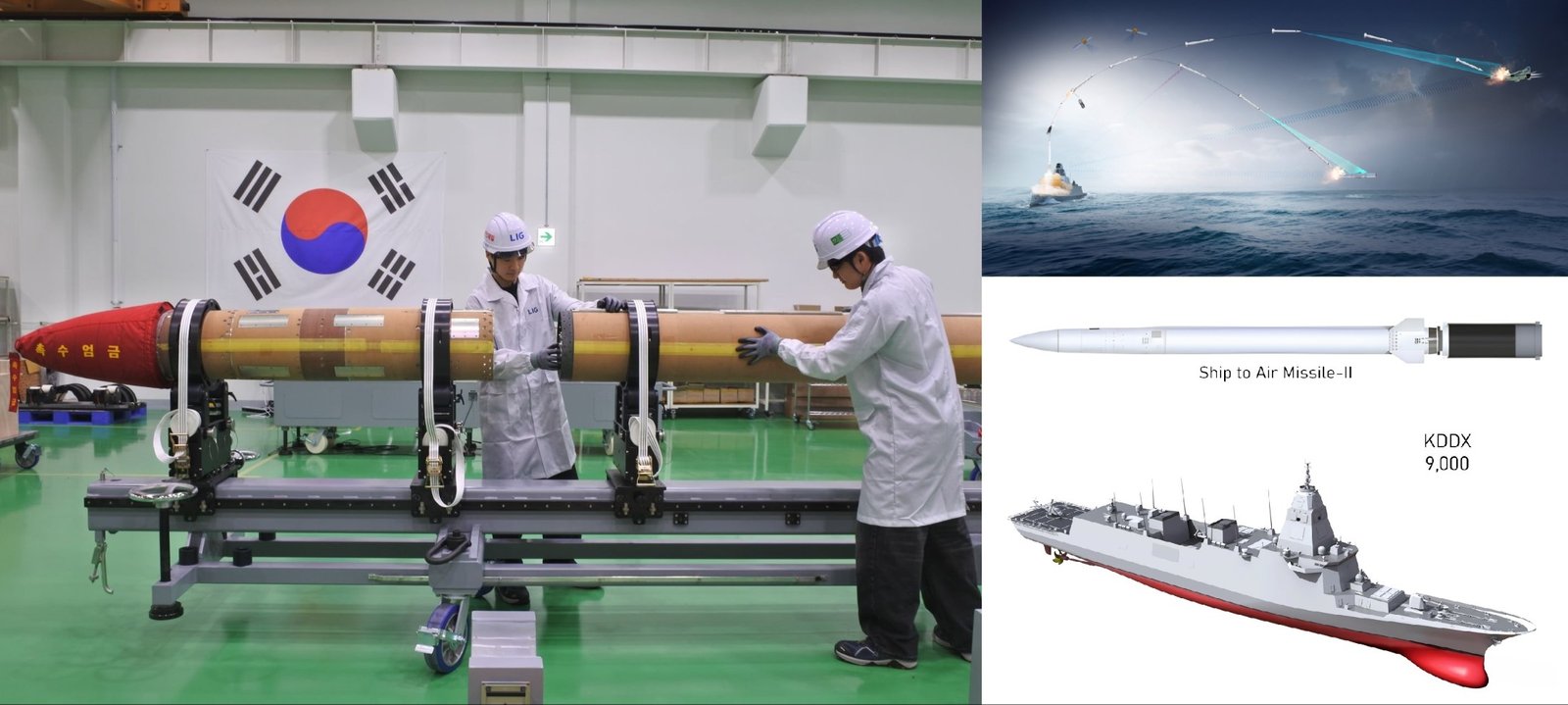
GUMI, South Korea — South Korean defense company LIG Nex1 has officially begun assembling the first prototype missiles for the Republic of Korea (ROK) Navy's Ship-to-Air Missile-II (KSAM-II) program, marking a key milestone in the development of the country's next-generation indigenous long-range naval air-defense system.
According to a July 14 report by Asia Business Daily, production of the first flight-test prototype missiles is starting this month at LIG Nex1's dedicated missile assembly and inspection facility in Gumi. The facility, which held its completion ceremony in March 2026, includes specialized assembly lines, inspection rooms, and blast-resistant work areas designed to support the production of advanced guided missiles.
The KSAM-II is being developed as a domestically produced replacement for the U.S.-made Standard Missile-2 (SM-2) and is intended to become the primary long-range air-defense missile for the ROK Navy's future surface combatants.
Dedicated Production Facility Supports Program
The Gumi facility represents an important step in South Korea's effort to strengthen its domestic missile manufacturing capability. According to the report, the plant is equipped with dedicated assembly and inspection areas designed specifically for missile production.
The first flight-test missiles now entering production will be used during the program's development and testing phase, which is scheduled to continue through 2030.
Missile Design and Assembly Process
The KSAM-II is derived from the anti-aircraft missile variant of South Korea's L-SAM air-defense system.
The missile measures approximately six meters in length and consists of three main sections:
- A forward guidance section containing electronic systems.
- A central body housing the warhead and propulsion system.
- A rear booster.
Each interceptor passes through approximately 20 assembly stages, with the complete manufacturing process taking around three months per missile. According to Asia Business Daily, the final assembly stage alone requires about 20 workers, reflecting the complexity of the production process.
Advanced Seeker and Performance Targets
The KSAM-II is equipped with a third-generation high-precision seeker incorporating a 1-kilowatt Gallium Nitride (GaN) Solid-State Power Amplifier (SSPA).
According to the reported specifications, the seeker is designed to provide improved detection, tracking, and interception performance against aerial threats, including small supersonic cruise missiles. Reports state it can detect and track targets as small as 0.3 meters while processing tracking data at a high rate of up to 100 calculations per second for trajectory prediction.
The missile is also designed to:
- Reach speeds of around Mach 5.
- Withstand maneuvering loads of up to 17G during flight.
Planned Integration on KDDX Destroyers
The KSAM-II has been designed for the Korean Vertical Launching System (K-VLS) and will be carried at a ratio of one missile per launch cell.
The missile is planned for deployment aboard the ROK Navy's future KDDX stealth destroyers, where its primary mission will be to intercept hostile aircraft and incoming anti-ship missiles, providing long-range protection as part of the ships' layered air-defense capability.
A 1:3 scale model of the KSAM-II was publicly displayed by LIG Nex1 during MADEX 2025, alongside the existing K-SAAM (Haegung) missile.
Program Value and Localization Goals
LIG Nex1 was selected as the prime contractor for the KSAM-II program in 2024 after receiving a KRW 330.6 billion system-development contract from South Korea's Defense Acquisition Program Administration (DAPA).
Including future production, the total program cost is estimated at approximately KRW 690 billion.
One of the program's primary objectives is to achieve a localization rate exceeding 90 percent, allowing the ROK Navy to reduce dependence on imported missile systems and strengthen domestic control over procurement, maintenance, and stockpile management.
Development Timeline
Development of the KSAM-II is expected to continue until 2030.
Before entering operational service, the missile is expected to complete more than ten flight tests as part of its certification process.
Separate reports have also discussed a possible future sea-based ballistic missile interceptor concept linked to the KSAM-II program and drawing on M-SAM-III technology. However, South Korean authorities have not officially announced an operational anti-ballistic missile (ABM) variant, and the concept remains in the planning stage.
The start of prototype missile assembly at the Gumi facility marks the transition of the KSAM-II program from system development into the production of flight-test hardware, representing another step toward fielding an indigenous long-range naval air-defense capability for the Republic of Korea Navy.
Source : asiae.co.kr
——— End of Article ———