NEW DELHI — India's Defence Research and Development Organisation (DRDO) is developing a new long-range air-launched ballistic missile (ALBM) for the Indian Air Force (IAF), with the weapon being designed for integration with the Su-30MKI fighter aircraft. The project is expected to enhance the IAF's long-range precision strike capability by allowing fighter aircraft to engage strategic targets from stand-off distances.
Based on currently available information, the new long-range ALBM is more likely to be the Rudram-4 Long-Range Stand-Off Weapon (LRSOW) than a direct air-launched version of the Pralay ballistic missile. However, DRDO has not officially identified the programme, and no formal confirmation has been issued regarding the missile's designation.
The missile is being developed using technology derived from the indigenous Pralay surface-to-surface tactical ballistic missile programme, which recently completed user evaluation trials. By adapting the Pralay platform for air launch, DRDO aims to provide the IAF with a new deep-strike capability while expanding the operational flexibility of the missile.
Pralay-Based Air-Launched Missile Under Development
According to available information, the air-launched missile is expected to carry a 500 kg-class warhead and deliver strikes at ranges of more than 700 km. Some assessments indicate the missile's range could approach 1,000 km, depending on payload configuration and launch altitude. However, DRDO has not officially confirmed its final operational range.
The missile is expected to follow a manoeuvrable quasi-ballistic trajectory and travel at hypersonic speeds exceeding Mach 5. This flight profile is intended to reduce enemy reaction time while improving survivability against modern air defence systems.
The weapon is planned to support Penetration-Cum-Blast (PCB) warheads, enabling it to engage hardened military infrastructure such as underground bunkers, command centres, radar installations and fortified facilities.
Engineering Challenges for Su-30MKI Integration
The Pralay missile was originally developed as a solid-fuel, canisterised quasi-ballistic missile with a reported range of 150–500 km and the ability to carry warheads weighing between 350 kg and 1,000 kg.
Adapting the system for air launch presents major engineering challenges. Reports indicate the ground-launched Pralay is approximately five tonnes in weight and belongs to the nine-metre-class. Reducing its weight while maintaining performance is considered essential for safe carriage by the Su-30MKI.
The Su-30MKI currently operates the air-launched BrahMos supersonic cruise missile, which weighs about 2.5 tonnes. Integrating a heavier ballistic missile would likely require significant engineering work, including possible structural and hardpoint modifications to the aircraft.
According to available reports, flight testing of the air-launched Pralay variant is projected for the 2028–29 timeframe.
Rudram-4 LRSOW Also Advancing
Alongside the Pralay-derived ALBM, DRDO is also developing the Rudram-4, also known as the Long-Range Stand-Off Weapon (LRSOW).
The Defence Acquisition Council (DAC) granted Acceptance of Necessity (AoN) for the programme in 2023, allowing the project to move forward.
According to information linked to DRDO, Rudram-4 is intended to be a lighter stand-off weapon with a range in the 1,000–1,500 km class, speeds exceeding Mach 5, and compatibility with the Su-30MKI, Mirage 2000 and Rafale fighter aircraft.
The missile is being developed for precision strikes against command centres, radar installations, hardened military targets and air defence systems. It is expected to use inertial navigation, satellite navigation, and imaging infrared or passive seekers for terminal guidance.
Progress of the Rudram Missile Family
The Rudram missile programme has continued to expand with multiple variants under development.
- Rudram-1 is an air-to-surface anti-radiation missile (ARM) designed to detect, track and destroy enemy radar and air defence systems.
- Rudram-2 is a longer-range air-to-surface missile that retains anti-radiation capability while expanding its ability to engage a wider range of ground targets. The missile is designed to fly at hypersonic speed.
- Rudram-3 is an extended-range air-to-surface missile that also retains anti-radiation capability and is designed to fly at hypersonic speed, providing greater stand-off strike capability.
- Rudram-4 (Long-Range Stand-Off Weapon/LRSOW) is being developed as a hypersonic, long-range air-to-surface missile intended to engage enemy radar systems, command centres, air defence assets and hardened military targets from extended stand-off distances.
These earlier variants have progressed through integration and testing on the Su-30MKI platform, providing experience for future developments within the Rudram family.
Large Missile Renders Draw Attention
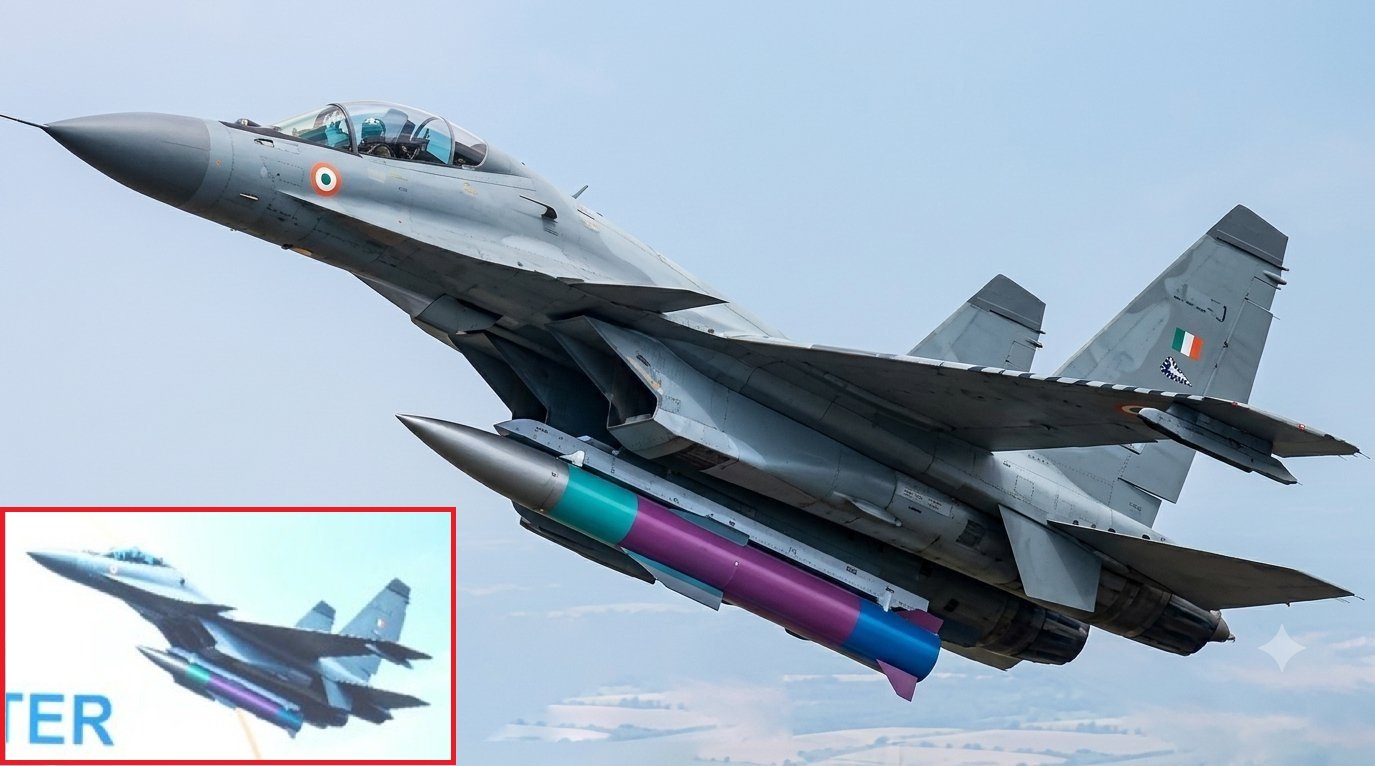
Recent open-source digital renders have shown a Su-30MKI carrying a large stand-off weapon comparable in size to the air-launched BrahMos missile. The images have generated discussion regarding India's long-range air-launched missile programmes.
Separately, some commentary has linked these discussions to Israel's Golden Horizon air-launched ballistic missile, with open-source estimates mentioning ranges between 800 km and 2,000 km, depending on the source. However, neither India nor Israel has officially confirmed any acquisition or joint development involving the Golden Horizon missile.
Expanding India's Long-Range Strike Capability
The combination of a Pralay-derived air-launched ballistic missile and the Rudram-4 Long-Range Stand-Off Weapon (LRSOW) is expected to provide the Indian Air Force with additional long-range precision strike options from existing fighter aircraft.
Both programmes are being developed by DRDO with participation from public and private sector production partners. Official details regarding final specifications, testing milestones, production schedules and induction timelines have not yet been announced.
——— End of Article ———