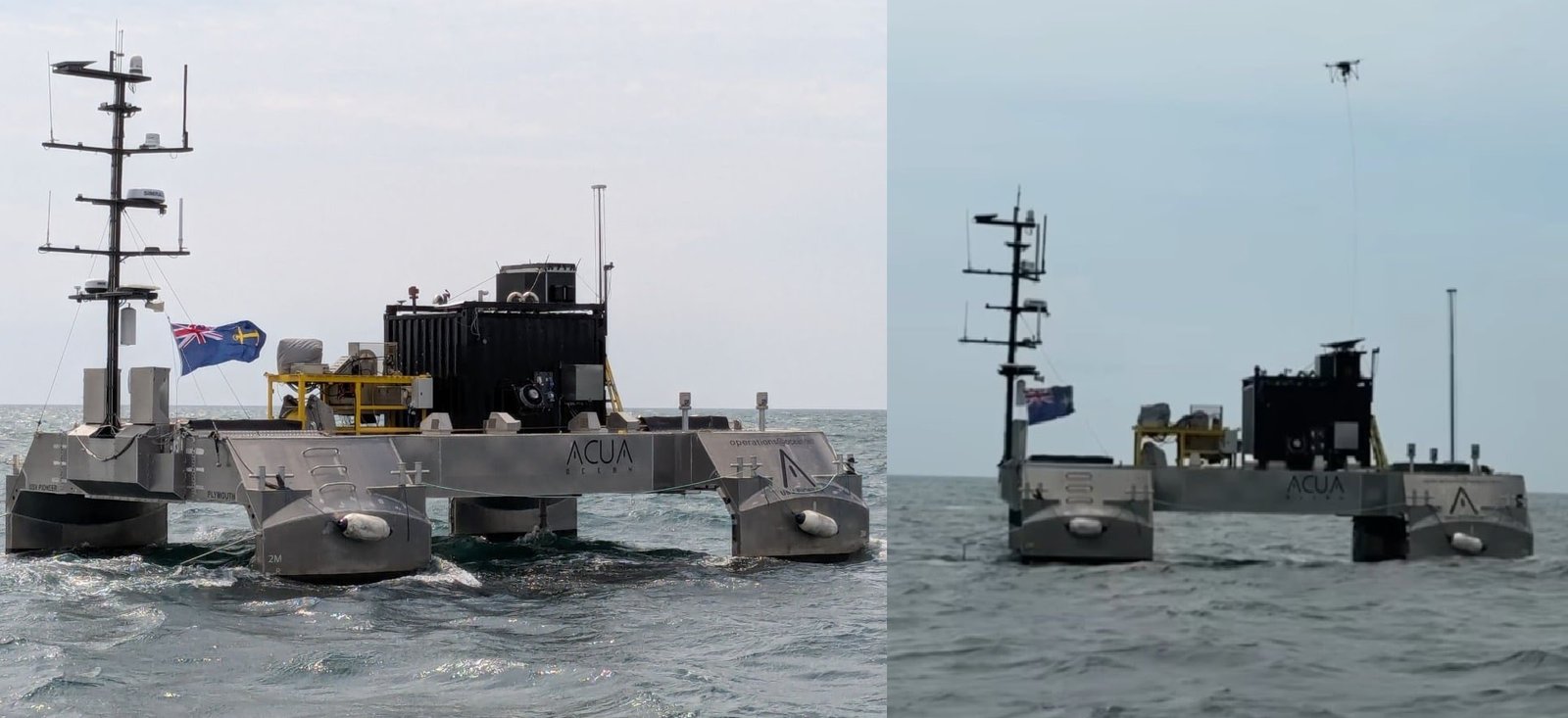
LONDON — British maritime robotics company ACUA Ocean and American sensor and drone manufacturer Teledyne FLIR Defense have successfully demonstrated an integrated autonomous maritime system capable of launching and recovering a tethered drone from an uncrewed surface vessel (USV) without any personnel on board either platform.
The two-day demonstration was conducted for the UK Ministry of Defence (MOD) and offshore industry partners under the UK Defence Innovation (UKDI) programme. According to the companies, the trial validated an integrated system combining an uncrewed surface vessel (USV) with a tethered uncrewed aerial system (T-UAS) to provide persistent intelligence, surveillance and reconnaissance (ISR) over extended periods.
Autonomous Vessel and Drone Operated Together
The demonstration used ACUA Ocean's USV Pioneer together with Teledyne FLIR Defense's SkyCarrier autonomous drone launch and recovery platform.
Installed on the deck of the Pioneer, the SkyCarrier automatically deployed and recovered a SkyRanger R70 drone during open-ocean operations. The launch and recovery platform is housed inside a protective container that unfolds into an articulating landing pad, enabling autonomous take-off and landing even while the host vessel is moving or operating on uneven surfaces. According to Teledyne FLIR Defense, the system supports launch and recovery while the host vehicle is travelling at speeds of up to 50 km/h (31 mph).
The USV Pioneer is the United Kingdom's first uncrewed vessel certified by Lloyd's Register for remote operation and is capable of operating either remotely or autonomously.
Tethered System Enables Continuous Surveillance
During the trials, the SkyRanger R70 remained connected to the Pioneer through a managed power and data tether.
The tether continuously supplies electrical power from the vessel, eliminating the drone's dependence on its onboard battery while maintaining a direct data connection. This allows the aircraft to remain airborne for extended periods without repeatedly landing for battery replacement or recharging.
According to the companies, the configuration creates a persistent aerial surveillance capability while keeping the drone positioned directly above the vessel throughout the mission.
Onboard AI and ISR Capability
The SkyRanger R70 is equipped with multiple embedded NVIDIA processors that perform real-time artificial intelligence processing onboard.
The drone uses four dedicated computer vision cameras for autonomous object detection and classification without relying on remote processing. It also carries a stabilised electro-optical and infrared sensor suite designed to provide Group 2 intelligence, surveillance and reconnaissance (ISR) capability on a Group 1 airframe.
Stable Platform Supports Open-Ocean Operations
ACUA Ocean said the Pioneer's seakeeping performance was a key factor in supporting tethered drone operations.
During tests conducted in January 2026, the vessel operated in 4.25-metre (13.9-foot) wave heights while achieving a 60 percent reduction in roll and a fourfold reduction in peak roll rates compared with traditional monohull vessels. According to the company, this stability enables sustained tethered drone operations in challenging open-ocean conditions.
Previous Royal Navy Demonstrations
The Pioneer has already completed multiple demonstration contracts for the Royal Navy, supporting intelligence, surveillance and reconnaissance (ISR) and anti-submarine warfare (ASW) tracking missions.
The vessel also completed a 100-hour continuous offshore operation in June 2026 without physical human intervention.
According to ACUA Ocean, the UKDI-funded demonstration confirmed the successful integration of the tethered drone system with the Pioneer's modular payload architecture and validated its operational performance during open-ocean trials.
Designed for Long-Endurance Maritime Missions
The companies said the integrated system addresses a requirement identified by the Royal Navy and wider UK defence community for persistent surveillance across both air and sea domains while reducing the need to place personnel in repetitive or hazardous environments.
They added that the combined capability supports missions including:
- Intelligence, surveillance and reconnaissance (ISR)
- Anti-submarine warfare (ASW) support
- Mine countermeasures
- Protection of undersea cables
- Security of offshore energy infrastructure
According to ACUA Ocean, the integrated air-and-surface system is designed to provide multi-week ocean endurance.
Company Statements
Neil Tinmouth, CEO of ACUA Ocean, said the demonstration represents an important milestone for UK maritime autonomy.
"Securing UKDI funding for this demonstrator is a significant milestone for ACUA Ocean and for UK maritime autonomy more broadly. Integrating the SkyRanger R70 with the Pioneer creates something genuinely new: a persistent, deployable multi-domain ISR capability that the Royal Navy can put to sea today. Teledyne FLIR Defense bring a battle-proven, operator-trusted UAS to a platform that is built, certified and ready. We look forward to demonstrating what this system can do."
Richard Cunha, Principal Product Director for Unmanned Aerial Systems at Teledyne FLIR Defense, said the combination expands the scope of maritime surveillance missions.
"The SkyRanger R70 has earned its reputation in the most demanding operating environments in the world. Pairing it with the Pioneer Mk2's exceptional sea-keeping capability and endurance opens up a new class of persistent maritime ISR mission that simply wasn't possible before."
UKDI Supports Defence Innovation
The project was funded by UK Defence Innovation (UKDI), the Ministry of Defence's organisation responsible for supporting early-stage defence technologies. UKDI operates with a ring-fenced annual budget of at least £400 million to accelerate the development and delivery of new capabilities for the UK Armed Forces.
According to ACUA Ocean and Teledyne FLIR Defense, the successful demonstration supports continued development of the integrated system and its potential future deployment at scale.
——— End of Article ———