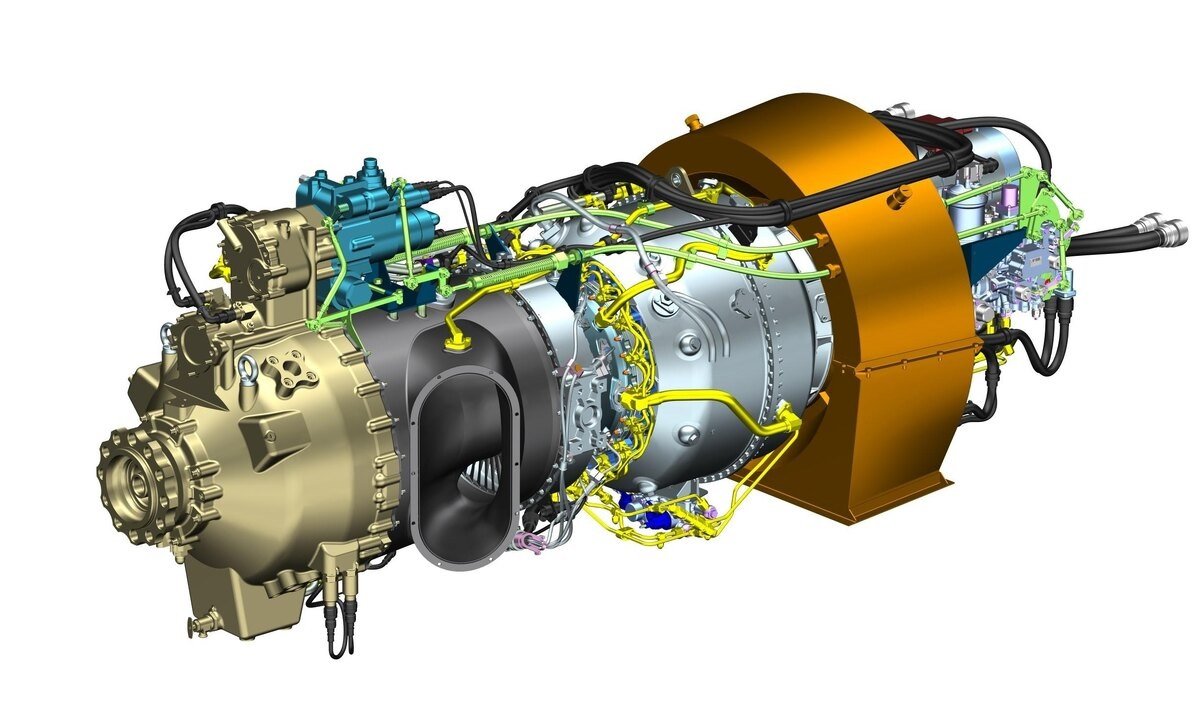
St. Petersburg, Russia — On August 18, Russia’s United Engine Corporation (UEC), part of the Rostec state corporation, announced that it has completed the design documentation and approved the mock-up of the new VK-1600S turboprop engine for small passenger and light aircraft.
The VK-1600S is being developed by UEC-Klimov as a fixed-wing derivative of the VK-1600V turboshaft engine developed for the Ka-62 helicopter. The new engine is rated at 1,450 horsepower at take-off.
Based on the VK-1600V
UEC plans to use a significant number of existing components from the VK-1600V to reduce the time required to develop the aircraft version. According to the company, the VK-1600S and VK-1600V are expected to share 60–65 percent of their components, including the gas generator and other key assemblies.
The adaptation for fixed-wing aircraft has required changes to the free turbine, while new gearbox and accessory-drive units have also been developed for the VK-1600S.
The approach allows UEC-Klimov to use previously developed engine technology rather than developing the entire power plant from the beginning. Rostec has previously described the VK-1600V as an engine designed for helicopters in the 5–8-tonne take-off-weight class.
FADEC and Operating Conditions
The VK-1600S will use a full-authority digital engine control system (FADEC), or FADEC, with the BARK-15S control unit.
The system is designed to support stable engine operation at altitudes from 300 to 4,500 metres, relative humidity of up to 100 percent, and temperatures ranging from –50°C to +55°C.
The VK-1600 family already uses electronic engine-control technology. The VK-1600V, for example, uses the BARK-15V automatic regulation and control unit developed by UEC-Klimov.
Demonstrator and Testing
According to Anton Kolosov, chief designer of the VK-1600 programme at UEC-Klimov, work is now focused on completing the VK-1600S demonstrator and preparing a specialised test bench.
The current development plan calls for completion of the test stand, manufacture of the demonstrator and bench testing by the end of 2026.
After these activities, the programme is scheduled to move to the production of three engines for initial endurance and specialised testing. A flight-test programme using a flying laboratory is also planned.
The overall development programme is scheduled for completion by the end of 2027, including type certification and the release of production design documentation.
Planned Aircraft Applications
The VK-1600S is designed for single-engine aircraft and is planned to operate with the AV-17 propeller.
One of its intended applications is the TVS-2DTS, an all-composite aircraft developed as a successor to the Soviet-era An-2. The engine is also planned for installation on modernised An-2 and An-3 aircraft that remain in service in Russia.
The programme is intended to provide a new turboprop power plant for this class of light aircraft and support the continued operation and modernisation of existing aircraft as well as the development of new designs.
Development Contract
The VK-1600S programme is being carried out under a 3.376 billion ruble contract signed between UEC and Russia’s Ministry of Industry and Trade in May 2025.
The contract requirements include integration of the engine with the An-2, TVS-2DTS and other light aircraft.
UEC describes the VK-1600S as the first Russian power plant developed in this class. Its development is based on the existing VK-1600V engine, while modifications to the turbine, gearbox and accessory systems are being made for fixed-wing applications.
The programme is therefore moving toward a demonstrator and ground-testing phase in 2026, followed by prototype testing, flight evaluation and certification planned through 2027.
——— End of Article ———