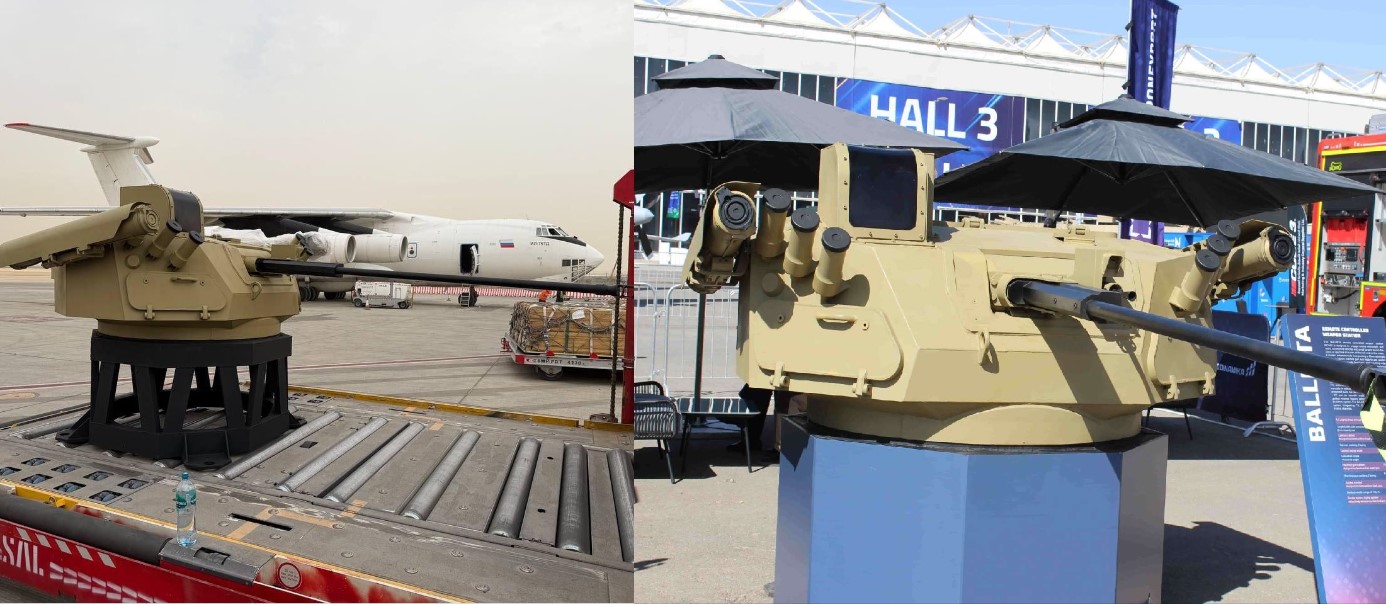
Riyadh, Saudi Arabia : Russia has formally unveiled the Ballista remote-controlled weapon station (RCWS) as an export-oriented combat module during the World Defense Show 2026 in Riyadh. The system was presented by Rosoboronexport, Russia’s state defense export agency, as a modular lethality upgrade intended for installation on existing armored vehicles and fixed defense positions. The presentation positions Ballista as a modernization solution for international customers seeking enhanced firepower and protection without replacing legacy vehicle fleets.
The debut took place within the framework of the World Defense Show 2026, where Russian defense manufacturers highlighted systems tailored to markets in the Middle East, Africa, and Asia. Ballista was promoted as export-ready and optimized for rapid integration on wheeled and tracked platforms already in service.
Design Concept and Integration Approach
Ballista is designed as a remotely operated, unmanned combat module emphasizing modular installation and compatibility with older armored platforms. With a reported dry weight of approximately 1,650 kilograms, the system remains within roof-load limits typical of many legacy armored personnel carriers. This weight threshold is critical for vehicles that cannot accommodate heavier infantry fighting vehicle turrets without extensive structural modification.
The turret has a low vertical profile and is intended for retrofit on platforms such as the BTR family of armored vehicles and comparable chassis. Overall dimensions are listed as 4,035 millimeters in length, 2,418 millimeters in width, and 1,239 millimeters in height from the mounting surface. These proportions reflect an effort to balance compactness with the integration of medium-caliber armament and missile systems.
Armament Configuration
The primary weapon fitted to Ballista is the 30 mm 2A42 automatic cannon, a dual-feed system allowing the operator to select between different ammunition types during engagement. The ammunition load is stated as 300 rounds. The 2A42 cannon is widely used across Russian and export combat vehicles and is intended for engagements against infantry, lightly armored vehicles, and field fortifications.
Secondary armament consists of a coaxial 7.62 mm PKTM machine gun supplied with 2,000 rounds. This weapon supports close-range engagements and provides sustained suppressive fire while conserving main gun ammunition.
For extended-range and anti-armor missions, Ballista carries two Konkurs-M anti-tank guided missiles (ATGMs) mounted externally on either side of the turret. These missiles provide an engagement range of up to 4,000 meters and are intended for use against heavy armor, hardened positions, and other high-value targets. The inclusion of ATGMs places Ballista closer in capability to unmanned medium-caliber turrets rather than light remote weapon stations.
Traverse, Elevation, and Crew Protection
Ballista offers continuous 360-degree traverse and an elevation range from −5 degrees to +70 degrees. This elevation envelope is intended to support operations in dense urban environments, mountainous terrain, and against elevated targets. The system is operated entirely from within the vehicle through a remote console, keeping the crew under armor at all times.
Remote operation reduces exposure to small-arms fire, snipers, shrapnel, and threats from unmanned aerial systems. This design reflects broader trends in armored vehicle development prioritizing crew survivability through unmanned or remotely controlled weapon systems.
Fire Control and Sensors
The weapon station integrates a stabilized fire-control suite combining high-resolution daylight television cameras, thermal imaging sensors for night and reduced-visibility conditions, and a laser rangefinder. The stabilization of these sensors allows target detection and engagement while the host vehicle is in motion. According to promotional material, the system is designed to operate under varied weather conditions and during high-speed maneuvering.
The fire-control architecture supports day-and-night operations and is intended to provide accurate target tracking and engagement across the full range of the mounted weapons.
Self-Protection Features
In addition to its offensive armament, Ballista incorporates an organic self-protection system. Six 81 mm smoke grenade launchers are mounted on the turret, providing rapid obscuration for the host vehicle. This capability is intended to support maneuver, disengagement, or response to detection by enemy optics and range-finding systems.
Export Strategy and Market Positioning
The introduction of Ballista reflects a broader Russian export strategy focused on incremental modernization rather than wholesale fleet replacement. By offering a heavily armed but modular unmanned turret compatible with existing vehicles, Russia is targeting armed forces operating large inventories of legacy platforms with limited modernization budgets.
At the World Defense Show, Ballista was displayed alongside other Russian systems aimed at the same market segment, including the BTR-22 armored personnel carrier and the Sarma 300 mm multiple launch rocket system (MLRS). Together, these exhibits formed part of a coordinated effort to maintain visibility and competitiveness in the Middle Eastern defense market.
On the exhibition floor in Riyadh, journalists observed Ballista configured as a compact yet heavily armed combat module that bridges the gap between light remote weapon stations and full infantry fighting vehicle turrets. Russian officials presented the system as suitable not only for wheeled armored vehicles but also for fixed defensive installations requiring remote, protected operation.
As presented at WDS 2026, Ballista is positioned as an export-ready solution delivering increased direct-fire capability, extended engagement range, and improved crew protection, while allowing customer nations to extend the operational relevance of existing armored fleets without transitioning to entirely new vehicle families.
——— End of Article ———