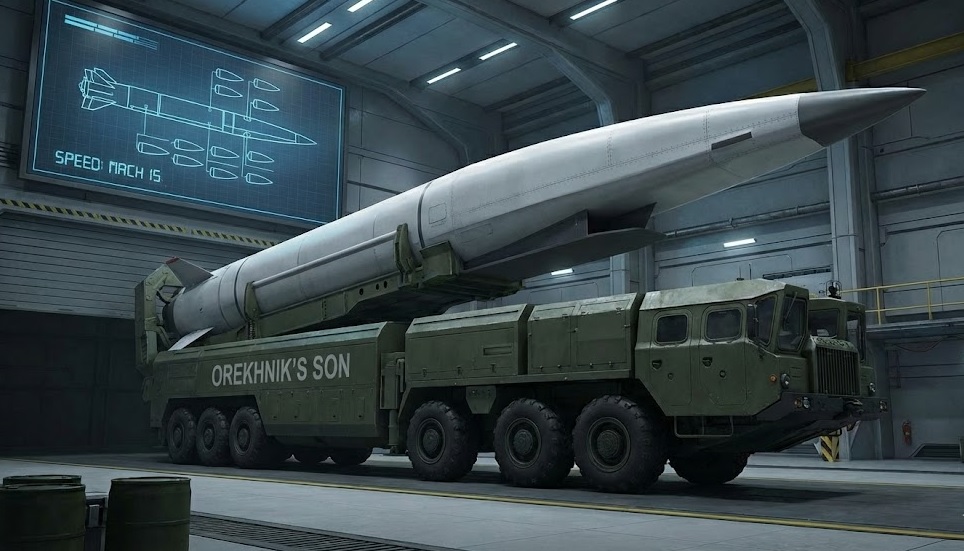
MOSCOW — Feb. 25, 2026 : Russia’s defense industry is reportedly developing a more advanced version of the Oreshnik intermediate-range ballistic missile (IRBM), according to statements published in Russian media and attributed to retired Colonel Viktor Baranets. The new system is unofficially referred to as “Orekhnik’s son” or “Son of Oreshnik” and is described as an upgraded, more powerful iteration of the existing missile.
Development and Reported Capabilities
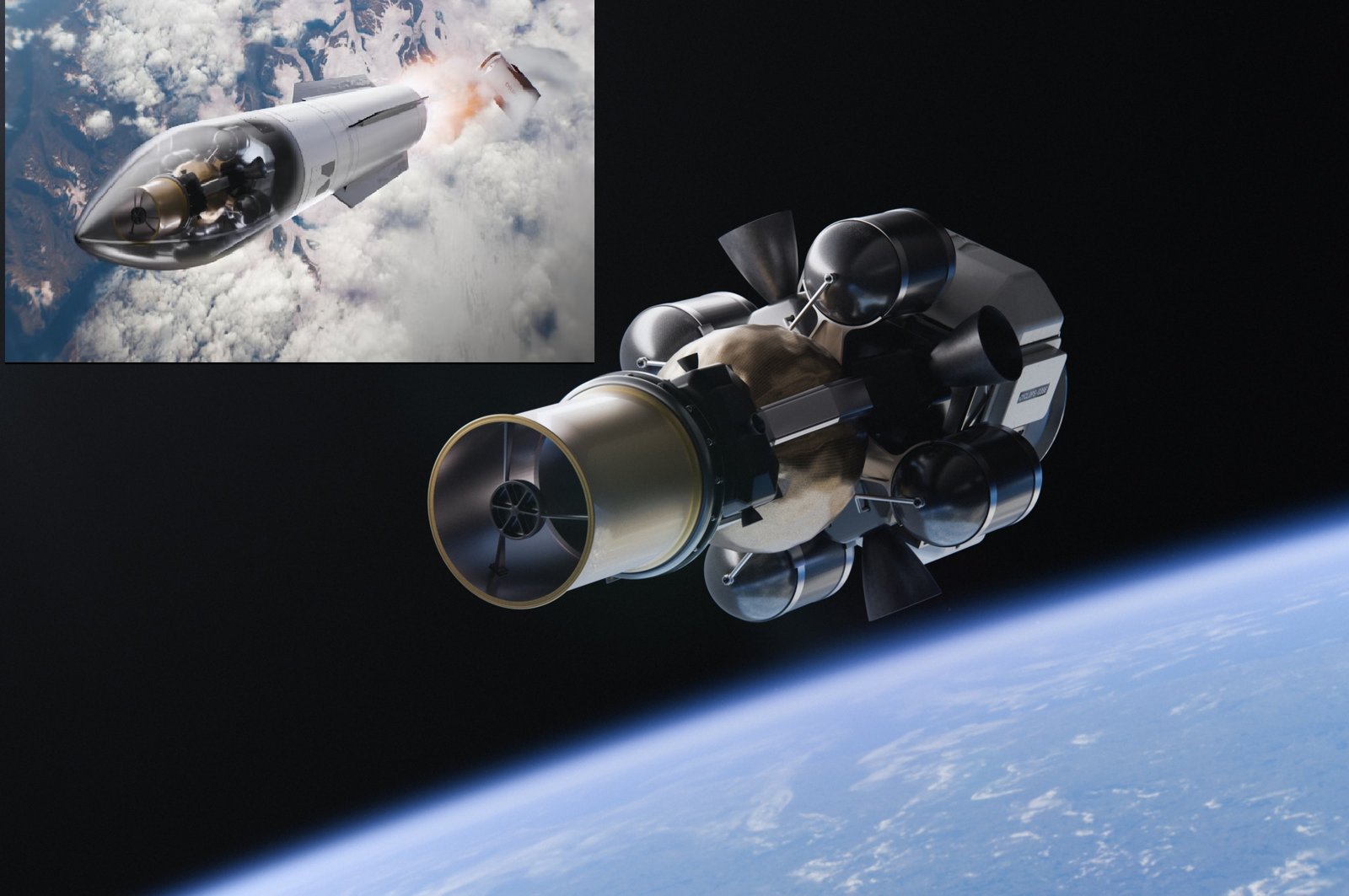
According to media reports, the upgraded missile is designed to carry eight kinetic warheads, an increase over the configuration of the current Oreshnik system. The warheads are intended for deep-penetration strikes against fortified and underground facilities, with a stated capability to destroy targets located at depths of approximately 30 meters.
The missile is also reported to feature a hypersonic flight profile, enabling rapid long-range deployment. Based on the specifications cited in the reports, the system would be capable of reaching London within eight minutes of launch.
Assuming a launch from western Russian territory near Moscow, the approximate straight-line distance to London is about 2,500 kilometers. Covering this distance in 8 minutes (480 seconds) would require an average speed of approximately 5.2 kilometers per second, or about 18,750 kilometers per hour. This corresponds to roughly Mach 15–16, depending on atmospheric conditions.
Baranets, a retired Russian colonel and military commentator for Komsomolskaya Pravda, stated that engineering efforts are currently focused on improving strike precision and overall accuracy. He said these enhancements are aimed at increasing the effectiveness of the system against strategic targets in Ukraine and Western countries.
In addition to accuracy improvements, Baranets indicated that specialists are working on expanding payload capacity, advancing fuel technology, and integrating updated guidance systems. He described the project as intended to surpass the current Oreshnik missile in power and overall combat parameters.
There has been no official confirmation of the new system from the Russian Ministry of Defense. The information available is based on media reports and statements attributed to Baranets.
Background on the Oreshnik Missile
The existing Oreshnik, meaning “Hazel Tree,” is a road-mobile intermediate-range ballistic missile capable of hypersonic speeds exceeding Mach 10. The system is equipped with six multiple independently targetable reentry vehicles (MIRVs), each carrying submunitions. It can be configured to carry either nuclear or conventional payloads.
The missile has an estimated operational range of between 3,500 and 5,500 kilometers. It is derived from the RS-26 Rubezh program and entered service in 2025.
The Oreshnik was first used in combat on Nov. 21, 2024, against a target in Dnipro, Ukraine. A second reported use occurred on Jan. 8, 2026, against targets in the Lviv region. Following its introduction, Oreshnik systems were placed on combat duty in Belarus.
Strategic Context
The reported development of “Orekhnik’s son” follows the deployment of the original Oreshnik system during the ongoing conflict in Ukraine. By increasing the number of kinetic warheads from six to eight and expanding its underground strike capability to approximately 30 meters, the upgraded missile is described as part of broader efforts by Russia’s defense sector to enhance systems capable of penetrating fortified structures and modern air and missile defense architectures across the European theater.
All currently available details regarding the new missile remain based on media reporting and expert commentary, with no formal announcement or technical specifications released by Russian defense authorities.
——— End of Article ———