MOSCOW, February 23, 2026 : Russia has positioned the Su-34 strike fighter as the first tactical combat aircraft capable of intercontinental-range transit without aerial refueling, citing its ability to fly distances equivalent to the route between Moscow and Washington, D.C., under a maximum-fuel ferry configuration.
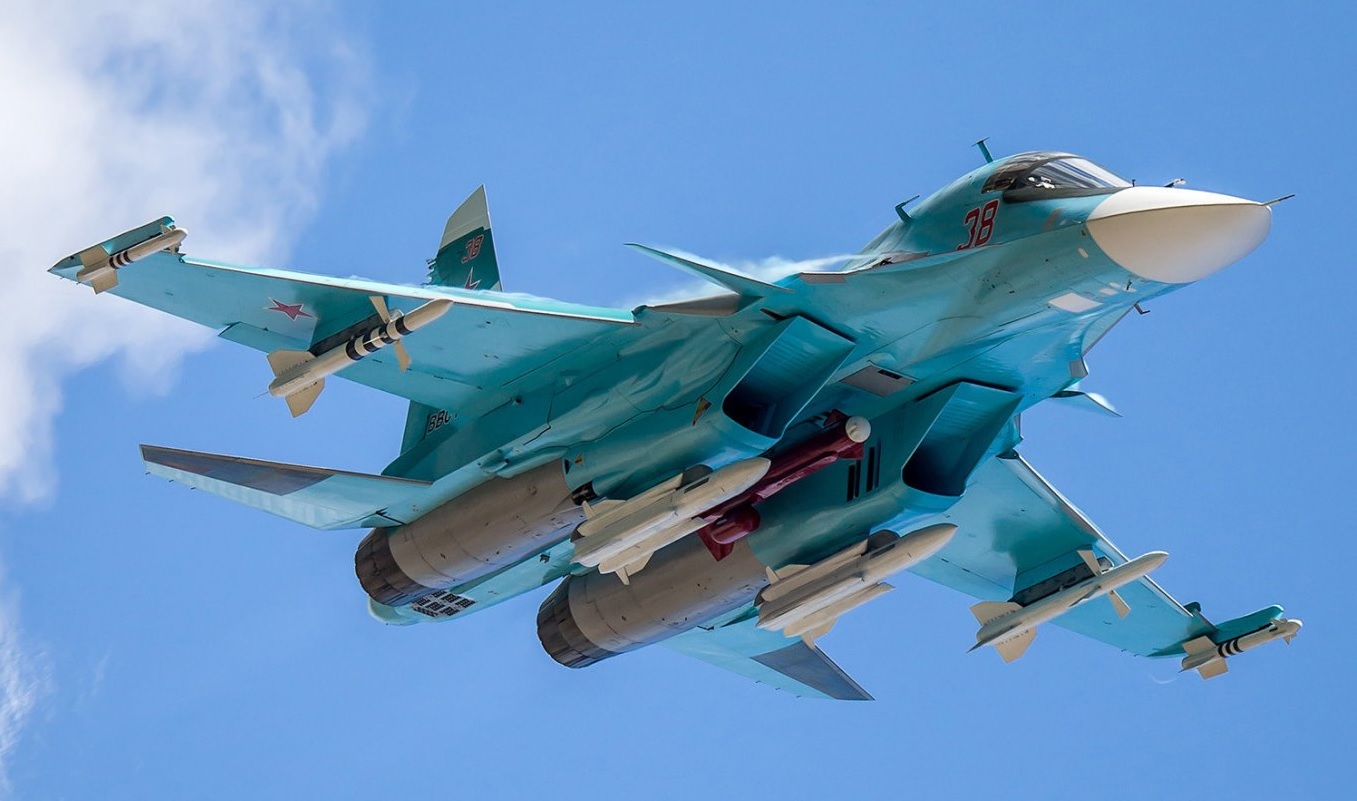
A report published on February 22, 2026, by Military Watch Magazine stated that when equipped with three 3,000-liter PTB-3000 external drop tanks, the Su-34’s ferry range approaches 8,000 kilometers. This range estimate reflects optimized cruise conditions at altitude, minimal payload, and the aerodynamic penalties associated with carrying external fuel tanks.
The straight-line distance between Moscow and Washington, D.C., ranges from approximately 7,500 to 7,821 kilometers depending on the specific departure and arrival coordinates, such as central Moscow to downtown Washington. Based on this measurement, analysts assess that the Su-34 has sufficient fuel capacity to complete such a transit without tanker support when configured exclusively for ferry operations.
Ferry Range Versus Combat Radius
Defense aviation sources differentiate between ferry range and combat radius. Ferry range refers to a transit configuration with limited or no weapons load, optimized fuel management, and cruise flight conditions. Combat radius reflects operational deployment with weapons, maneuvering, and mission-specific profiles.
According to manufacturer data and defense references, the Su-34’s standard ferry range on internal fuel alone is estimated between 4,000 and 4,500 kilometers under minimal load conditions. Some broader assessments place the internal-fuel ferry range closer to 4,800 to 5,000 kilometers, approaching the 5,500-kilometer benchmark often used to define intercontinental range.
The aircraft’s combat radius varies between 1,100 and 1,700 kilometers depending on mission profile, weapons load, and flight regime, including low-level penetration or high-low-high strike profiles. With external fuel tanks during operational missions, the action radius is cited at approximately 1,700 kilometers.
The Su-34 is fitted with a retractable aerial refueling probe, allowing range extension through tanker support. However, the current intercontinental characterization specifically refers to unrefueled ferry capability.
Design and Technical Characteristics
The Su-34 is a twin-engine, twin-seat, all-weather supersonic strike fighter derived from the Su-27 airframe but extensively redesigned for ground-attack operations and long-endurance missions. The aircraft features a widened forward fuselage with a side-by-side armored cockpit protected by titanium plating. It is equipped with K-36 ejection seats and provisions to support extended-duration sorties.
Powered by two Saturn AL-31FM1 turbofan engines, the Su-34 has a maximum speed of approximately Mach 1.8 at altitude and a service ceiling of up to 15,000 meters. The aircraft is capable of sustaining maneuvers up to +9 g. Official documentation notes that the aircraft’s noise level is approximately half that of earlier-generation strike platforms.
The Su-34 can carry between 8,000 and 8,500 kilograms of ordnance across 12 external hardpoints. Its weapons inventory includes guided bombs, cruise missiles, anti-ship missiles, air-to-air missiles, and standoff munitions. The aircraft supports day-and-night, all-weather operations and is equipped with terrain-following radar and an integrated electronic warfare suite.
Its passive electronically scanned array radar provides a reported detection range of 200 to 250 kilometers against large surface targets. The aircraft is configured to engage ground, surface, and airborne threats, including air defense systems and command-and-control infrastructure.
Operational Employment
Since 2022, the Su-34 has been employed extensively in Russia’s military operations in Ukraine. The aircraft has conducted long-range strike missions, reconnaissance sorties, and standoff attacks using UMPK and UMPB guided glide bomb kits.
These glide bombs are launched from distances reported between 37 and 56 miles behind front lines and are capable of reaching targets at ranges exceeding 60 to 70 kilometers. This standoff capability allows the aircraft to operate at increased distance from contested air defense zones, in some cases launching munitions from within Russian-controlled airspace.
The platform has been used against ground positions, surface targets, and air defense systems protecting infrastructure and command facilities.
However, the aircraft has also sustained losses during the conflict. On January 28, 2026, Ukraine reported the downing of a Russian Su-34 over the Black Sea, a claim confirmed by the Ukrainian General Staff. Additional losses were reported in February 2026 and on earlier occasions, underscoring operational risks when flying near contested airspace.
Production and Fleet Status
Production of the Su-34 continues at the Novosibirsk Aircraft Plant under the United Aircraft Corporation. Rostec announced on November 6, 2025, the delivery of a new batch of Su-34 aircraft to the Russian Ministry of Defense under the state defense order.
Additional deliveries were reported in September, October, and December 2025. Including prototypes and pre-production aircraft, total output has reached at least 153 units.
Ongoing production incorporates combat-experience-based refinements aimed at enhancing survivability, electronic protection, and mission versatility across strike, reconnaissance, and electronic warfare roles.
Comparative Positioning
In comparison with older strike aircraft such as the Su-24M, the Su-34 offers greater payload capacity, extended range, improved sensor systems, and enhanced electronic protection measures. Its configuration positions it between a heavy fighter and a medium bomber, supporting deep-strike missions, extended loiter operations, and multi-role tasking.
While the approximately 8,000-kilometer figure applies strictly to ferry operations with external fuel tanks and minimal payload, defense assessments indicate that this capability places the Su-34 among the longest-ranged tactical combat aircraft currently in operational service.
Russian sources emphasize that this unrefueled transit endurance differentiates the aircraft within the fighter-bomber category, although sustained intercontinental combat operations would require aerial refueling and mission-specific load configurations.
——— End of Article ———