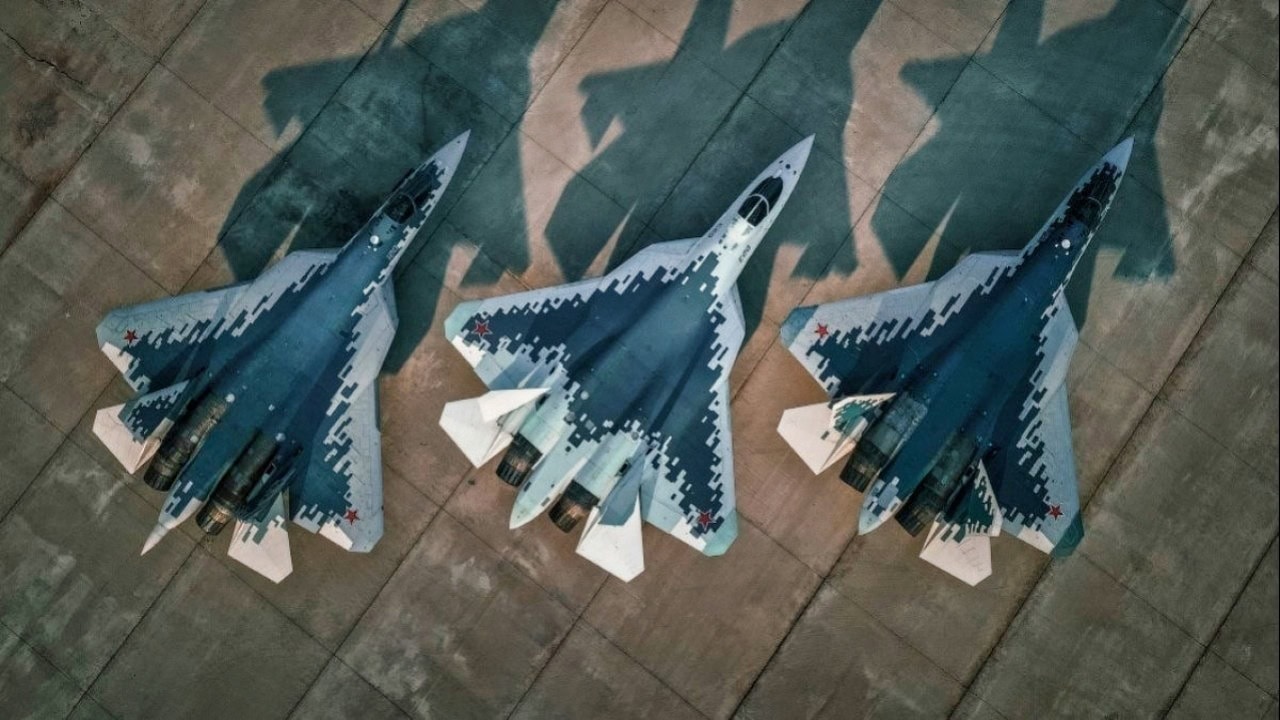
Moscow : Rostec has delivered a new batch of Su-57 fifth-generation multirole fighter aircraft to the Russian Ministry of Defense, continuing the implementation of the state defense order for advanced combat aviation. The handover was carried out by the United Aircraft Corporation (UAC), a Rostec subsidiary, following the completion of factory testing and acceptance procedures.
According to UAC, the newly supplied aircraft are built in a revised technical configuration that reflects incremental upgrades to onboard systems, weapons integration, and operational performance. The fighters were manufactured at the Komsomolsk-on-Amur Aviation Plant, Russia’s primary production facility for the Su-57 program.
Factory Trials and Military Acceptance
Before transfer to the Ministry of Defense, each aircraft underwent a full cycle of factory trials, including ground inspections, systems verification, and test flights. After delivery, pilots from the Russian Aerospace Forces (VKS) conducted acceptance flights across multiple operational modes to confirm the performance of the upgraded avionics, flight control systems, and integrated weapons complex.
Officials involved in the acceptance process stated that the testing focused on validating the reliability of new electronic components and ensuring compatibility with recently introduced airborne munitions. The aircraft were formally accepted into service after completing these evaluations.
Program Status and Production Timeline
The latest delivery follows the previous batch of Su-57 fighters transferred to the Russian military in November 2024. These handovers are part of a long-term contract under which the Russian Ministry of Defense is scheduled to receive 76 serially produced Su-57 aircraft by the end of 2027.
Rostec has reported that production of the Su-57 is proceeding on a continuous basis, with design updates introduced in successive batches rather than through a single major modernization program. This approach is intended to incorporate operational feedback while maintaining steady output from the production line.
Statements from Industry Leadership
Rostec Chief Executive Officer Sergey Chemezov said that the Su-57 program remains in active development, with modernization driven by data gathered during operational use. He noted that the aircraft delivered in the current batch incorporate enhancements aimed at improving combat effectiveness and survivability when operating against advanced air defense systems.
UAC Chief Executive Officer Vadim Badekha stated that the Su-57 is presently the most advanced combat aircraft in service with the Russian military. He added that work is ongoing to further expand the platform’s weapons options and electronic warfare capabilities, with additional upgrades planned for future production lots.
Technical Configuration and Capabilities
The Su-57 is designed as a multirole frontline aircraft capable of engaging air, ground, and maritime targets. The updated technical configuration delivered in this batch includes refinements to the integrated weapons system, allowing for the use of additional long-range and precision-guided munitions. Avionics upgrades include improved cockpit displays and automated flight control functions intended to enhance pilot situational awareness and reduce workload during complex missions.
The aircraft also features updated electronic countermeasure systems designed to increase resistance to electronic jamming and radar detection. The Su-57 is engineered for round-the-clock operation and is certified for use in adverse weather conditions and high-threat environments.
A VKS pilot who participated in the acceptance flights confirmed that the latest modifications expand the range of missions the aircraft can perform, particularly through the integration of new airborne weapons and updated mission systems.
Fleet Size and Engine Development
Industry estimates suggest that between 55 and 60 Su-57 airframes have been produced to date, including prototypes and serial production aircraft. In parallel with airframe production, development continues on the second-stage engine, known as the AL-51F1. This engine is intended to provide increased thrust, improved fuel efficiency, and sustained supersonic cruise without afterburner use once it enters full operational service.
Rostec has stated that new production facilities and upgraded manufacturing lines have been introduced at Komsomolsk-on-Amur to support higher output rates, despite ongoing constraints on international supply chains. The company maintains that these measures will allow it to meet the delivery schedule outlined in the current state defense order.
——— End of Article ———