Maldives / UK : The Maldives has formally rejected an international ruling on its southern maritime boundary and initiated an expanded military surveillance operation in waters surrounding the northern Chagos area, marking a significant policy reversal and a new phase in a long-running Indian Ocean maritime dispute.
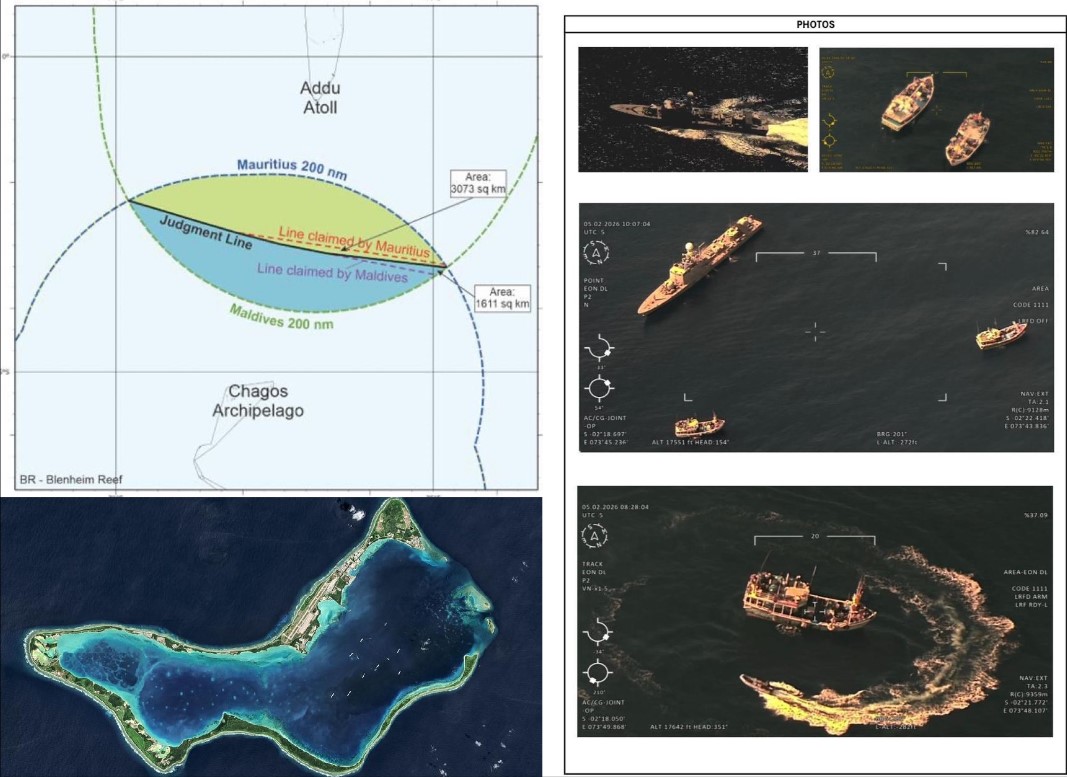
In a statement released on Thursday, the Ministry of Defence confirmed that the Maldives National Defence Force (MNDF) has begun what it described as a “special surveillance operation” covering up to 200 nautical miles from the country’s southern baseline. The operation, which commenced on February 4, involves the MNDF Coast Guard vessel Dharumavantha and unmanned aerial systems operated by the MNDF Air Corps.
According to the ministry, the deployment is intended to monitor and protect maritime zones that the government considers part of the Maldives’ exclusive economic zone (EEZ), following the administration’s decision not to recognise maritime boundaries established by an international tribunal.
Legal Position and Constitutional Basis
The defence ministry said the move follows President Mohamed Muizzu’s presidential address to Parliament earlier on Thursday. In that address, Muizzu stated that the Maldivian state does not recognise any changes to national territory that contradict the Constitution or domestic law.
The ministry cited Article 115(d) of the Constitution, which assigns the president responsibility for safeguarding national independence and territorial integrity. It also referenced Article 243, the Armed Forces Act, and the Maldives Maritime Zones Act as providing the legal basis for continued military monitoring and protection of maritime areas, including the EEZ.
Officials stressed that the MNDF is conducting surveillance within what the government defines as Maldivian maritime zones under national legislation, rather than undertaking offensive military action.
Withdrawal of Previous Government Correspondence
President Muizzu also announced the formal withdrawal of a letter sent in 2022 by former president Ibrahim Mohamed Solih to the prime minister of Mauritius concerning the sovereignty of the Chagos Archipelago.
Muizzu said consultations with local and international legal experts concluded that the letter had negatively affected national security interests and maritime claims. The current administration maintains that the correspondence departed from the Maldives’ long-standing legal position during international proceedings.
The former government has rejected accusations of legal mishandling, stating that its actions were consistent with international law.
ITLOS Ruling and Its Implications
The dispute centres on a 2023 ruling by the International Tribunal for the Law of the Sea (ITLOS) on the maritime boundary between the Maldives and Mauritius. Under that decision, the Maldives was awarded approximately 92,563 square kilometres of disputed maritime area but lost around 45,331 square kilometres of waters it had previously claimed as part of its EEZ.
The tribunal’s reasoning relied in part on an advisory opinion issued by the International Court of Justice (ICJ), which concluded that sovereignty over the Chagos Archipelago lies with Mauritius and described the United Kingdom’s historical administration of the islands as unlawful.
President Muizzu has stated that his government will not recognise the maritime boundary determined by ITLOS, arguing that Maldivian EEZ limits are already defined under domestic law through archipelagic baselines established in the Maritime Areas Act.
United Kingdom Response and Absence of Military Measures
Despite the Maldivian military deployment and the rejection of international rulings, the United Kingdom has not announced any military response to the developments in the northern Chagos area.
British officials have reiterated that the sovereignty dispute over the Chagos Archipelago is a legal matter between the United Kingdom and Mauritius, and have emphasised diplomatic engagement rather than enforcement action. The UK Foreign Office has cited existing international court opinions and rulings as the appropriate framework for resolving the issue.
Analysts note that the absence of a military response reflects the United Kingdom’s current strategic posture, which prioritises legal processes, diplomatic negotiations, and alliance coordination, particularly in regions involving United States military facilities. The presence of the US base on Diego Garcia and ongoing discussions over the future status of the archipelago are widely seen as factors limiting unilateral military action.
There has been no indication from London that the UK intends to challenge Maldivian surveillance activities through force, and officials have not characterised the MNDF operation as a direct security threat.
Chagos Archipelago and International Context
The maritime dispute is closely linked to the Chagos Archipelago, including Diego Garcia, which hosts a major United States military facility. The Maldivian government has said it has engaged in diplomatic communication with the United Kingdom, sending two formal letters asserting what it describes as a stronger Maldivian claim to the Chagos area than that of Mauritius.
Muizzu confirmed that he also held a telephone conversation with the British deputy prime minister to convey Malé’s position. According to the president, his administration has additionally proposed an arrangement to the United States under which Washington could continue operating its naval base on Diego Garcia if sovereignty over the islands were to be transferred to the Maldives.
Commission of Inquiry and Institutional Changes
The president announced the establishment of a Commission of Inquiry to examine how the Maldives’ case before international tribunals was handled under the previous administration. He also said that a specialised government office would be created to manage legal, technical, and diplomatic work related to maritime disputes and boundary claims.
Government officials described these steps as necessary to coordinate future international litigation and negotiations more effectively.
Ongoing Surveillance Operations
The MNDF has stated that it will continue surveillance activities in the southern maritime zone, characterising them as routine enforcement and monitoring measures consistent with national law. Authorities have emphasised that the Maldives regularly conducts patrols within its EEZ, and that the current operation reflects a policy decision to actively assert its interpretation of maritime boundaries.
The situation remains under close observation as diplomatic discussions continue and regional stakeholders assess the implications of the Maldives’ rejection of the ITLOS ruling.
——— End of Article ———