Tokyo — Japan’s Ministry of Defense has started planning a new close-range air defense system called the Close Range Air Defense System (CRADS) to counter large numbers of small drones and other airborne threats.
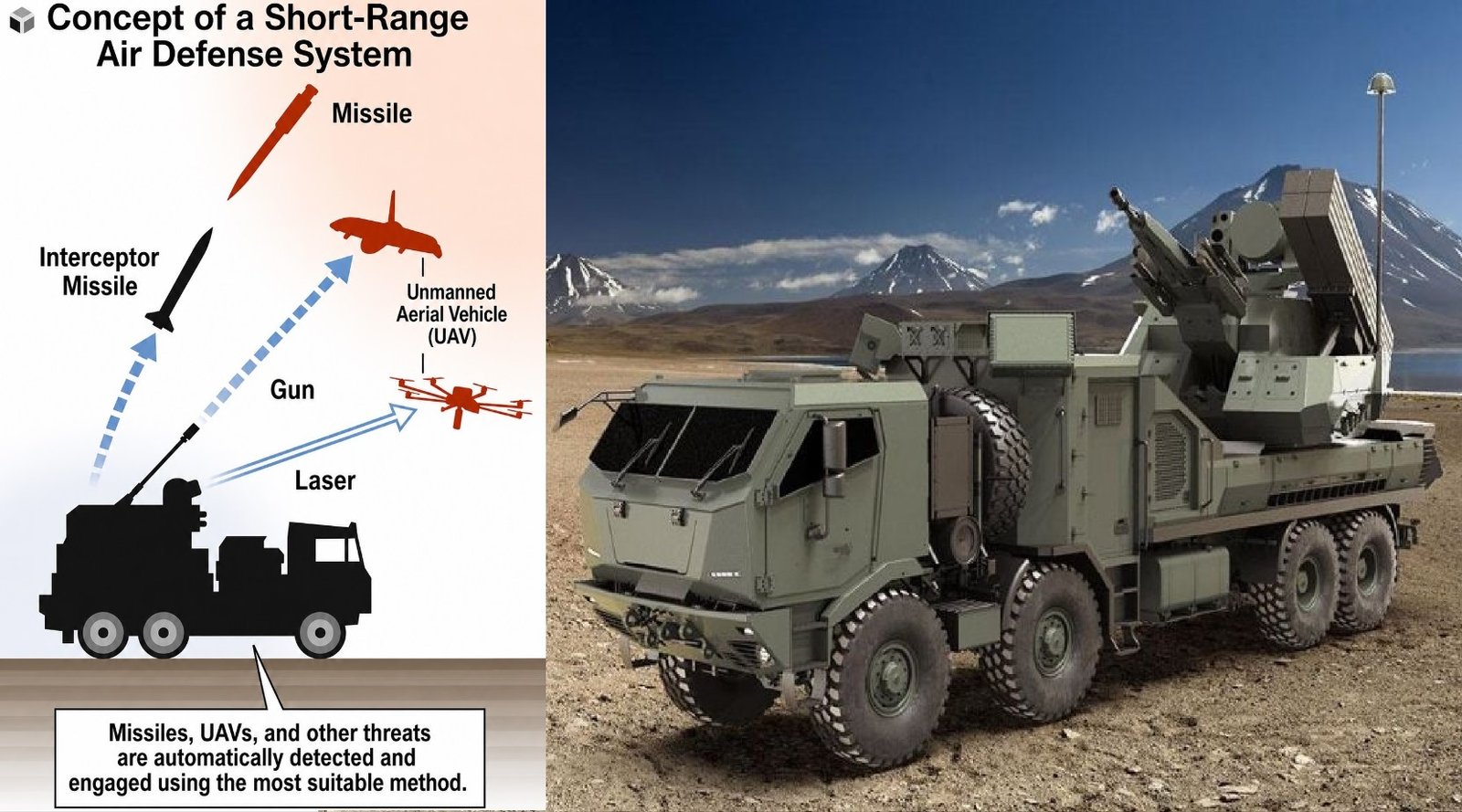
According to a Ministry of Defense document reported by the Yomiuri Shimbun , CRADS will combine interceptor missiles, an automatic cannon and a laser weapon on a single self-propelled wheeled platform. The system is planned for the Japan Ground Self-Defense Force (JGSDF).
The Ministry of Defense plans to include CRADS in its fiscal 2027 budget request as a “matter request,” meaning the specific funding amount has not yet been fixed.
CRADS is designed to automatically identify incoming targets and select the most suitable weapon. Missiles would provide longer-range interception but are expensive and limited in number. The automatic cannon would provide a cheaper option with a larger ammunition supply but a shorter range. The laser would have an even shorter engagement range but would not require conventional ammunition, provided sufficient power is available.
The combination is intended to help counter drone swarms and saturation attacks involving many missiles launched almost simultaneously, while reducing the use of expensive missiles against low-cost targets.
The wheeled platform is intended to give CRADS greater mobility so it can move with ground forces. It is expected to initially complement the existing Type 93 short-range air defense system, which uses missiles based on the Type 91 MANPADS and is mounted on high-mobility vehicles.
CRADS is part of Japan’s wider effort to modernize its short-range air defense. In parallel, the Ministry of Defense is developing another wheeled air defense system intended to eventually replace the Type 93. That program involves a surface-to-air missile based on an existing air-to-air missile design, with contracts awarded to Mitsubishi Heavy Industries and Toshiba. Available information points to the AAM-5 family as the likely basis, although the specific missile has not been officially identified in the information provided.
Japan is also developing directed-energy weapons. The Ministry of Defense plans a fiscal 2027 demonstration project for a high-power microwave system designed to disrupt the electronic control systems of drones. Japan has also been developing vehicle-mounted high-power laser systems.
Together, these programs are intended to provide the JGSDF with additional mobile and layered options against small drones, drone swarms and large-scale missile attacks.
——— End of Article ———