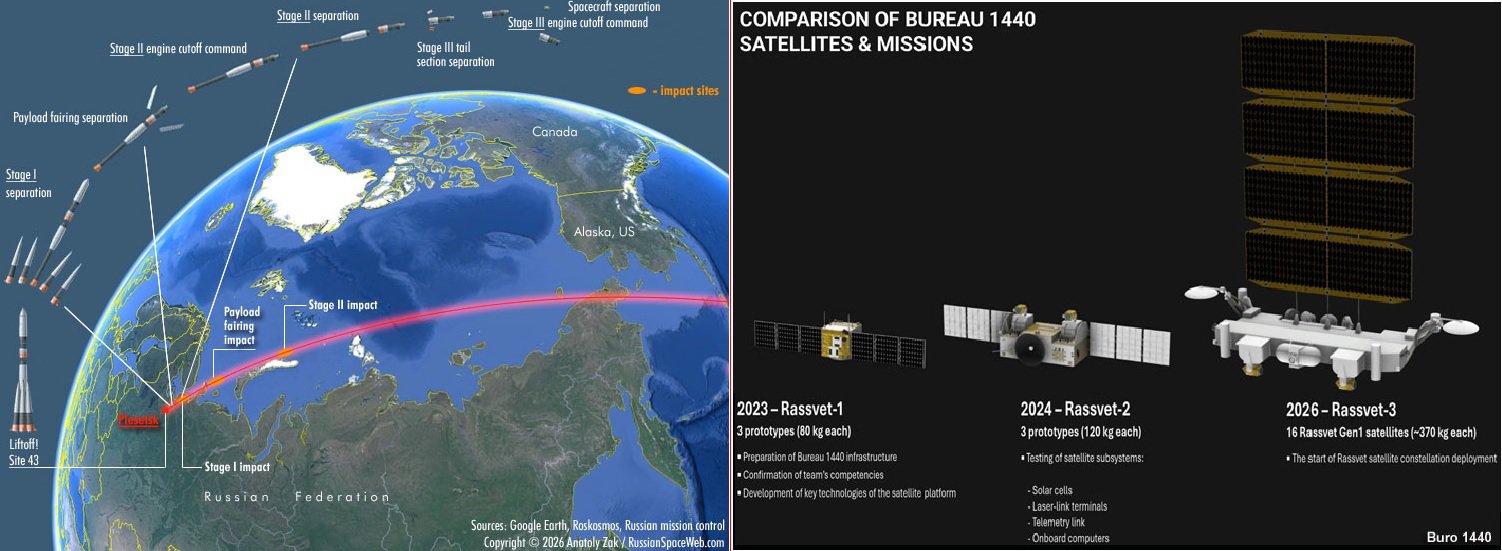
Moscow — Two satellites from Russia’s second Rassvet broadband constellation group are heading toward atmospheric reentry after failing to perform orbit-raising maneuvers, according to tracking data analyzed by Anatoly Zak of RussianSpaceWeb.
The two satellites had fallen below 300 kilometers by late August and appear to be undergoing natural orbital decay caused by atmospheric drag. The development is another setback for Bureau 1440, the Russian company developing the Rassvet low Earth orbit (LEO) broadband network, which Russian officials have promoted as a domestic alternative to SpaceX’s Starlink.
The affected spacecraft are part of 16 Rassvet-3 satellites launched on July 19 at approximately 17:51 UTC from the Plesetsk Cosmodrome aboard a Soyuz-2.1b rocket. The U.S. Space Force catalogued 17 objects from the mission — the 16 satellites and the rocket’s upper stage — in an initial orbit of about 289 by 327 kilometers with an inclination of 82.3 degrees.
Bureau 1440 said on July 20 that all satellites had separated from the upper stage and established contact with mission control. The company said they would begin transferring to their target orbit after subsystem checks and activation. Neither Roscosmos nor Russia’s Ministry of Defense publicly acknowledged the July 19 launch.
Tracking data showed that nine of the 16 satellites began orbit-raising maneuvers between late July and early August. By August 5, 11 satellites were climbing. However, by late August, three of those satellites had stopped maneuvering and began slowly losing altitude between 310 and 330 kilometers. None of the 16 satellites from the July batch had risen above 360 kilometers. Their altitudes were about 200 kilometers lower than those reached by surviving satellites from the March batch at a comparable point.
The July group’s orbital plane is also more than 100 degrees different from that of the March group, based on their right ascension of the ascending node.
The latest problem follows the loss of Object 4 from the first Rassvet batch. Launched on March 23, the satellite never performed an orbit-raising maneuver and reentered the atmosphere on June 6, after spending about 75 days in orbit.
Rassvet is intended to provide Russia with an independent satellite broadband network. Bureau 1440 has stated plans to deploy about 250 satellites by 2027, when commercial service is planned to begin, and eventually expand the constellation to as many as 900 satellites by 2035. Other reports have cited a target of 292 satellites by the end of 2027. Each Rassvet-3 satellite has a mass of about 370 kilograms and is designed for near-polar orbits.
The first Rassvet group is already providing limited coverage over Ukraine, according to Ukrainian satellite communications analysts. Volodymyr Stepanets told Militarnyi that the satellites provide at least two daily communications windows over Ukrainian territory, with each lasting more than an hour. Ukrainian adviser Serhii Beskrestnov, known as Flash, has estimated that Russia would need 200 to 250 satellites for stable, continuous coverage.
The satellite problems have also coincided with security concerns around Plesetsk. Roscosmos Director General Dmitry Bakanov previously said Ukrainian forces attempted a drone attack on the facility during preparations for the March launch. Ukrainian drones were again detected in the surrounding Arkhangelsk region on August 23, one day before another classified Russian military satellite was launched from Plesetsk on August 24.
As of August 25, Roscosmos, the Russian military and Bureau 1440 had not issued an official update on the status of the underperforming satellites from the July Rassvet launch.
——— End of Article ———