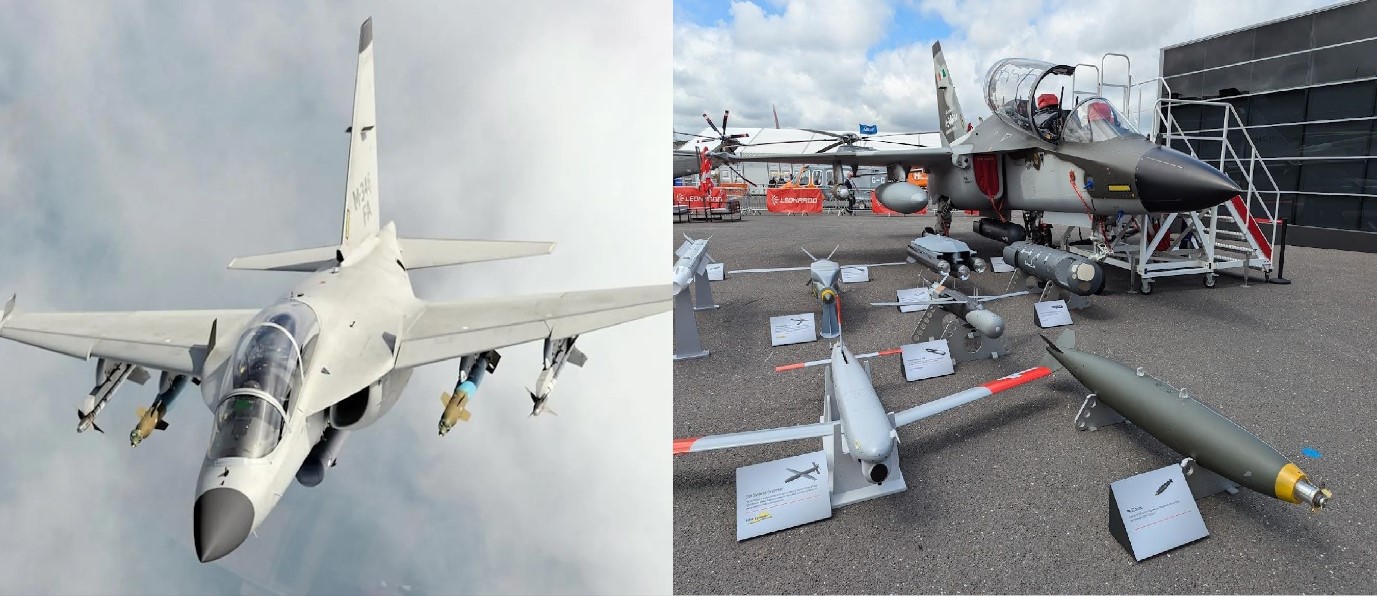
JAKARTA / SINGAPORE : Indonesia has formally decided to procure Italy’s M-346F Block 20 fighter attack aircraft, closing the door on Pakistan’s bid to sell the JF-17 Thunder and concluding months of speculation surrounding Jakarta’s next light combat aircraft acquisition. The decision was confirmed on Wednesday at the Singapore Airshow, where Indonesia’s Ministry of Defence signed a Letter of Intent (LoI) with Italy’s aerospace manufacturer Leonardo for the M-346 Fighter Attack variant.
The announcement delivers a clear outcome to a competition that had drawn attention across Asia’s defense industry. While reports earlier this year suggested Indonesia was nearing a deal for up to 40 JF-17 Block III fighters, Jakarta’s final choice underscores a different operational priority for the Indonesian Air Force.
Airshow Signing Clarifies Indonesia’s Direction
The Letter of Intent, signed on the sidelines of the Singapore Airshow, outlines Indonesia’s intention to acquire the M-346F Block 20 and pursue industrial cooperation. Leonardo confirmed that discussions will now move toward finalizing a procurement contract, which is expected to cover approximately 24 aircraft in its initial phase, alongside training, logistics, and local industry participation.
Indonesian officials did not publicly address the earlier JF-17 reports during the months of speculation, but the formal commitment to the Italian platform effectively settles the matter. The decision aligns with Indonesia’s broader air force modernization program, which already includes the induction of the Rafale and plans to operate the F-15EX.
Earlier JF-17 Reports Proved Premature
In January, a series of media reports, including one citing unnamed officials, claimed Indonesia was in advanced negotiations with Pakistan for JF-17 Block III fighters, potentially bundled with unmanned aerial systems. Those reports were accompanied by publicity around high-level defense meetings between Jakarta and Islamabad, fueling expectations of a breakthrough export deal for Pakistan.
Defense analysts now assess that those reports overstated the maturity of the talks. No formal documentation or procurement notice emerged from Indonesia during that period, and the Ministry of Defence maintained a neutral public stance. The subsequent decision in favor of the M-346F indicates that Indonesia’s evaluation process ultimately favored a platform tailored to training and light combat rather than a dedicated frontline fighter.
Operational Requirement Favored a Dual-Role Aircraft
The Indonesian Air Force requirement centered on replacing its aging BAE Hawk 109/209 fleet, which has long served as both an advanced trainer and a light attack aircraft. Jakarta sought a modern Lead-In Fighter Trainer (LIFT) capable of preparing pilots for high-performance fighters while also providing credible operational capability for patrol, counter-insurgency, and air-policing missions.
The M-346F Block 20 met this dual-role requirement. Developed from the M-346 Master advanced trainer, the fighter attack variant is designed to transition seamlessly from training to operational missions without the cost and complexity associated with heavier combat aircraft.
By contrast, the JF-17 Thunder is a single-engine multirole fighter optimized for combat operations. While capable in air defense and strike roles, it does not function as an advanced trainer, which would have required Indonesia to maintain a separate LIFT platform alongside any JF-17 fleet.
Capabilities of the M-346F Block 20
The Block 20 configuration selected by Indonesia incorporates a modern digital cockpit with a Large Area Display, advanced mission computers, and a fully networked avionics suite. The aircraft is equipped with Leonardo’s Grifo fire-control radar, with the Block 20 standard expected to include an Active Electronically Scanned Array (AESA), enabling air-to-air tracking, ground mapping, and precision-strike support.
The platform supports Link 16 tactical data links, aerial refueling, helmet-mounted displays, and external targeting pods for laser-guided weapons. With seven external hardpoints and a payload capacity of roughly three tonnes, the M-346F can carry air-to-air missiles for air policing, as well as guided and unguided munitions for ground attack.
A key feature for Indonesia is the Embedded Tactical Training System (ETTS), which allows pilots to simulate complex combat scenarios, sensors, and weapons in flight without carrying live ordnance. This capability enables cost-effective training for pilots transitioning to aircraft such as the Rafale, while preserving airframe life and reducing operating costs.
The aircraft’s twin-engine configuration, powered by Honeywell F124 turbofans, also provides an added margin of safety for training and maritime patrol operations, particularly over Indonesia’s vast archipelagic territory.
JF-17 Program Faces Availability Challenges
Indonesia’s decision also comes amid persistent concerns over the JF-17’s operational availability. According to defense assessments and open-source reporting, the JF-17 fleet operated by the Pakistan Air Force has faced low serviceability rates, with availability frequently reported below 50 percent. The situation has been attributed to shortages of spare parts, supply-chain constraints, and dependence on multiple foreign suppliers for key subsystems.
Pakistani officials have acknowledged maintenance and logistics pressures in recent years, and a portion of the JF-17 fleet has periodically remained grounded due to parts shortages. These factors have raised questions among potential customers about long-term sustainment, lifecycle costs, and readiness levels, particularly for air forces seeking high availability from relatively small fleets.
While the JF-17 remains a core component of Pakistan’s air combat capability and is in service with several smaller air forces, the availability challenges have complicated its export prospects in more competitive markets.
Strategic and Industrial Implications
For Italy’s Leonardo, the Indonesian decision represents a significant foothold in Southeast Asia and reinforces the M-346 program’s positioning as both an advanced trainer and a light combat aircraft. The LoI includes provisions for industrial cooperation with Indonesian firms, supporting Jakarta’s goal of strengthening domestic aerospace capabilities.
For Pakistan, the outcome marks a missed opportunity to secure what would have been the largest export order in the JF-17 program’s history. Indonesia, as Southeast Asia’s largest economy and a high-profile regional air power, was widely viewed as a potential reference customer.
Next Steps
Negotiations between Indonesia and Leonardo are expected to continue in the coming months to finalize contract terms, delivery schedules, training packages, and local industrial participation. Once concluded, the M-346F Block 20 will assume both training and light combat duties within the Indonesian Air Force, gradually replacing the Hawk fleet and supporting the transition to more advanced fighters.
The decision clarifies Indonesia’s procurement strategy: prioritizing multi-role, cost-efficient platforms that combine training and operational capability, while maintaining interoperability with Western combat aircraft already entering service.
——— End of Article ———