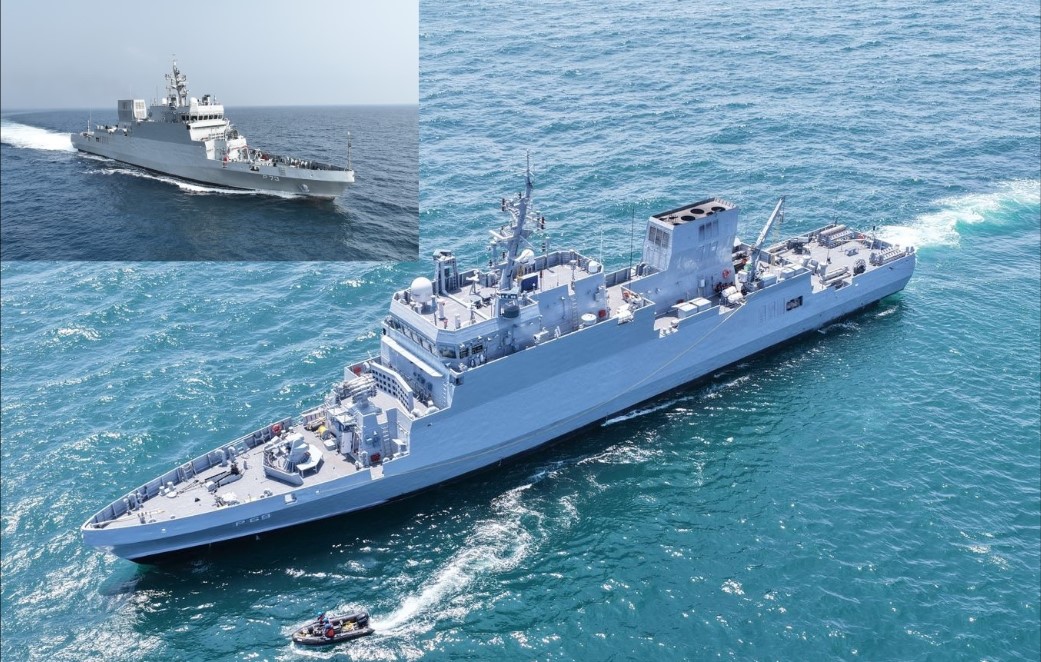
CHENNAI, — February 23, 2026 : The Indian Navy will commission INS Anjadip on February 27, 2026, at Chennai Port, marking the induction of the third Anti-Submarine Warfare Shallow Water Craft (ASW-SWC) under the Arnala-class program. Admiral Dinesh K. Tripathi, Chief of the Naval Staff, will preside over the commissioning ceremony.
INS Anjadip is the third vessel in the Arnala subclass being constructed by Garden Reach Shipbuilders & Engineers (GRSE) under a Public-Private Partnership (PPP) model in collaboration with Larsen & Toubro (L&T) Shipyard, Kattupalli. The keel for the vessel was laid in June 2022, it was launched in June 2023, and it was delivered to the Indian Navy on December 22, 2025.
Project Background
The ASW-SWC program involves the construction of 16 vessels in total — eight under the Arnala subclass by GRSE and eight under the Mahe subclass by Cochin Shipyard Limited (CSL). The ships are being inducted to replace the aging Abhay-class corvettes that have been in service since 1989.
INS Anjadip follows INS Arnala, commissioned in June 2025, and INS Androth, commissioned in October 2025. Upon commissioning, the vessel is expected to join the Eastern Naval Command to strengthen anti-submarine operations along India’s eastern seaboard, including the coasts of Tamil Nadu and Puducherry.
Design and Construction
Constructed in accordance with the classification rules of the Indian Register of Shipping (IRS), INS Anjadip incorporates approximately 88 percent indigenous content. Major systems and equipment are sourced from Indian defense manufacturers, including Bharat Electronics and Mahindra Defence, in line with the government’s Aatmanirbhar Bharat initiative aimed at increasing domestic defense production.
The vessel incorporates stealth features designed to reduce radar cross-section, along with measures to lower acoustic and infrared signatures to enhance survivability in contested environments.
INS Anjadip is named after Anjadip Island off the coast of Karwar, Karnataka. The vessel carries forward the legacy of the earlier INS Anjadip, a Petya-class corvette that served the Navy until its decommissioning in 2003.
Operational Role
The primary mission of the Arnala-class ASW Shallow Water Craft is the detection, tracking, and neutralization of submarines in coastal and shallow waters. With a draught of 2.7 meters, the vessel is designed to operate effectively in restricted littoral zones where larger, deep-draught warships face limitations.
In addition to anti-submarine warfare, INS Anjadip is configured for:
-
Coastal surveillance
-
Low-Intensity Maritime Operations (LIMO)
-
Subsurface mine-laying
-
Search and Rescue (SAR) missions
-
Interdiction of unmanned underwater vehicles and midget submarines
-
Coordinated ASW operations with maritime aircraft
The vessel is capable of sustained sub-surface surveillance in coastal waters up to 200 nautical miles from shore.
Technical Specifications
INS Anjadip belongs to the Arnala-class Anti-Submarine Warfare Shallow Water Craft category and displaces approximately 900 tonnes (standard), with gross tonnage reaching up to 1,490 tonnes.
The ship measures 77.6 meters in length, has a beam of 10.5 meters, and a draught of 2.7 meters. It is powered by three marine diesel engines connected to three waterjets through reversible reduction gears, making it the largest Indian naval warship class propelled by waterjet systems. The propulsion configuration provides enhanced maneuverability and agility in shallow-water operations.
The vessel has a maximum speed of 25 knots and a cruising speed of 14 knots. Its operational range is approximately 1,800 nautical miles at cruising speed, with an endurance of up to 10 days. The ship accommodates a complement of 57 personnel, including seven officers and 50 sailors.
Sensors and Combat Systems
INS Anjadip is equipped with an indigenous combat management and sensor suite. Its underwater detection capability includes a DRDO-developed ‘Abhay’ Hull-Mounted Sonar and a Low-Frequency Variable Depth Sonar (LFVDS). The vessel also carries towed array sonar systems for extended sub-surface surveillance.
The anti-submarine weapons package includes:
-
RBU-6000 anti-submarine rocket launchers
-
Two triple-tube torpedo launchers configured for Advanced Light-Weight Torpedoes
-
Automated mine-laying rails
For surface and close-range defense, the vessel is fitted with:
-
A 76 mm Super Rapid Gun Mount (SRGM)
-
A 30 mm Naval Surface Gun
-
Two 12.7 mm stabilized remote-controlled guns
-
Two AK-630M Close-In Weapon Systems (CIWS)
-
Two 12.7 mm DShK machine guns
The ship also features a helicopter deck capable of operating a Chetak or Dhruv helicopter for maritime reconnaissance and coordinated anti-submarine operations.
Strategic Significance
The commissioning of INS Anjadip strengthens the Indian Navy’s coastal and littoral anti-submarine warfare capabilities in the Indian Ocean Region. The ASW-SWC program reflects continued emphasis on indigenous warship design, modular construction, and domestic supply chains, with all vessels under the program expected to be inducted by the end of 2026.
With its shallow draught, waterjet propulsion, and integrated indigenous combat systems, INS Anjadip enhances India’s layered maritime defense framework, particularly in near-shore and shallow-water operational environments.
——— End of Article ———