NEW DELHI, — March 3, 2026 : India is preparing to procure five additional squadrons of the S-400 Triumf long-range surface-to-air missile system from Russia, a move that would double its planned inventory to ten squadrons and significantly expand coverage across the western and eastern sectors.
The proposed acquisition follows the 2018 intergovernmental agreement valued at approximately $5.4–$5.5 billion for five S-400 squadrons. Three have been delivered and inducted into service, while the remaining two are expected by 2026 or 2027. Deliveries under the original contract were delayed due to disruptions in Russian defense production and supply chains.
The Indian Air Force has submitted a proposal for five additional squadrons along with expanded missile stocks. The Ministry of Defence is expected to examine the proposal, and preliminary discussions with Russian officials are underway. India has also approved procurement of 288 additional S-400 missiles worth approximately ₹10,000 crore. Some reports indicate that longer-term evaluations of the S-500 system are also being considered.
Complete Structure of One S-400 Squadron in Indian Service
In Indian service, a single S-400 squadron functions as a fully self-contained, mobile fire unit designed for autonomous and networked operations. Each squadron is organized into two batteries, with integrated command, surveillance, engagement, and launch elements.
Command and Control
At the core of the squadron is the 55K6E command-and-control post. This vehicle-based command unit fuses radar tracks, assigns targets, prioritizes threats, and manages missile engagements. It connects to higher-echelon air defense networks, including the Integrated Air Command and Control System (IACCS), enabling coordinated and centralized operations. The command post can also interface with legacy systems such as S-200D and S-300 radars and receive cueing from airborne early warning platforms including the Beriev A-50.
Primary Surveillance Radars
Each squadron includes two long-range surveillance radars, one assigned per battery.
The primary search radar is the 91N6E “Big Bird”, a three-dimensional phased-array radar with a detection range between 340 km and 600 km depending on target characteristics. It can track up to 300 targets simultaneously and is designed with resistance to electronic jamming. This radar provides early detection of aircraft, cruise missiles, and certain ballistic missile trajectories.
Engagement and Fire-Control Radars
Each battery is equipped with one 92N6E “Grave Stone” multi-function engagement radar, for a total of two per squadron. The 92N6E performs target tracking and missile guidance functions. It has a range of approximately 340 km and can track up to 20 targets while guiding multiple interceptors simultaneously for fire control.
Together, the surveillance and engagement radars form the core sensor chain of the squadron.
Launchers
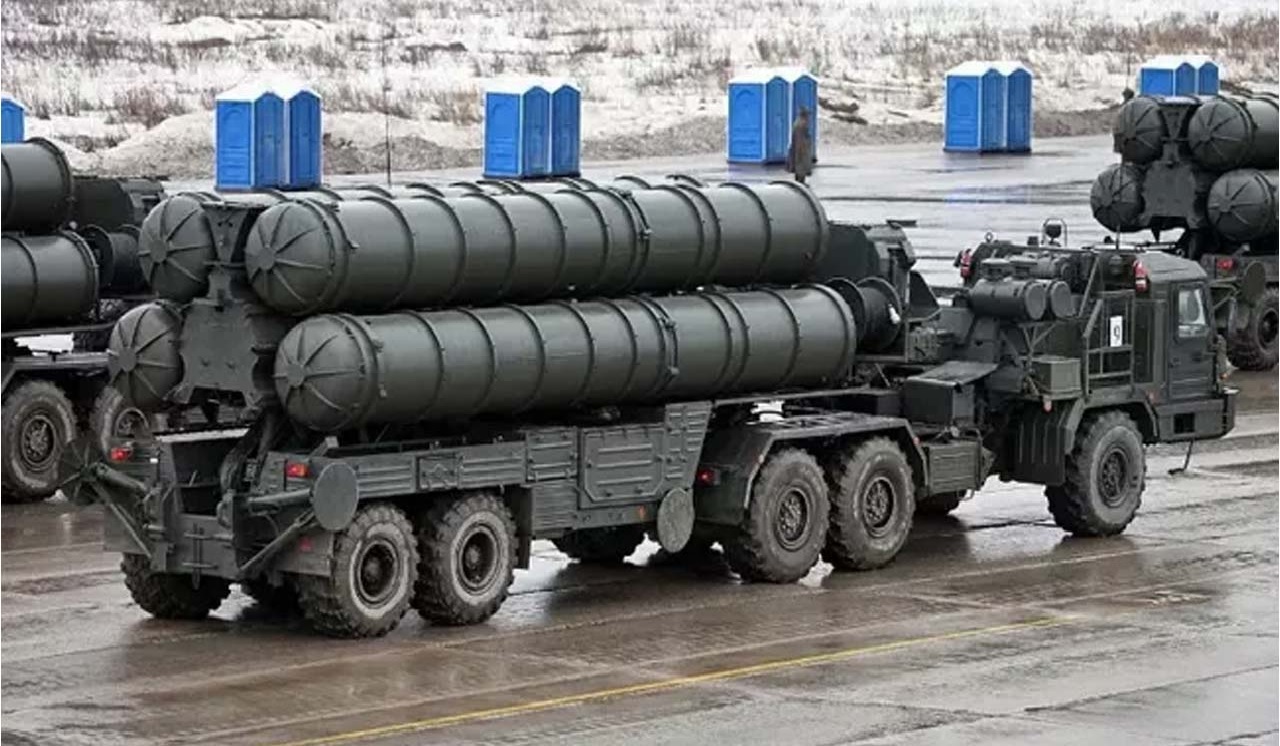
A standard S-400 squadron in Indian configuration typically fields approximately 12 Transporter-Erector-Launchers (TELs), six per battery. Each TEL carries four canisterized interceptor missiles, resulting in 48 ready-to-fire interceptors per squadron before reload.
Separate missile transport-and-reload vehicles accompany the launchers for replenishment. Additional support vehicles provide power supply, communications, mobility support, and maintenance capability. The entire squadron remains road-mobile and can relocate to reduce vulnerability to counter-strikes.
Additional and Specialized Radar Options
Beyond the baseline radar set, the S-400 architecture allows integration of additional sensors depending on operational requirements and terrain.
The 96L6E “Cheese Board” radar, with a detection range of up to 300 km, is commonly deployed as an all-altitude detector. It enhances detection of low-flying targets such as cruise missiles and terrain-masking aircraft and is installed when the squadron operates autonomously or requires enhanced target acquisition in complex terrain.
For anti-stealth and low-observable target detection, the Protivnik-GE UHF radar (400 km range) or the Gamma-DE L-band radar can be integrated. These frequency bands improve detection probability against aircraft with reduced radar cross-sections.
VHF-band radars such as the 1L119 Nebo SVU provide sector search and tracking against certain stealth profiles. Passive electronic intelligence systems including Moscow-1 and Avtobaza-M, both capable of detection ranges around 400 km, can be incorporated to identify emitting targets without revealing the squadron’s own position.
Electronic warfare support systems such as the 1RL220BE jamming radar may also be integrated for countermeasure support. The 15I6ME system extends coverage by 30 km, 60 km, or 90 km depending on configuration.
For improved radar horizon in forested or hilly terrain, radars such as the 92N6E or 96L6E can be mounted on the 40B6M mast assembly to elevate sensors and improve detection of low-altitude cruise missiles.
Missile Types and Engagement Capabilities
The S-400 employs a mixed-load missile strategy, allowing different interceptor types to be launched from the same TEL.
The 48N6 series provides engagement ranges up to 250 km against aerodynamic targets. The 9M96 series offers ranges up to 120 km and is optimized for maneuvering targets and precision-guided munitions. The 40N6E long-range missile extends engagement distances to approximately 380–400 km against aerodynamic targets and up to 60 km against ballistic missiles.
Engagement altitudes reach up to 30 km for aircraft and cruise missiles and 25 km for ballistic missile targets. The system is capable of intercepting targets traveling at speeds up to 4,800 meters per second. A full squadron can engage dozens of targets simultaneously under heavy electronic countermeasures.
Operational Role and Network Integration
The S-400 functions as a mobile, multi-sensor fire unit optimized for layered defense. Its architecture enables sensor fusion, automated target allocation, and coordinated engagements across multiple batteries.
In Indian deployment, the system integrates into higher-level command networks, contributing to a common air picture. It operates alongside indigenous systems including Akash and MRSAM, and is expected to complement the forthcoming indigenous long-range air defense program known as Project Kusha, which received Acceptance of Necessity in September 2023 for five squadrons with interceptor tiers of 150 km, 250 km, and 350–400 km.
Strategic Context
The planned expansion of the S-400 inventory is intended to address two-front security considerations involving Pakistan and China. Reported operational performance during Operation Sindoor against Pakistan has reinforced the Indian Air Force’s assessment of the system’s utility.
Doubling the number of squadrons will increase coverage for airbases, command nodes, logistics hubs, industrial infrastructure, and population centers. It also provides greater operational flexibility, allowing for rotation, maintenance cycles, dispersal, and sustained readiness during prolonged high-intensity scenarios.
The procurement deepens India-Russia defense cooperation while India continues parallel efforts to reduce long-term import dependence through indigenous development. Immediate priorities include completion of pending deliveries under the 2018 contract, accelerated missile replenishment, and seamless integration of Russian-origin systems with India’s expanding domestic air defense architecture.
——— End of Article ———