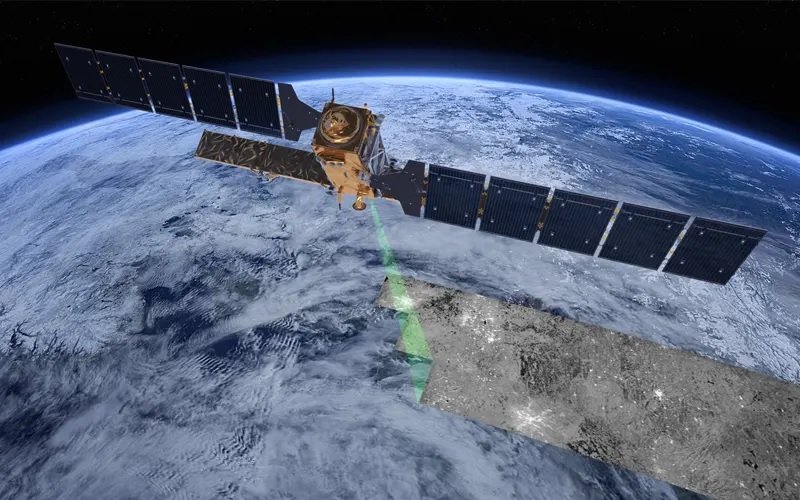
The Indian Space Research Organisation (ISRO) is working on a major technological upgrade for future satellites. Through its U R Rao Satellite Centre (URSC) in Bengaluru, ISRO is developing an advanced Integrated Avionics Package (IAP) — essentially a compact ‘satellite brain’ that will manage most of a satellite’s core functions from a single, integrated unit.
This new system is designed to simplify satellite architecture by combining various critical systems into one, making future satellites lighter, more efficient, and quicker to build and launch.
What Is the Integrated Avionics Package (IAP)?
In traditional satellite design, different functions like communication, telemetry (data transmission to and from the satellite), positioning, data handling, and on-board computing are handled by separate hardware units. The IAP aims to merge all these essential subsystems into a single compact module.
This integrated system would not only reduce the size and weight of satellites but also lower their power consumption — a major advantage in space missions where every kilogram and watt counts.
Key Features and Technical Details
The IAP is being designed to fit into a small space measuring 220mm x 220mm x 60mm, and will weigh under 4 kilograms. Despite its compact size, it will carry out multiple critical functions by integrating:
-
On-Board Computer (OBC) for satellite control
-
Baseband Data Handling (BDH) to manage satellite data streams
-
Solid State Recorder (SSR) for on-board data storage
-
Satellite Positioning System (SPS) for accurate orbit tracking
-
Telemetry and Telecommand (TTC) System for two-way communication with ground stations
-
Payload Data Transmitter RF Chain for transmitting mission data to Earth
The IAP uses multiple printed circuit boards (PCBs) for managing RF signals, data processing, power management, and avionics interfaces.
A notable feature is its RF/data handling card, capable of operating up to 10 RF channels across a frequency range of 600 MHz to 12 GHz, with programmable modulation schemes and data transmission speeds up to 12.5 Gbps — making it versatile for various satellite missions.
Why Is ISRO Developing This?
This development is part of ISRO’s strategic plan to expand India’s satellite fleet over the next five years. As India prepares to build and launch more satellites — both for Earth observation, navigation, and deep-space missions — it needs systems that are modular, scalable, and efficient.
By simplifying the internal architecture of satellites, the IAP will make it easier and faster to assemble and test new spacecraft, increasing ISRO’s capacity for both domestic and international satellite missions.
Industry Collaboration: A Call for Partners
To help test and validate this sophisticated system, ISRO has invited private companies to participate in building a ground test system for the IAP. The agency has issued an Expression of Interest (EOI) seeking firms with expertise in space systems testing.
The selected industry partner will be responsible for designing a testbed capable of simulating the space conditions and operational interfaces the IAP will encounter once in orbit. It must support satellite platforms up to the I-1K class (a widely-used satellite bus by ISRO) and handle different configurations of the IAP during its development.
ISRO will evaluate proposals based on a company’s technical know-how, previous experience, infrastructure, skilled workforce, and financial stability.
A Step Towards Future-Ready Satellites
As of December 2024, India operates 22 satellites in Low Earth Orbit (LEO), 31 in Geosynchronous Orbit (GEO), and runs deep-space missions like Chandrayaan-2 orbiter and Aditya L-1. In 2024 alone, ISRO executed 261 launches with a 97% success rate — a record for the agency.
With such a rapid pace of operations, future-ready, efficient technologies like the Integrated Avionics Package are critical. This initiative reflects ISRO’s vision of making India a leader in next-generation satellite manufacturing and space systems integration, supported by a growing ecosystem of Indian space industry players.
The Integrated Avionics Package marks an important shift in satellite design — from multiple, bulky units to a streamlined, integrated system acting as the ‘brain’ of the spacecraft. Through this effort, ISRO not only advances its technological capabilities but also opens up new opportunities for private industry collaboration, strengthening India’s position in the global space sector.
——— End of Article ———