LONDON — Russia's so-called shadow fleet was highly likely used as a launch and recovery platform for drones that carried out surveillance missions over military bases across Europe, including U.S. Air Force installations in England and Germany, a new report by the International Institute for Strategic Studies (IISS) said.
This report assesses that it is highly likely the Kremlin conducted a coordinated Uninhabited Aerial Vehicle (UAV) campaign over Europe between August 2024 and February 2026, spanning a dozen NATO states and Ireland.
— IISS News (@IISS_org) July 2, 2026
It is also likely that Russian-linked vessels and the shadow… pic.twitter.com/pGRtWRHPtE
The study examined 144 drone incursions recorded across 13 NATO countries and Ireland between August 2024 and February 2026. The incidents targeted military bases, nuclear facilities and other sensitive defense sites. IISS assessed that the operation was likely coordinated by Russia's Main Directorate of the General Staff (GRU), using commercial vessels operating in coastal and international waters to deploy uncrewed aircraft.
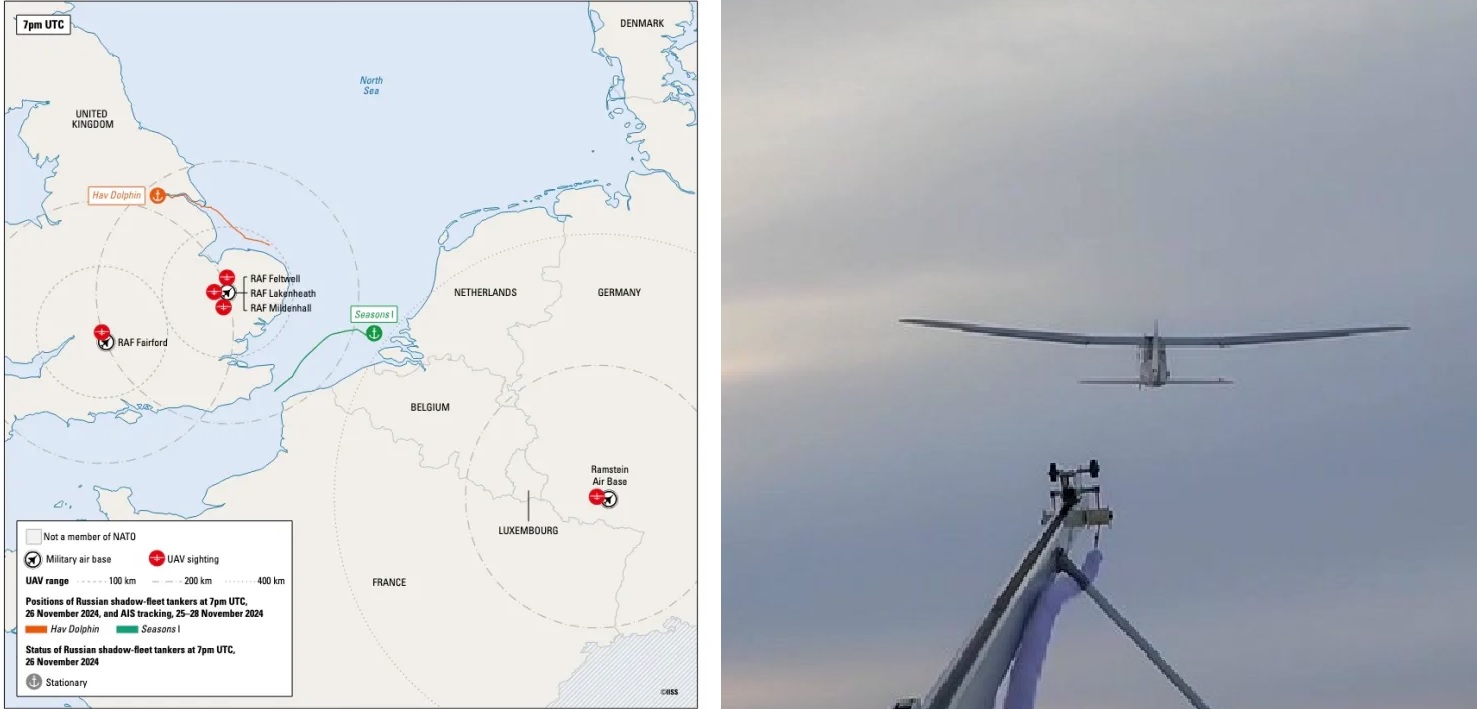
The first wave of incidents documented in the report occurred in late November 2024, when unidentified drones repeatedly flew over RAF Lakenheath, RAF Mildenhall, RAF Feltwell and RAF Fairford in England. Around the same period, drones were also reported over Ramstein Air Base in Germany.
RAF Lakenheath received particular attention. At the time, infrastructure work was underway to prepare the base for the return of U.S. B61 nuclear gravity bombs. Those weapons were deployed there in July 2025, the report said.
Drone activity continued through 2025. In December, at least five drones were detected over France's Île Longue naval base in Brittany, home to the country's sea-based nuclear deterrent. Similar incursions were reported over Kleine-Brogel Air Base in Belgium and Volkel Air Base in the Netherlands, both locations that store U.S. nuclear weapons under NATO arrangements.
Investigators combined open-source shipping records, drone performance data and the timing of the incidents to trace possible launch platforms. The report says Russian-linked commercial ships, including sanctioned oil tankers, coastal freighters and civilian vessels operating with disabled tracking transponders, were likely used to launch and recover the aircraft offshore.
One vessel identified in the report is the cargo ship Hav Dolphin. Shipping data placed the vessel in Hull during the same period drones appeared over nearby RAF bases in November 2024. German and Dutch authorities later examined the ship in May 2025 after drones were reported over German defense facilities while it was anchored in the Kiel Bight.
Another vessel, Seasons 1, was operating in the North Sea near British military installations during several of the reported drone sightings.
Using commercial ships allowed operators to remain outside military security perimeters while providing a mobile platform that could launch and recover aircraft from coastal or international waters.
Witnesses at RAF Lakenheath said the drones approached at low altitude with visible navigation lights before climbing as they departed. Observers also reported engine noise more consistent with petrol-powered aircraft than the electric motors typically used by consumer drones.
The report identifies the Russian-built Orlan-10 as one possible platform. The aircraft uses an internal combustion engine, has an operational range of up to 500 kilometers and an endurance of about 12 hours. It can also carry electronic warfare equipment for signal monitoring and communications interference. Those characteristics fit a maritime launch profile from ships operating well offshore.
IISS also said modified commercial drones or custom-built long-range fixed-wing aircraft using cellular communication systems instead of conventional radio links remain a plausible alternative. Using those platforms would make attribution more difficult than deploying a recognizable Russian military drone.
None of the drones involved in the 144 recorded incidents were intercepted or recovered, the report found. The flights exposed gaps in NATO's ability to detect and counter small, low-flying surveillance drones operating around military facilities.
A February 2025 investigation by the UK-based The i Paper suggested the incursions over British bases may have involved GRU operatives on the ground. The reporting prompted calls from former UK Security Minister Tom Tugendhat for a parliamentary inquiry. A subsequent investigation by the UK Ministry of Defence did not identify any suspects.
The UK Ministry of Defence declined to comment on intelligence matters following publication of the IISS report. The ministry said it takes the security of military bases seriously, has invested in counter-drone capabilities and that the Armed Forces Bill will provide defence personnel with greater powers to defeat drones threatening military sites.
U.S. Air Forces in Europe confirmed the drone activity over its installations in England during 2024. A spokesperson said the events were monitored and there was no impact on personnel or operations. The command declined to discuss intelligence assessments related to those responsible, citing operational security.
European governments have not publicly accused Russia of launching drones from commercial vessels, although the IISS report says officials privately acknowledged the suspected connection between the drone flights and Russian-linked ships.
Source: IISS and The War Zone
——— End of Article ———